Thelonious Ellison
ErasureThelonious Ellison, whom his narration calls Monk, is an experimental novelist, son, brother, fisherman, art lover, and woodworker who resists being reduced to any single role. His defining conflict is between an inwardly complex sense of self and the identities assigned to him by family, literary institutions, and racial convention. When he publishes a deliberately provocative novel as Stagg R. Leigh, that tension becomes a public performance: the mask gives his work an audience while making it harder to keep author, character, and person distinct.
Identity and Background
Monk introduces himself as a fiction writer but is uneasy about stories whose main characters are writers. He anticipates that his private journal may be read after his death, and his opening self-description already turns identity into a problem of narration: rather than accept the writer as his sole defining role, he names other parts of his life. Woodworking matters in part because it embarrasses his mother, who for years calls his pickup truck a station wagon. The detail makes his account both self-conscious and wry; even a family description can become a small argument over who gets to define him.
His background resists familiar assumptions about Black life. Monk has dark brown skin, curly hair, and a broad nose, and he has been detained by white police officers in New Hampshire, Arizona, and Georgia. He understands that society categorizes him as Black, but he did not grow up in an inner city or the rural South: his family owned a bungalow near Annapolis, and his grandfather, father, brother, and sister were doctors. He graduates summa cum laude from Harvard, though he hates the experience, and describes himself as good at mathematics but unable to dance or play basketball well. While in college he joins the Black Panther Party partly because he feels pressure to prove that he is Black enough. That pressure comes from more than one direction: some Black people and some white people question his racial authenticity, including in response to his novels and even after a missed basketball shot.
Family Loss and Care
Family responsibility abruptly reorganizes Monk’s life. After Lisa is shot and killed, his own account of family is already marked by grief; later, Bill tells him about the collapse of his marriage, finances, and professional life. Bill says that he lied to Sandy for fifteen years, that the judge believed her, and that he has confused his children and owes more money than he earns. Monk feels compassion for his brother and is impressed by his response to the harm and confusion in his family, but he also recognizes that Bill is not in a position to care for Agnes Ellison.
The prospect of caring for Agnes Ellison and Lorraine turns from an abstract concern into a decision about where Monk will live. He imagines leaving his apartment in Santa Monica, taking leave from teaching, putting his belongings in storage, and flying east; he then moves in with Agnes Ellison and Lorraine. His account conveys the change through practical preparations and the image of a life being packed up, rather than through a grand declaration. He views the move as an obligation that narrows his freedom, yet also as a chance to try to live up to Lisa’s example. The family’s need, and Bill’s inability to meet it, make Monk’s return to Washington, D.C., a consequence of several losses rather than a fresh start freely chosen.
Agnes Ellison’s cognitive decline deepens this burden. Monk visits her daily even though she can no longer remember who he is; later, her body becomes more fit while her mind fails completely. The contrast makes the limits of care plain: presence and routine remain possible, but recognition does not. Monk’s brief description in the judges’ biographical material—lonely, estranged from Bill, unable to speak with his dead sister, and visiting his mother—compresses his family life into a portrait of connection repeatedly obstructed by illness, death, or conflict.
The Writer and the Mask
As a novelist, Monk is widely unread. His five books of experimental stories and novels are considered dense and inaccessible, and he is best known for The Second Failure. His alienation from the publishing world sharpens when his agent questions whether a new manuscript can be sold. Monk argues that the books he sees published have exhausted him and that his manuscript expresses that frustration. His agent recognizes the parody but warns that the publishers who produce the work being mocked may be offended, as will readers more generally. Monk’s response is not to soften the book but to proceed through a new authorial identity.
He instructs Yul to present Stagg R. Leigh as a man living alone in the nation’s capital, recently released from prison, uneasy about life outside, and willing to discuss only the book. These details are not a disclosure of Monk’s own biography; they are elements of the persona he constructs to make the manuscript legible to the publishing industry. Monk understands the arrangement as a mask and a game, and admits that the promise of a check is part of its appeal. The disguise lets the book enter a market that has marginalized his own experimental work, but the success of that strategy depends on performing the very kind of identity he regards as expected of him.
That contradiction is explicit in his reflection on racism and literary classification. Monk recognizes the irony that refusing to write as racial testimony may place him on the other side of an imagined line, while adopting the Stagg R. Leigh persona may earn him economic opportunity by fitting expectations he resents. The pseudonym is therefore more than concealment: it exposes how the industry reads authors through racialized conventions, even as Monk exploits those conventions for access and income.
Public Recognition and Divided Identity
The Leigh persona grows beyond the manuscript. When the book is selected for consideration for The Book Award, Monk faces a dilemma: acknowledging that he is Stagg R. Leigh would expose his secret, but he cannot disqualify himself without doing so. He decides to ignore the book’s eligibility, assuming that no one would seriously award it. The decision leaves him inside a process in which he has a conflict of interest that he cannot openly explain.
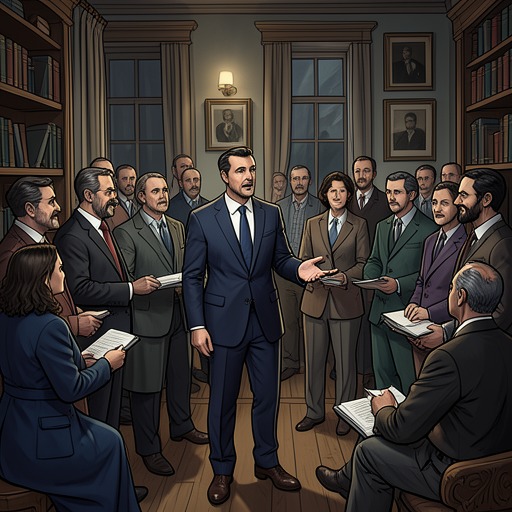
At the committee meeting, Monk sits among the judges and listens as the books are discussed. When Ailene Hoover raises Fuck, he is forced to hear the work considered as if its author were someone else. He travels to New York as Thelonious Ellison, Monk, and Stagg Leigh at once, telling himself that the divided identity is acting and that its substantial payment is deserved. At the ceremony, Yul recognizes him through the disguise and identifies him as Monk. The moment makes visible the strain beneath the performance: the assumed author can be recognized, but cannot be cleanly separated from the person sustaining him.
The public version of Stagg R. Leigh also appears on Kenya Dunston’s television program, where the audience welcomes the author behind a screen. Monk reflects on whether suppressing his own presence has made Leigh seem independently real, or whether the book itself has given that persona life. He even wonders whether he would have to silence Leigh if he could no longer keep himself hidden. These questions do not establish that the two identities have literally separated; they show Monk noticing how a role can acquire force through publication, publicity, and the expectations of an audience. His story leaves that division unresolved, making the success of the mask both an escape from literary exclusion and a fresh form of confinement.