Davis Gimbel
ErasureDavis Gimbel is an editor of the journal Frigid Noir whose encounters with Thelonious Ellison expose a sharp divide between intellectual performance and physical aggression. At a literary gathering, he responds to Ellison’s paper by throwing his keys and shouting at him; later, at a hotel, an argument about avant-garde art ends with Gimbel taking a swing at Ellison and tumbling into an azalea bush.
Identity and Introduction
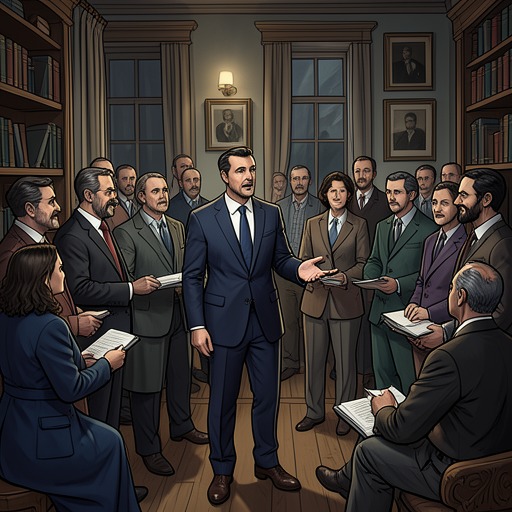
Gimbel is identified as the editor of Frigid Noir and appears among the audience for Ellison’s paper. His first entrance is conspicuously hostile: as Ellison returns toward his seat, a ball of keys flies past his head and strikes the flocked wallpaper. Ellison looks into the audience and identifies Gimbel as the thrower.
Gimbel follows the outburst by shaking his fist and shouting, “You bastard!” Ellison judges that Gimbel has not understood what he read and that his response is disproportionate, though he also suspects Gimbel wants to appear as if he has grasped the paper immediately. That assessment belongs to Ellison’s perspective; the scene establishes the public insult and the thrown keys, but not Gimbel’s account of what provoked him.
The Hotel Confrontation
At the hotel, Gimbel reappears after Linda Mallory storms out into the street. He calls Ellison’s name and recites, “A screaming comes across the sky. It has happened before, but there is nothing to compare it to now.” Ellison takes the literary allusion less as an argument than as evidence of Gimbel’s agitated postmodern pose. Linda and three other academics are also present, and a couple of bystanders stop at the gate to watch.
Gimbel circles Ellison while insisting that the whole culture has made him one of the sheep. He argues that an avant-garde movement must remain unfinished: if it achieved its purpose, it would cease to be avant-garde, since opposition to established systems of creation is what defines it. He concludes that they are “defunct practitioners of defunct art.” The language gives the confrontation the shape of a theoretical dispute, but it does not keep the encounter on intellectual ground.
Conflict and Narrative Role
Ellison rejects Gimbel’s performance and attempts to end the exchange. Gimbel then swings at him. Ellison sidesteps, and Gimbel rolls into an azalea bush; Linda and the other academics rush to help him, while Ellison shrugs to the confused onlookers and heads for the door.
Across the two encounters, Gimbel’s response to Ellison’s writing shifts from a thrown object and shouted abuse to a sustained display of critical jargon and another physical attack. The recurrence makes his hostility concrete, while the mismatch between the elaborate talk of avant-garde failure and the failed swing gives the hotel scene its irony. Gimbel’s portrayal remains limited to Ellison’s encounters with him: he is presented through public gestures, argumentative claims, and the narrator’s skeptical interpretation, rather than through an independent account of his motives.