Juanita Mae Jenkins
ErasureJuanita Mae Jenkins is the bestselling author of We’s Lives In Da Ghetto, a novel praised as a truthful account of Black life and promoted by a national talk-show host. Her brief but consequential appearances expose a tension at the heart of Thelonious Ellison’s story: Jenkins says she wrote because she saw too few books about her community, while Ellison recoils at the narrow ideas of Black experience through which her success is celebrated. The book does not offer an independent, extensive portrait of Jenkins; readers encounter her principally through her public reception and Ellison’s sharply critical response.
Public Profile and Literary Success
Jenkins is identified as the author of the runaway bestseller We’s Lives In Da Ghetto. Her visibility reaches Ellison in several forms: a bookstore poster announces an upcoming reading, her novel sits on display, and a magazine review describes it as a major work of African American literature. The review presents the book as uniquely capable of conveying the experience of Black America, turning literary praise into a claim about whose work can represent an entire community.
The review’s account of the novel centers on Sharonda F’rinda Johnson, a fifteen-year-old pregnant with her third child, who lives with a drug-addicted mother and a brother described as mentally deficient. After her brother is killed in a drive-by shooting, with the bullet passing through his cherished Michael Jordan autographed basketball, Sharonda watches her mother grieve and decides she must have a voice in the culture. These details reach the reader through a review rather than an extended account of Jenkins’s own artistic intentions, an important distinction in a story concerned with how literary work is packaged and interpreted.
Stated Purpose and Television Appearance
On Kenya Dunston’s talk show, Jenkins explains that she once worked at a publishing house, watched manuscripts arrive and books come out, and wondered where the books about her people were. She says that this absence prompted her to write We’s Lives In Da Ghetto. The studio audience applauds, and Dunston tells her that the book struck a chord. The exchange establishes Jenkins’s stated aim as a response to perceived gaps in publishing, while the enthusiastic reception shows how readily the book is framed as answering a broad communal need.
The interview offers one of the clearest glimpses of Jenkins speaking for herself, but it is still a public, compressed exchange: Dunston welcomes her, they hug, and the conversation quickly affirms the book’s success. The narrative provides no comparable private history or sustained account of Jenkins’s life beyond the career explanation she gives on air. Her characterization therefore rests on the contrast between that stated purpose and the larger claims made for her novel by reviewers, retailers, and television.
Ellison’s Encounter with the Book
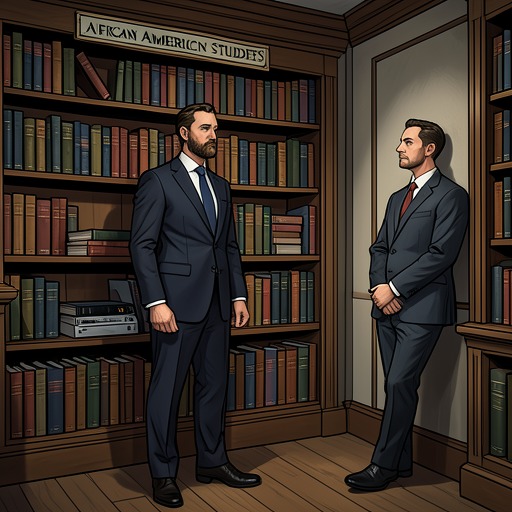
At a Borders bookstore, Ellison searches for his own books and finds them not in Literature or Contemporary Fiction but alphabetically arranged in African American Studies. He is angered by the placement: readers looking for African American Studies, he thinks, may not want his novels, while readers seeking an obscure retelling of Greek tragedy are unlikely to find them there. The classification turns a question of shelving into a practical threat to sales, as well as a sign that the store has assigned his work a racial category he believes misrepresents it.
The same visit brings Jenkins’s book directly into view. Ellison notices the poster for her upcoming reading, picks up a copy, and reads its opening passage, written in conspicuously nonstandard dialect about a child caring for her younger brother while their mother works cleaning white people’s houses. He closes the book, feeling physically sickened, just as his sister returns. His response is presented as his own judgment, not as proof of Jenkins’s intentions: the scene places his distaste beside the bookstore’s racial sorting and forces the reader to consider how his objections are shaped by the demands he has encountered as a Black novelist.
Representation and the Limits of the Portrait
Ellison’s experience includes a reviewer’s complaint that his reworking of Aeschylus’ The Persians has little apparent connection to African American experience. Elsewhere, he recalls an agent urging him to abandon classical retellings and French poststructuralist parodies in favor of gritty stories of Black life. Against that pressure, Jenkins’s commercial success appears to confirm the marketability of a recognizable, readily classified account. Yet her television explanation complicates any simple account of her as merely a product of that market: she describes writing from a perceived absence of stories about her community.
Ellison later reflects that he did not write to offer testimony, represent a people, or paint a definitive picture of their lives, and recognizes the irony that refusing racial self-expression has itself left him positioned within a racialized system. Jenkins’s role in this contrast is not resolved into a verdict on her motives or her work. Rather, the novel sets her stated desire for representation against the sweeping critical claim that her book alone conveys Black America, while Ellison’s marginalization reveals the constricting effects of treating either writer as a racial spokesperson. Jenkins consequently functions as a significant figure in the novel’s examination of how a writer’s work is read, marketed, and made to stand for a community, even though the evidence gives little access to her beyond those public terms.