Lisa Ellison
ErasureLisa Ellison is a physician, sister, and daughter whose life is remembered through a sharp contrast: she works directly with people in need while her younger brother, Thelonious Ellison, tends toward abstract thought and solitary pursuits. She is not given an extended independent narrative; instead, her character emerges through her medical work, the differences among the siblings, and memories that acquire new weight after her death. Her shooting is reported abruptly, while the family’s grief makes clear how much her practical presence had held together.
Identity and Background
Lisa Ellison is the older sister of Thelonious Ellison and Bill Ellison, and the daughter of Agnes Ellison. She studied at Vassar and was approaching graduation when she had already committed herself to medical school. That choice places her on a path toward professional care and responsibility, sharply unlike Thelonious Ellison’s early literary life. At the family table during his freshman-year Christmas break, he tells their father about reading James Joyce in college; Bill Ellison responds with a groan, while Lisa, then nearing graduation, has adopted what her brother recalls as a death-girl attitude. The brief recollection sketches her as a young woman with an independent manner, but also locates her within the family’s familiar division between her practical career and her brother’s academic interests.
The family name carries a different weight for each sibling. Thelonious Ellison remembers that, as a child, people recognized him as belonging to the Ellison family and connected his appearance to his father and uncle. As he grew older, his feelings about that inheritance changed. Lisa’s own identity is presented less through such reflection than through what she does: she becomes a doctor and serves patients in a part of the city where poverty is close at hand. Her professional life gives the family name a public, practical expression.
Medical Work and Public Commitment
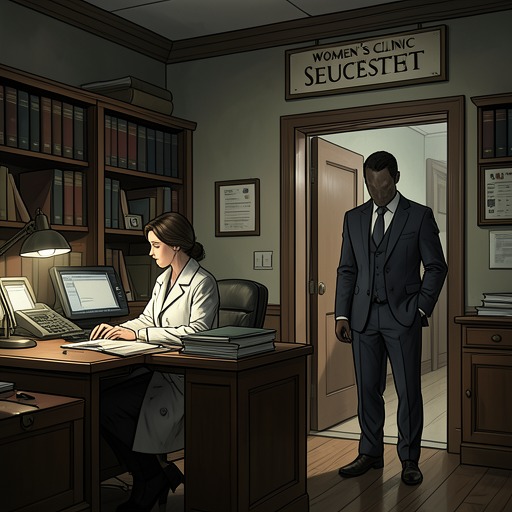
Lisa Ellison lives above Adams-Morgan but practices in Southeast Washington, D.C., at Women’s Clinic Southeast. The neighborhood’s poverty is described in concrete contrast with the nearby tourist and political landmarks: some residents cover windows with towels against rain and board up doors at night. Lisa works in this setting because, as Thelonious Ellison understands it, this is where people live. He contrasts her daily risks and service to poor women, including women seeking abortions, with his own fishing, woodworking, novel-writing, and teaching.
Her work exposes her to picket lines and danger. Thelonious Ellison recalls that she crossed those lines to provide care, and the clinic visit makes the risk immediate even on a day when no picketers are present. The waiting room turns toward him as he enters, requiring him to identify himself as Dr. Ellison’s brother before he can settle in. The staff’s initial suspicion and the patients’ attention establish the clinic as a place where Lisa is known and where a visitor’s presence must be accounted for. The scene also makes her professional life visible to her brother in a way it had not been before.
When Lisa comes out to meet him, wearing a white jacket with a stethoscope around her neck, Thelonious Ellison sees her composed, comfortable, and in command. His response is pride and awe. Their embrace begins unevenly: her half is stiff, while his is not, but the warmth of his gesture softens the encounter and surprises her enough that she blushes. The moment is small, yet it changes his view of her work from a distant fact into something he can witness. She tells him she still has two patients to see before they can leave, a detail that keeps the clinic’s demands present even in their reunion.
Siblings and Family Ties
Lisa Ellison’s relationship with Thelonious Ellison is marked by affection that coexists with distance. He believes she probably does not hate him, but says it became clear early in their lives that she had little use for him. She sees him, in his account, as flighty and detached from the real world. Her judgment is sharpened by the difference between their daily lives: while she is working in medicine, he writes dense novels, fishes, cuts wood, or teaches literary theory. He also remembers her belief that he had passed through college without studying, a view he calls false but recognizes she held firmly. Their difference is not simply a disagreement about personality; it reflects the different kinds of work each sibling treats as consequential.
Her judgment of Bill Ellison is more severe. She is described as cool toward Thelonious Ellison but frozen toward Bill, who is a wealthy plastic surgeon with a wife and children. The account distinguishes her objection from rejection of his sexuality: she resents that he practices medicine for the accumulation of wealth. That distinction makes her criticism a moral judgment about the purpose of professional life, and links it to her own work among poor patients. The siblings’ strained relations therefore arise not only from temperament but also from competing ideas about what their education and professions are for.
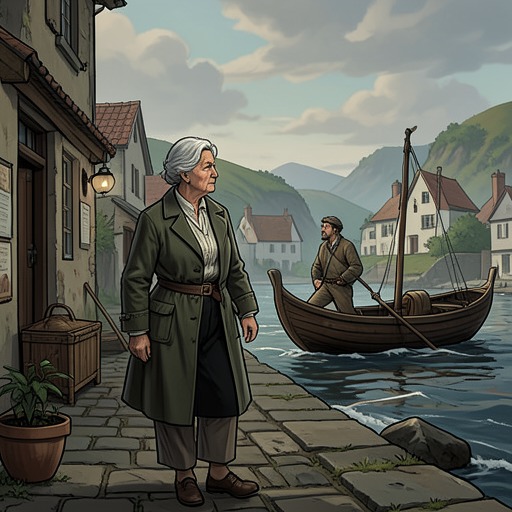
Lisa’s bond with Agnes Ellison is recalled through childhood and bereavement. Agnes Ellison remembers the children swimming near the family boat when they were young, and says that she enjoyed watching Lisa, Bill, and Thelonious Ellison have fun together. Later, at the community dock, she acknowledges that Lisa is gone. Thelonious Ellison takes her arm and tells her that Lisa was special and loved her; Agnes Ellison answers that she loved Lisa too. The exchange gives their closeness a reciprocal form, even as Agnes Ellison’s failing memory and Lisa’s absence make that bond painful to revisit.
Death and Narrative Significance
Lisa Ellison’s death enters the narrative in a few blunt words: someone tells Thelonious Ellison that she was shot, then confirms that Dr. Lisa is dead. The compressed report offers no extended account of the shooting itself. Its abruptness is part of the effect: the person who had appeared so assured in the clinic, and whose work required her to cross picket lines, is suddenly reduced to news of an irreversible loss. The narrative does not supply further circumstances in this scene, so the emphasis falls on the fact of her death and the shock of receiving it.
The loss becomes one part of Thelonious Ellison’s recognition that his family is coming apart. He thinks of his father as dead for several years, Lisa as recently murdered, Agnes Ellison as slipping into senility, and Bill Ellison as struggling to find himself while losing other parts of his life. He resists imagining himself as the captain of a sinking ship, because that would suggest an authority he does not possess; instead, he reaches for images of a mechanic on the wrong kind of vessel and a physician in a monastery. Lisa’s absence is thus not an isolated sorrow. It changes the family’s remaining structure and leaves Thelonious Ellison facing responsibilities he cannot master by intellect alone.
The remembered scenes also prevent Lisa from becoming only a symbol of loss. She is the young woman nearing medical school, the doctor who calmly directs a clinic, the sister whose affection is awkwardly but genuinely met by her brother, and the daughter her mother remembers watching by the water. Her life is presented through work and relationships rather than through a private account of her thoughts. That limitation gives the retrospective portrait its shape: Thelonious Ellison comes to understand her more fully at the very moment the family can no longer call on her presence.