Hedrich's Wannsee Conference Invitation
FatherlandHeydrich’s invitation is both a summons to an interagency meeting and a piece of evidence that reveals the policy concealed behind the Nazi state’s official language. Dated November 19, 1941, it links a July authorization to preparations for a “complete solution of the Jewish question in Europe,” notes that deportations to the East were already underway, and calls officials to a discussion at Wannsee. In 1964, when the minutes had been removed from the archive, the invitation’s survival gave March a documentary path into the crime and its cover-up.
Document and Purpose
The invitation identifies its author as Reinhard Heydrich and frames the gathering as a discussion, followed by luncheon, intended to establish a uniform view among central agencies about the work still required for the “final solution.” Heydrich says he is acting under a commission from the Reichsmarschall, who had charged him to prepare the necessary organizational, technical, and material measures. The letter thus presents mass persecution as coordinated administrative business, assigning it institutional scope while obscuring its human consequences behind euphemism.
The invitation also places the meeting in an unfolding chronology rather than at the beginning of the policy. It says that, from October 10 onward, Jews had been evacuated from German territory, including the Protectorate, to the East in continuous transports. It summons the recipients to December 9, 1941, at noon, in the office of the International Criminal Police Commission at Am grossen Wannsee, No. 56-58. The letter’s combination of an asserted mandate, ongoing deportations, and a proposed interagency discussion makes its language evidence of both preparation and implementation.
Discovery and Archival Context
March encounters the invitation while examining correspondence in an archive. An earlier notice, dated January 6, 1942, confirms that the interagency discussion and luncheon originally scheduled for December 9 had been postponed to January 20 at the same Wannsee address. The change of date becomes significant when March and Halder consult the minutes-and-memoranda series: instead of the record of the meeting, they find a sheet stating that the minutes have been removed at the request of the Reichsführer-SS in the interest of state security. The notice is dated April 6, 1964; the minutes had been extracted by Heydrich eleven days earlier.
The contrast between the surviving invitation and the absent minutes turns archival arrangement into part of the evidence. The file preserves Heydrich’s summons and the later postponement notice, but the central record of what was discussed has been taken away under an assertion of state security. March learns that the Gestapo can remove records on those grounds and usually transfers them to the vaults on Prinz-Albrecht-Strasse. What is missing therefore points not to an accidental gap but to an exercise of institutional power over the documentary record.
Copies, Risk, and Interpretation
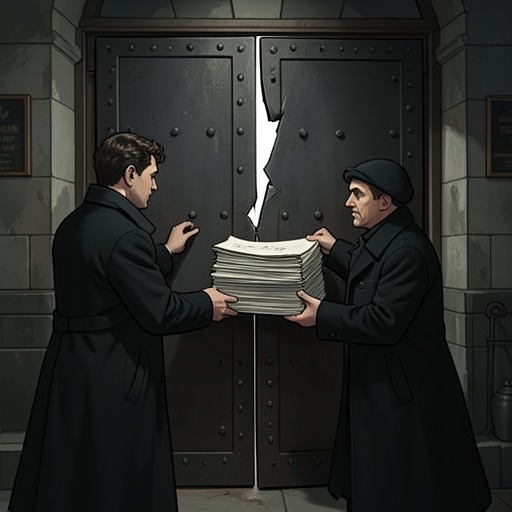
The invitation reaches March as one of three poor-quality photocopies made from papers in the Reichsarchiv. The reproductions are faint, hastily positioned, and skewed. Halder, frightened by the invitation and its implications, initially does not want to make copies; after doing so, he returns the papers to their boxes and shelves, and the two men leave by a rear entrance. His fear gives the fragile copies a human context: preserving evidence requires actions that expose the person handling it to danger.
Read alongside the July 31 directive reproduced with it, the invitation records a chain of authorization and coordination. The directive charges Heydrich with preparing measures for a complete solution within the German sphere of influence in Europe; the invitation cites that commission and calls the relevant agencies together. In the narrative, the document is not a complete account of the meeting or a substitute for the missing minutes. Its force lies in what it securely establishes: the authority invoked, the administrative coordination sought, the deportations already in progress, and the regime’s later removal of the meeting record.