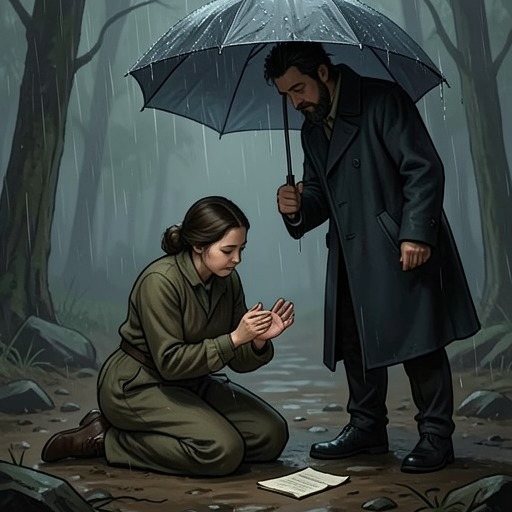
Ava and Cade
FirebugAva and Cade’s bond is at once a lived parent-child relationship and, as the story reveals, a biological one. He takes her in when she is a grieving child on the run; she grows up understanding his home as her own and his steady care as the shape of family. When danger tears them apart, her need to find him makes visible what years of ordinary life have already established: Cade is not merely her guardian, but her home and the person she cannot bear to lose.
A Bond Built in Hiding
Ava and her mother spent much of Ava’s childhood on the run. Her mother sometimes returned secretly to Currant despite the danger to Cade, as though staying away exhausted her and home was the only place she could recover. Even at five, Ava understood home as wherever Cade was. That sense of belonging arose amid concealment and risk, not from an uncomplicated or uninterrupted family life.
One holiday visit became a week of being snowed in. Ava’s mother seemed happy, and Cade spoiled Ava with candy, books, homemade cider, and new pajamas. He showed her how to string popcorn and cranberries for a Christmas tree. With no ornaments, they decorated it with those chains and paper snowflakes; for Ava, it was the most beautiful tree she had ever seen. Duncan visited, and Ava asked whether he was related to Santa because of his appearance. His present held four carved animals—a pony, dog, cat, and tiny bird—which he animated with a tap. The figures paraded to Ava’s clapping before freezing in mid-prance. The memory gathers Cade’s practical tenderness and Duncan’s magic into the same picture of a rare, cherished week at home.
The relationship also has its own history of names. Before Ava lived with him, Cade called her Mouse, apparently because of her squeaky little-girl voice. When she arrived at his doorstep about five years before the present, soaked by rain and shaking with cold and grief over her mother’s death, he called her a half-drowned rat, then ushered her inside and wrapped her in a blanket. Rat replaced Mouse: a nickname formed at the moment he made room for her in his home, and one that remained affectionate because it came from him.
Care in Ordinary Routines
Ava’s attachment to Cade shows in the daily habits she treats as signs of a normal life. After a night spent hunting an ice elemental, she finds him scrubbing dishes while Duncan drinks coffee at the kitchen table. She objects to Cade doing her chores and takes up the dishcloth and silverware herself. She explains that chores matter as a daily ritual: she wants to return to ordinary teenage life, not simply repay Cade’s kindness. Duncan understands that distinction, while Ava suspects Cade may misread her motives as gratitude alone.
Cade’s care is neither grand nor indulgent in every moment. When Ava misbehaves, he does not yell; he takes time to think before addressing it. Their repeated pattern leaves her feeling bad about what she has done and ready to listen by the time he speaks. His considered criticism can be difficult to argue with, but its measured quality is part of the security she associates with him. Their closeness allows for friction: Ava sometimes yells at him, and his discipline can feel more painful for being patient than an outburst would be. Yet when she is frightened and far from home, even the possibility of hearing his voice matters more than avoiding a reprimand.
Separation and the Fear of Losing Him
During a dangerous flight, Ava tries calling home and then Cade at work, hoping to hear that he is all right. She reaches Sylvie instead. When Cade eventually answers, Ava is so relieved to hear his voice that she nearly cries. He has missed her message because his cabin has unreliable phone reception, and she tells him what happened, smoothing over the most embarrassing details. He lets her finish without interrupting. The call restores contact, but it cannot remove the danger surrounding them.
Cade tells Ava that Duncan has suggested closing the shop for a few days and that he plans to pack from home and head to Duncan’s. Ava recognizes the invitation beneath his indirect wording: he wants them to come too, but neither of them can safely discuss the plan plainly while Venus may be monitoring them. Their guarded communication is itself a form of care, shaped by the need to keep one another out of danger.
Later, when Ava and her companions reach Duncan’s place, she realizes Cade is missing and asks where he is. Lock points out that Cade would have left a note if his plans had changed; he probably never made it back to pack. Ava understands that Cade has been kidnapped. She fears Venus will keep him alive for now because she needs him, but may still hurt him, and that Venus may not know when to stop. Ava’s attempt to hold onto the thought that he is only temporarily misplaced does not lessen the urgency: finding him becomes inseparable from protecting the family she has built around herself.
The Father and the Guardian
The story brings Cade’s parentage into focus through the distinction Ava has long made between biological identity and lived relationship. When Angela recognizes that Ava risked herself to save her father, Ava corrects her by calling Cade her guardian. The correction reflects the name and role through which Ava has known him, not an absence of attachment. Angela then asks who told Cade and who told Ava her birthday. Ava answers that her mother told her; she has no birth certificate. The missing document leaves her with her mother’s word, while the exchange clarifies that Cade is also her father.
That revelation adds a biological fact to a relationship already established by years of protection, shared home, discipline, and memory. It does not replace the guardian-daughter bond with a new one. Ava’s instinctive title for Cade remains meaningful precisely because it describes what he has done: he raised and protected her. The story makes parenthood legible through both descent and practice, showing how the facts of ancestry can arrive after the obligations and affections of family have long been lived.
Duncan’s account of his own attachment to Cade sharpens that emphasis. He says he has no children of his own and that Cade is the closest thing he has, though not his flesh and blood. Duncan’s decisions against allowing Venus to lead are driven by his fear that she would eventually kill Cade, whether to provoke or punish Ava. Ava recognizes the same logic in her own efforts to protect family. Cade stands at the center of these overlapping bonds: Ava’s guardian and father, and Duncan’s chosen family. The relationship’s significance lies not only in what is revealed about their blood ties, but in the care and protective choices that had already made them family.