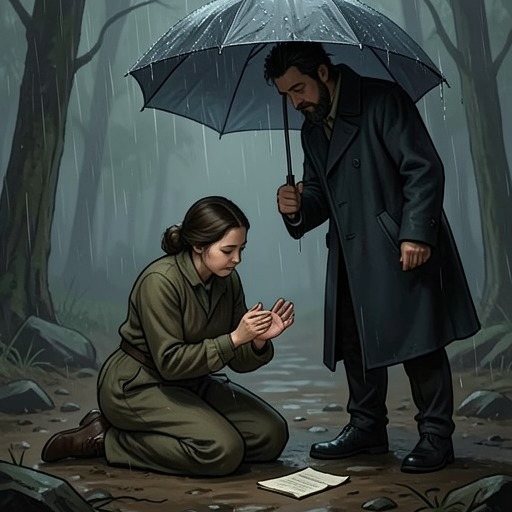
Ava and Cade adapt to a father-daughter relationship
FirebugAva and Cade adapt to a father-daughter relationship only after a lifetime of living one without naming it. For years, Cade is Ava’s guardian, the person she recognizes as home and the center of the ordinary life she longs to recover. When she learns he is her biological father, the discovery unsettles their familiar closeness rather than replacing it. Their new understanding has to make room for the old one: the daily care, private jokes, and shared history that had already made them family.
A home built through care
Ava’s attachment to Cade begins before she can fully explain it. While she and her mother, Lilia, are on the run, Lilia sometimes sneaks back to Currant despite the danger to Cade. Even as a five-year-old, Ava understands why: home is where Cade is. During one winter visit, snow keeps them there for a week. Lilia seems happy, while Ava is spoiled with candy, books, and homemade cider. Cade gives her new pajamas and shows her how to string popcorn and cranberries for a Christmas tree. With no ornaments, they decorate it with popcorn chains and paper snowflakes; the makeshift tree becomes, in Ava’s memory, the most beautiful she has seen.
Duncan’s visit makes that childhood Christmas still more vivid. Ava asks whether he is related to Santa, and he plays along before giving her a present containing four carved animals: a five-inch pony, a dog, a cat, and a bird small enough to fit in his thumb’s span. He taps the figures, and they spring to life, parading to Ava’s clapping before freezing mid-prance. The magic belongs to Duncan, but the memory is rooted in the family life Cade has helped make possible: a warm home, a tree built by hand, and a child secure enough to ask for the spectacle again and again.
That sense of family persists in less picturesque routines. After a night spent hunting an ice elemental, Ava finds Cade washing dishes while Duncan drinks coffee at the kitchen table. She objects to Cade doing her chores and takes up the dishcloth herself. Her insistence is not simply repayment for his kindness: chores are a daily ritual, and doing them helps her return to the normal teenage life she wants. Cade may misunderstand the gesture as gratitude, but Duncan recognizes what it means to her. In another small measure of their intimacy, Cade calls her Rat. The name carries the memory of her arrival at his doorstep five years earlier, soaked by rain and shaking with cold and grief after her mother’s death; once he had wrapped her in a blanket, the nickname remained.
Family at stake
As danger closes in, Ava’s care for Cade becomes a motive for action. When Angela warns that she takes protecting her family seriously, Ava answers that she does too, and argues that Venus would eventually have killed Lock. She does not tell Angela that Lock became a tithe to spare her and the other dryads. Ava is trying to protect Lock, but her answer also expresses the family logic that governs her bond with Cade: a loved one’s safety can justify entering danger, even when the choice carries a cost.
Angela recognizes that logic when she says Ava’s effort to save her father must have mattered as much as protecting Angela’s son. Ava immediately corrects her: Cade is her guardian, family, but not a relative. That distinction is sincere. Ava has long wanted Cade as a father, yet she believes the timeline rules it out: her mother, she says, was nowhere near him for at least a year before Ava was born. She has no birth certificate, only the account of her mother and Cade, and Angela presses her to consider how little independent proof supports that account.
The revelation and its cost
The possibility that Lilia concealed the truth changes Ava’s reading of their history. She realizes that her mother may have lied to protect both Cade and Ava: if they were captured, a child who did not know Cade was her father could not be tortured into revealing it. This explanation makes the secret an act of protection, not a denial of affection, but it still feels to Ava like a stab in the chest. She also believes Cade probably did not know. If he had known, she thinks, he would never have stood aside while Lilia ran alone; he would have faced the Coterie for them without hesitation.
The disclosure reaches Cade too. After Ava has a week to recuperate, Alistair summons her to the Inferno, and Cade drives her there. Angela has told him that he is Ava’s father, but the two have spent the week circling the subject without discussing it. Ava has wanted to meet her father for years; now that he is beside her, the familiarity between them makes the change harder, not easier. They already have a comfortable relationship, and neither knows how to move it into new language. With the bookstore no longer available as a familiar place to retreat to, their awkwardness has nowhere to hide.
From guardian to father
Ava tells Cade that she once hoped he and Lilia would have a happy ending together, but that hope died with most of her childhood dreams. The new relationship is not bad, she explains; it is surreal, because she has thought of him one way for so long. Cade, in turn, says he cannot believe Lilia lied to him: she had hidden things, but had never directly lied to him before. He does not even know Ava’s birthday, and she might already be eighteen. The secret has therefore deprived them not only of a name for their relationship but of basic knowledge about her beginnings.
Their first clear step into the changed relationship comes quietly. Cade admits that he used to hope for a life with Lilia too, and that he had hoped all the time. Ava answers by calling him Dad. He smiles so openly that she recognizes in it the smile Lilia had fallen in love with. Later, she understands that the word caused it. Alone in her loft, Ava summons a small blue flame and traces the equation Cade + Lilia = Ava in the air until it is fixed in her mind. The formula joins biological parentage to the life that preceded its discovery: Cade is not made her family by the revelation; the revelation gives their existing family a new truth to live with.
Kinship beyond the secret
Duncan’s account of his own choices helps Ava understand the protective inheritance surrounding her. He says he never wanted to lead the Coterie, only to prevent Venus from leading it, because he feared Venus would eventually kill Cade to spur or punish Ava. Duncan has no children of his own and regards Cade as the person he has, as dear to him as a son. Ava recognizes the same logic in her own defense of Lock’s family. She cannot remain simply furious with Duncan for helping set events in motion; in his position, she believes she would have made the same choices.
That parallel clarifies what the revelation does and does not change. Blood supplies a newly discovered fact, while years of care supply the lived relationship: Cade has been Ava’s protector and home, and Ava has already treated his safety as a matter of family. Their adjustment is awkward precisely because the bond is real and longstanding. Its ending is not a sudden transformation but a small, consequential act of recognition: Ava says Dad, Cade smiles, and the childhood equation she traces at last names what their shared life has made true.