Ava–Venus
FirebugAva–Venus is not a reciprocal alliance but a relationship of ownership enforced by the Coterie’s blood pact. Venus claims Ava as a child, a weapon, and a source of future power; Ava’s resistance begins with the knowledge that the bond was imposed on her and sharpens whenever Venus uses it to dictate whom she must serve or what may be done to her body.
The Bond's Foundation
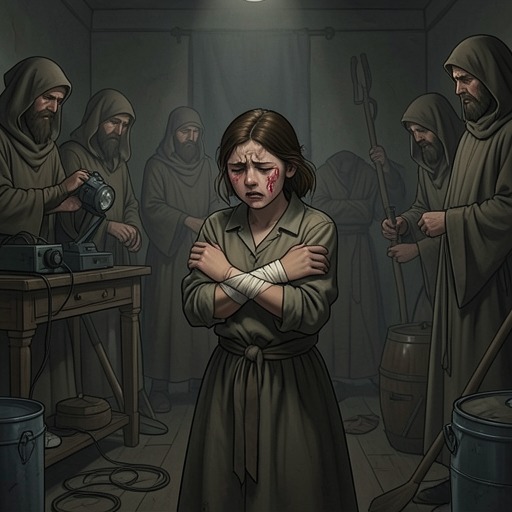
The relationship takes shape before Ava can meaningfully consent to it. When she is barely thirteen, Venus’s guards keep her from bolting and escort her into a dark room where thirty crimson-robed witnesses stand around the ceremony. Cade, Ava’s legal guardian, is not allowed to attend because he is not part of the Coterie. The ritual’s staging makes the imbalance plain: Ava is barefoot, frightened, and held by warded guards, while Venus controls the room and the proceedings.
Ava has already chosen to take Cade’s surname, explaining that she has no family attached to her former name and wants distance from the Coterie history carried by her mother’s. Venus accepts the name Ava Jane Halloway, then cuts Ava’s hand with a silver knife and places her own fire ward in Ava’s palm. The charm disappears into blood and ash. Venus frames the pact as a replacement family, declaring that the Coterie must come before everything and that Ava’s heart, thoughts, words, and movements belong in its service. The blood drawn from Ava is collected with ash, while the ward survives the flames: the ceremony makes her allegiance material even as its language tries to make that allegiance intimate.
Ava understands the ceremony as a sentence rather than a welcome. Once someone completes the blood-pact ceremony, Venus treats membership as permanent; objection does not open a path out, because the pact permits release only through Venus’s death or Ava’s. The nominal possibility that Venus might free her offers little real hope. What Venus calls family is therefore inseparable from control: the ritual claims Ava’s identity at the same moment it removes her freedom to leave.
What Venus Seeks
Venus’s claim on Ava reaches back to the years before their direct confrontation. Ava’s mother had escaped the Coterie after becoming pregnant, fearing that Venus would seize the child if she proved to be a firebug—or use her as leverage if she were human. She also feared that Venus would force Ava’s father into reproductive service. The danger was not hypothetical: the firebug trait is recessive, and Ava’s father carried the gene without wielding fire. Because both parents could pass it on, Venus could have treated them as the foundation of a supply of firebugs. Ava’s mother fled rather than wait to learn whether her child would inherit the power.
Ava did inherit it. To the Coterie, that made her a rare living weapon; to Venus, her mother’s escape meant the loss of an asset and a challenge to her authority. Ava describes her mother’s choice as a flight that had to last forever, because returning or living openly would have exposed the family to the Coterie’s reach. Venus’s later pursuit of Ava thus repeats the danger that had driven her mother away: the powerful organization does not recognize the family’s right to decide what happens to a firebug or to the people connected to one.
When Venus comes to the cabin to recruit Ava personally, she presents Coterie membership as protection and power, but Ava understands that the visit is meant to prevent another escape. Venus acknowledges that she killed Ava’s mother, while insisting that her death was not intended. Ava rejects the distinction: Venus’s kidnapping and forced labor had caused the outcome, even if murder had not been the original plan. Venus then makes the coercion explicit. Joining through the blood-pact ceremony is framed as a choice, but refusal would bring violence against Cade, the humans and pets Ava cares about, and potentially the whole town. Venus’s offer therefore turns the language of consent into a threat: Ava may choose, but Venus has already defined the cost of saying no.
That threat also clarifies why Venus treats Ava differently from ordinary Coterie personnel. Ava is too valuable to discard casually, but her value is precisely what makes her vulnerable to being owned, assigned lethal work, and kept for the organization’s purposes. Venus’s power over her is not simply a demand for obedience; it is an attempt to convert Ava’s rare ability and family history into resources under Coterie control.
Obedience, Defiance, and the Cost of Refusal
The pact turns ordinary assignments into tests of ownership. Ava is sent to hunt targets for the Coterie, with refusal defined as a violation that can bring someone to kill her; the work is not a path toward a better position but the price of remaining alive under Venus’s rule. Ava contrasts that forced role with the ordinary summer jobs she wishes she could have, making clear that the injury is not only the violence she must carry out but the absence of any meaningful choice about her life.
That coercion becomes personal when Venus gives Ava a file ordering her to kill Duncan. Ava lets the file fall rather than accept it, then refuses directly, saying Duncan is off limits. Her objection is not a general rejection of danger: she has been made into a weapon, but she draws a line at using that weapon against someone she cares about. Venus answers by slapping her hard enough to split the inside of her cheek. As Ava falls to her knees, Venus’s ward swings in front of her, a physical reminder of the ceremony: although the charm is within reach, the pact forbids Ava from taking it or attacking Venus.
The bond’s legal and magical construction leaves Ava with no safe route out. Coterie lawyers wrote the agreement, Ava signed it in blood, and a blood witch sealed it. Its stated exits are Venus’s death or Ava’s, while Venus’s theoretical power to release her offers no dependable alternative. Ava considers seeking the blood witch’s help but recognizes that doing so would bring a swift execution for both of them. The pact thus governs not only what Ava must do, but which forms of resistance she can even attempt. After refusing Duncan’s assignment, she hands the file back with blood on it and a tight-lipped smile, gambling that Venus needs her too much to kill her for disobedience; she cannot be sure Cade would be safe if that gamble failed.
Defiance does not persuade Venus to relinquish control; it changes the use the Coterie plans to make of Ava. Later, Owen tells her that she is considered too untrustworthy to work in the field and that the organization had intended to wait until she was older before placing her under lock and key. Her resistance has accelerated that plan. He also reveals the Coterie’s breeding program: Ava is to be kept alive for reproduction, with Owen invoking the possibility that Venus might allow her to name a child after her mother. The threat gives a brutal meaning to the fear that had driven Ava’s mother to flee: the Coterie sees a firebug’s capacity to have children as another organizational asset. Ava’s disgust at the prospect of Owen touching her marks this as an assault on bodily autonomy as well as freedom, extending Venus’s claim from Ava’s labor and powers to her future and her body.
Family as Care and as Possession
A later exchange with Ryan sharpens the difference between family offered through care and family imposed as ownership. Ryan explains that his biological mother was a selkie who recovered her skin and left; when he saw her again, she judged him to resemble his human father, told him he belonged on land, and swam away without apology. He says he wanted what Ava has. Against that loss, Ava’s mother’s flight from the Coterie had been an attempt to protect her daughter, while Venus’s language of family demands Ava’s obedience and treats her future as the organization’s property. The contrast makes the bond’s central injury more precise: Venus claims intimacy to legitimize control, but the kinship Ava values is measured by protection and choice, not possession.