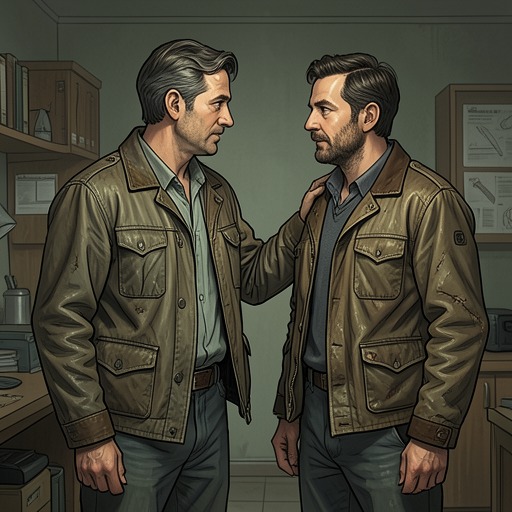
Cade–Duncan
FirebugCade–Duncan is a chosen-family relationship formed through years of shelter, everyday generosity, and mutual loyalty rather than blood or formal kinship. Duncan gave Cade a home when Cade left his parents as a teenager, and the friendship grew into a bond so fatherly that Duncan says Cade is the closest thing he has to a child. That attachment eventually becomes a political stake: Duncan opposes Venus in part because he believes she would kill Cade, and his decisions are inseparable from his determination to protect the family he has made.
A Home After Cade Left His Parents
Cade’s relationship with his own parents was distant. They did not get along, and they disapproved of his friendship with Lilia because of her family’s Coterie connections. Cade ignored their prohibition. At sixteen, he packed a bag and decided to live in his car, which he had bought with his own money. That lasted a week: Duncan found him camping in the woods and took him in. Cade lived with Duncan until he was old enough to establish a place of his own. Duncan’s intervention was not a brief rescue but a formative stretch of shared life, giving Cade a home when his parents’ house was no longer one.
The contrast persists into adulthood. Cade’s parents move to Vermont after he leaves, and the only regular contact described is a card on his birthday and another at Christmas. They sign their names rather than addressing him as their son or expressing affection. Duncan, by contrast, remains present. The difference is not merely between warm and cold gestures; it is between a nominal family tie that offers little intimacy and a chosen bond sustained by care.
Care in Ordinary Life and Family Rituals
Duncan’s affection appears repeatedly in practical acts. He stops by Cade’s home with fish after fishing, jam after making it, and eggs from his many chickens. He is one of the few people who regularly enters Cade’s kitchen, a small domestic detail that makes the household’s limited social world visible. Ava recalls that Cade and Lilia had spent much of her childhood on the run, sometimes returning secretly to Currant when Lilia could no longer bear to stay away. In that unsettled history, Duncan’s dependable visits and gifts help make home feel like a community rather than simply a place to hide.
His care also has a ritual shape. When Cade receives the sparse birthday or Christmas cards from his parents, Duncan seems to know and comes over. For Cade’s birthday he brings stout; during the winter holidays he brings mulled cider and whiskey. He sits by the fire whittling while Ava asks for stories about Cade as a teenager. Their response to the cards is a family tradition of their own: Cade turns one into a paper airplane, and Ava incinerates it in midflight. Duncan’s presence turns an occasion that might underline Cade’s rejection by his parents into a shared domestic ritual, complete with a fire, a drink, stories, and a joke.
Duncan’s kindness reaches Ava as well, but it also deepens the portrait of his place in Cade’s life. During one childhood Christmas, when Cade and Lilia had returned to Currant and snow kept them there for a week, Duncan visited and gave Ava four carved animals. The wooden pony, dog, cat, and tiny bird came alive at his touch and paraded to the beat of Ava’s clapping. The gift and the time he spent playing with her show Duncan entering the household not as an occasional benefactor but as part of its intimate family life. Years later, he still visits and brings food; the continuity connects the child Ava’s enchanted Christmas to the adult Ava’s understanding of Duncan as family.
Mutual Loyalty and the Meaning of Family
Ava understands the relationship through its effect on Cade. She considers Duncan the closest thing she will ever have to a grandfather and says she holds fiercely to family after losing her mother and never knowing her father. Even if she felt no personal attachment to Duncan, Cade’s love for him would be reason enough to protect their bond. Her promise to Duncan when she leaves—to look after Cade—is exchanged without words: she asks with her eyes, and Duncan silently agrees. The pair do not settle whether that promise means until Ava returns or in case she does not. Their unspoken exchange conveys trust, but also the danger surrounding the family they are trying to keep together.
The relation is not described as uncomplicated sentiment. Cade’s closeness to Duncan sits alongside the pain of his estrangement from his parents, and Duncan’s choice to protect him carries political consequences. When Duncan explains that he does not want to lead the Coterie, he distinguishes that reluctance from his opposition to Venus: he did not want her to take power either. He says he has no children of his own and that Cade is the one person who fills that place for him; he could not be prouder of Cade if they were related by blood. He believes Venus would eventually have killed Cade, whether to spur Ava or punish her. Protecting Cade, then, is not a secondary sentiment attached to Duncan’s political decisions. It is one of the reasons he makes them.
A Chosen Bond Under Threat
Duncan’s explanation reframes his part in the struggle without erasing its consequences. Ava recognizes the same protective logic she had used in speaking to Lock’s mother: Duncan, too, made choices to protect his family. She had wanted to be angry with him for being one of the small cogs that set events in motion, but concludes that she would have made the same choices in his place. The comparison shows how their bond extends beyond affection into a shared moral predicament: love demands action in a dangerous system, and those actions can help set larger events moving.
The relationship’s force lies in the gap between biological and lived kinship. Duncan is not Cade’s father by blood, and nothing in the account suggests that their bond depends on a legal designation. He becomes family by finding Cade when he has nowhere to go, giving him a home, continuing to show up, and placing Cade’s safety among the reasons he acts. Duncan’s pride in Cade makes that chosen status explicit; the years of hospitality and ritual make it tangible. In a story where family can be lost, concealed, or used as leverage, Cade and Duncan’s bond is both a refuge and a vulnerability—and the reason protecting one another carries such weight.