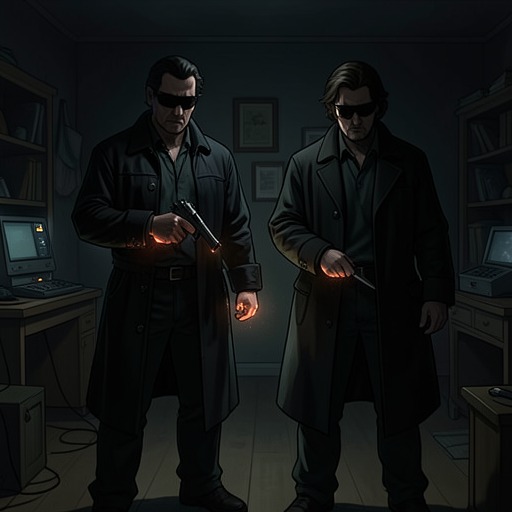
Ava and Lock
FirebugAva and Lock are friends whose loyalty takes the form of action: he stays beside her as she turns back toward the Coterie, and she treats his safety as part of the fight rather than a separate concern. Their closeness is affectionate, teasing, and occasionally charged with a momentary tension neither lets displace the friendship. More than a promise of companionship, their bond is a shared claim on family and danger.
A Friendship Formed Around Hiding
Ava grew up with her mother on the run, returning to Currant only when her mother could no longer bear to stay away. That life left little room for ordinary friendships: Ava later acknowledges that she had not really been able to have friends while growing up. Lock understands this history, and when she struggles with the fact that he is risking himself for her, he frames their closeness not as a debt she must repay but as what friendship means. If she goes into danger, he will follow; Ezra, too, is part of the circle they cannot simply leave behind.
The contrast between Ava’s constrained childhood and the ease of her adult friendship with Lock is important. She learned early that home was where Cade was, but the life built around that refuge was isolated. Lock’s presence gives her a different kind of security: not a place to return to, but a person who chooses to go with her. Their bond expands the family Ava can count on without erasing the central place of Cade in her life.
Protection Without Distance
Lock’s protectiveness appears in small, practical gestures as well as in moments of danger. When they need to leave a locker room without attracting attention, he draws Ava close and presents her as his girlfriend, using the cover to get them out together. Later, after she looks like an arson victim, he gets her back to the car, fastens her seat belt himself, tucks his jacket around her, and tells her to rest. Ava recognizes his tendency to fuss over her and appreciates it, even if she does not usually say so.
That care does not depend on seeing Ava as powerless. When she asks why he and Ezra are willing to keep helping, she idly juggles a small fireball, a habit connected to her mother’s lessons and to the way she thinks when nervous. Lock puts his hand directly in the flame’s path. Ava extinguishes it before it reaches him, but his deliberate gesture makes his point: he is not afraid of her. He treats her dangerous ability as part of the person he befriends, not as a reason to withdraw.
His support also means refusing to mistake what Ava wants for what she needs. After they get off a bus, she tries to persuade herself that Cade may have meant for them to stay away from Duncan’s. Lock keeps walking toward Duncan’s and tells her plainly that she wants to go home but needs to go there. His firmness is not indifference to her fear; it is his refusal to let her retreat from a danger they have already chosen to confront together.
Shared Risk and Shared Family
Lock helps Ava understand their return toward the Coterie through the image of firefighters running back into a burning building. Most people would flee the Coterie, he reasons, but their willingness to turn back can be understood as courage. The comparison does not make the danger smaller. It gives their decision a meaning beyond recklessness, while leaving Ava room to question whether they are being foolish.
For Lock, the fight is not Ava’s alone. He has joined the group’s movie nights and spends more time with Cade than with his own mother; he therefore regards Cade as family and the conflict as personal. Lock also tells Ava that the people around them have their own reasons to take a stand: Venus has targeted Duncan, whose safety matters to the drove protecting him, while Ezra’s joking presentation of himself as merely there for fun does not alter their sense that the three of them are a team. Lock’s account answers Ava’s guilt with a different principle: their shared risks belong to all of them, not only to the person most directly threatened.
That principle becomes especially pointed when Ava considers Lock’s mother, Angela. Ava argues that Venus would eventually have killed Lock, whom she sees as too kind for Venus’s service, and she does not reveal that he became a tithe to spare Angela and the other Dryads. Angela, in turn, recognizes that Ava’s effort to save her father came from the same protective attachment she feels toward her son, and that Lock would naturally have thrown himself into the fight. The exchange places Lock’s loyalty within a wider web of family obligations: his care for Ava and his connection to Cade coexist with the sacrifices made for his own family.
Affection, Tension, and the Chosen-Family Bond
The friendship can briefly feel more intimate than either character knows how to name. When Lock offers a solution Ava finds brilliant, she says she could kiss him; he takes a fraction too long to respond, and the air between them changes. His joking complaint about mixed signals, followed by Ava punching his shoulder, restores their familiar rhythm. The moment registers a charge without turning their relationship into a declared romance. Humor lets them acknowledge the awkwardness and return to the ease they already share.
Their physical and verbal gestures repeatedly make that ease visible: Ava snuggles against Lock’s side while asking whether they are being stupid, and he wraps an arm around her; later, he pulls her close enough to keep her safe while they escape. The gestures do not cancel the risks or disagreements between them. Instead, they show a friendship in which comfort and resolve are joined: Lock can soothe Ava, challenge her, and follow her into danger, while she can trust his care without mistaking it for fear of what she is.
Duncan’s explanation of his own choices sharpens the family logic that links them. He says he did not want Venus to lead, but also that Cade was the closest thing he had to a child and that Venus might have killed Cade to spur or punish Ava. Ava understands that Duncan acted to protect family, as she herself would have done. Lock’s allegiance to Cade and his decision to stand with Ava therefore meet at the same point: the people they love are not peripheral to the conflict but the reason they accept its danger. Their friendship turns that private attachment into mutual commitment, making chosen family something they enact by showing up for one another.