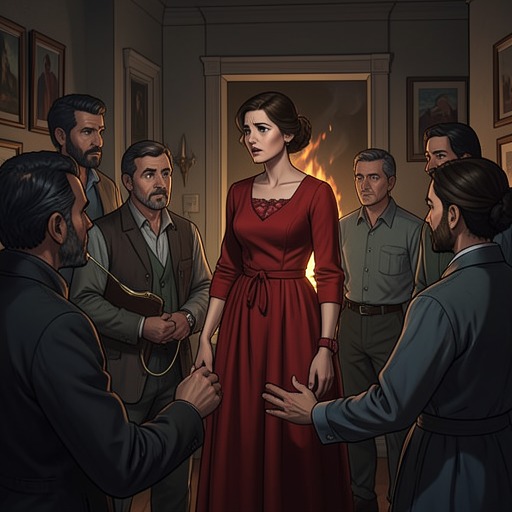
Ava and the Coterie
FirebugAva and the Coterie are bound by coercion rather than allegiance: after she refuses a job to kill Duncan, Venus demands compliance and turns that refusal into a public challenge. Ava’s resistance escalates into escape and flight, transforming her from an unwilling employee into an active opponent of the organization. Yet her opposition is complicated by the people who depend on the Coterie for protection, a reality she confronts even as the Coterie holds Cade and pursues her.
Coerced Service and the Refusal
Venus frames Ava’s refusal as a failure of compliance, not as a disagreement over the assignment. The job in question is a contract against Duncan. Ava remembers having refused it, then meets Venus’s demand with a deliberately calm smile rather than an argument. Her outward composure is a tactic: she knows that acting unusually subdued would reveal how much Venus has unsettled her. The exchange establishes the imbalance between them, but also Ava’s effort to retain some control over how she responds.
Ava understands that her usefulness makes her position different from that of Lock and Ezra. She fears Venus may kill all three, but sees at least a small chance that Venus will spare her because replacing a firebug is difficult; replacing bartenders is not. That calculation does not make Ava secure. It shows that the Coterie’s valuation of her is instrumental: the same ability that makes her valuable may postpone violence without freeing her from Venus’s power. Lock and Ezra, meanwhile, are treated as more expendable, so Ava’s resistance carries danger for the people who have been drawn into her situation.
Defiance Becomes Open Conflict
The conflict intensifies when Ava’s refusal is no longer private. As Lock later recounts the events to her, she has spoken back to Venus in front of witnesses, Ezra has crushed Venus’s new firebug, and Ava has burned part of the Inferno. She has also set Lock’s car alight, attracting the attention of the human police, and escaped. These actions answer Venus’s demand for submission with a conspicuous sequence of refusals. They also give Venus reasons to retaliate that reach beyond the original Duncan contract: Ava has challenged her authority in public, damaged her business, and complicated her dealings with human law enforcement.
The escape does not end the danger. After the fugitives leave a summer home burning, they drive without a destination, with Lock changing direction to create confusion rather than simply put distance between them and their pursuers. Ava asks whether the car led the Coterie to them. Lock instead notes that they had been found the day before as well and concludes that someone among them must be bugged. The suspicion turns pursuit into a problem of trust and exposure: the group cannot assume that changing locations will conceal them while an unknown tracking device may be betraying their movements.
Pursuit, Retaliation, and the Choice to Flee
Lock argues that Ava cannot safely go home. In his account, Venus cannot let the public defiance pass without a response; failing to bring the fugitives under control in public could invite mutiny. He warns that Venus enjoys making people suffer and that returning would place Ava, her house, and what she loves within reach. Ava wants to go home, but recognizes the force of his argument. The immediate consequence of her break with the Coterie is therefore not freedom to resume ordinary life, but the need to keep moving and to treat familiar places as potential targets.
The danger also strains Ava’s relationships with those fleeing beside her. She and Lock argue, and she is distressed by his anger; their conflict recalls the pain she feels when Cade is angry with her. After walking in silence, Ava catches up and links her arm through Lock’s to ask for a truce. The gesture does not resolve the threat from the Coterie, but it shows that resistance is collective in practice: Ava’s choices affect the companions who have been pulled into the conflict, and maintaining their trust matters while they remain in danger.
Protection and the Limits of a Simple Judgment
At Duncan’s, Ava’s anger at the Coterie intersects with her anger at Duncan and her fear for Cade, who is being held by the organization. Lock challenges her view of the Coterie as wholly evil by pointing to Luther, whom Ava knows socially and has seen pictured with his children. She had not known that Luther was a troll, or that he was heavily warded simply so he could work. The example forces her to confront a distinction she had not previously understood: the Coterie can provide protection to people who need it, even while exercising coercive power over others.
Ava does not readily absorb that complication. She responds angrily, asking whether Lock expects her to return to the Inferno and beg Venus for forgiveness, and demands to know whether Cade’s capture matters to him. Lock insists that Cade is family to them too; his point is not that Ava should submit, but that the organization’s role in people’s lives cannot be reduced to a single judgment. The argument leaves the contradiction unresolved. Ava has reason to resist Venus, and the Coterie’s protections may matter to people such as Luther, but neither fact cancels the threat to Cade or the pressure exerted on Ava.
From Employee to Opponent
Ava’s relationship with the Coterie changes through a series of actions rather than a formal declaration of independence: she refuses the contract against Duncan, declines to perform submission for Venus, helps escape after the Inferno is damaged, and accepts that returning home would expose others to retaliation. Each step narrows the possibility of treating her service as ordinary employment. By the time she reaches Duncan’s, the conflict has become both personal and political: Venus’s authority is at stake, the fugitives’ safety depends on avoiding detection, and Ava must contend with evidence that the Coterie can be both a source of protection and an instrument of control. Her resistance is therefore not a clean exit from the organization, but a dangerous break whose consequences extend to her companions and the people she hopes to protect.