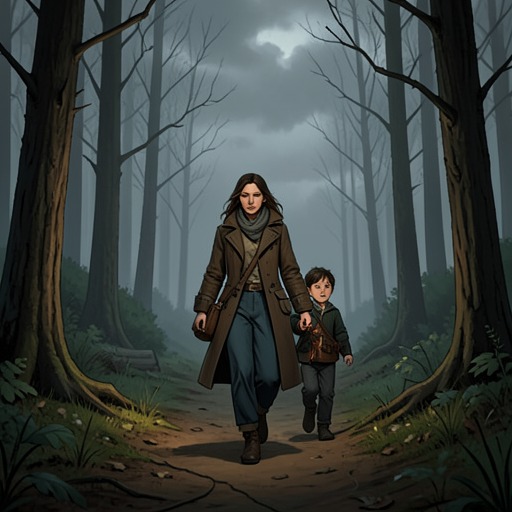
Ava–Lilia
FirebugAva and Lilia’s mother-daughter relationship is defined by fierce protection under the pressure of the Coterie’s pursuit: Lilia gives up the possibility of an ordinary family life so that Ava will not be claimed and used. Their years on the run make that protection costly, and Lilia’s death leaves Ava with a small necklace that connects her mother’s love to the man Ava has never met.
A Family Divided for Protection
Lilia’s decision to leave began with the danger that the Coterie posed to a firebug and the people close to one. She had spent much of her youth working for the organization, under Venus’s authority, and feared that it would claim Ava if it learned she was her daughter. If Ava inherited Lilia’s ability, the Coterie could force her to serve as a weapon; if she were human, she could instead become a bargaining chip against her mother. Lilia understood both possibilities as forms of ownership, not safety.
The risk extended to Ava’s father. Lilia knew that he carried the recessive firebug gene, though he could not produce fire himself. Together, the parents could have had firebug children, making them valuable to Venus as the basis for a force she could control. Lilia feared that Venus might force Ava’s parents into a breeding arrangement, treating them as means to build an army. She did not wait to discover whether Ava would be human or a firebug: she fled the Coterie before it could make that decision for them.
Lilia’s choice also determined what Ava would know about her father. If Ava had been born human, Lilia said she would have taken her back to him to be raised, then left rather than expose either of them to the Coterie. In Ava’s account, this possibility makes clear that Lilia’s separation from her daughter’s father was not a rejection of him or of Ava. She was prepared to disappear from both their lives if that was what their safety required. Ava grows up knowing that her father did not abandon them; they left him for his protection.
A Childhood in Hiding
The escape did not lead to a brief period of refuge. Lilia believed they would have to live under the radar indefinitely, moving before the Coterie could find them. When Ava recalls being twelve, she is eating dinner with Lilia and Benny at a Florida safe house. They had come from a desert climate, and the hot night, thick air, and loud insects make the setting feel unfamiliar; yet the larger pattern is familiar. The family never stayed anywhere longer than a few months because being hunted left no room to put down roots.
Ava remembers Lilia’s dark brown hair pinned up so a breeze could reach her neck, and thinks of her as the most beautiful woman in the world. She wishes she looked more like her mother, though she recognizes that she shares some of Lilia’s features and hair. The memory holds admiration alongside the everyday instability of their life: even in the safety house, home is temporary, and the future is organized around staying hidden.
Benny is part of the support network that makes this life possible. He is also a firebug, forced underground after conflict with an organization in Texas, and helps move creatures like them away from groups such as the Coterie. The scars down his back and his slight limp show Ava that this work is dangerous, though he does not explain exactly how he was injured. Lilia’s protection of Ava therefore depends not only on her own vigilance but on a precarious network of people who have also had to flee.
What Ava Is Told—and What She Cannot Know
Lilia explains their separation from Ava’s father while Ava is still young. She wants her daughter to understand that he would have loved her, given the chance. That reassurance matters because their circumstances could otherwise resemble abandonment: Ava lives with one parent, never meets the other, and must repeatedly leave each temporary home. Lilia gives her a different account of the absence, one grounded in protection rather than a lack of love.
Still, explanation cannot replace the relationship Ava never had. In the Florida memory, she assumes that her stockier build and less graceful manner may come from her father, then acknowledges that she cannot know because she has never met him. The uncertainty sits beside her certainty about Lilia. She can observe her mother across the dinner table and admire her; her father remains an imagined source of inherited traits. The contrast shows how Lilia’s effort to keep Ava safe preserves one parental bond while foreclosing the other.
Lilia’s Death and the Necklace
Ava’s recollection of Lilia’s final hours is broken by the hospital’s white floors, coats, and bandages, and by the red of her mother’s blood on her hands and shirt. The doctors cannot save Lilia; she falls into a coma and dies. Ava describes herself as numb, as though her heart had gone with her mother. The loss is not only emotional: at that moment, the person who has been her parent, protector, and constant companion is gone.
At the hospital, Ava pretends that a fictional aunt is coming to collect her. She knows she cannot wait there for help without risking discovery by the Coterie or intervention by Social Services. Before escaping, she says goodbye to Lilia and takes the necklace she had worn: a small silver heart with an interlocking star. Cade had given it to Lilia when they were young, after earning the money through mowing lawns, washing cars, and chopping firewood. Ava knows it was one of the things Lilia valued most, besides her daughter, and wears it herself as she leaves.
The keepsake also reveals the depth of Cade’s connection to Lilia. When Ava later reaches his door, soaked, exhausted, hungry, and grieving, he holds her and tends to her without first demanding an explanation. He breaks down only when he sees the necklace. Its smallness contrasts with the force of what it carries: Lilia’s memory, the love behind Cade’s gift, and the grief shared by the people she leaves behind. Even in mourning, Cade continues to care for Ava, giving her a form of shelter after the loss of the person who had kept her safe.
The Shape of Their Bond
Lilia’s love is expressed less through a secure home than through the repeated refusal to let the Coterie decide what Ava’s life will be. She leaves the organization, accepts permanent flight, and raises her daughter with an honest account of why they cannot stay and why Ava’s father is absent. Protection gives Ava a childhood with her mother, but it also demands secrecy, displacement, and a separation from the rest of her family.
The relationship is therefore remembered through both intimacy and danger: Lilia’s appearance at a dinner table, her explanations to a child, and the necklace Ava carries out of the hospital all stand against the threat that forced them to live on the move. After Lilia’s death, the necklace makes that bond portable. It cannot restore their life together, but it preserves a tangible connection to Lilia—and, through Cade’s response, to the family history Ava is only beginning to understand.