Cap Hollister
FirestarterCap Hollister is a senior official of the Shop, a practiced manager of covert operations whose defining belief is that crises can be contained and repaired. The Manders farm disaster unsettles that confidence: Charlie McGee’s power turns a planned capture into a public and lethal catastrophe. Cap answers with secrecy, political damage control, and renewed plans to possess Charlie, but his authority increasingly depends on compromises with John Rainbird and is finally disrupted by a terror he cannot govern.
Authority and the Manders Farm Disaster
When the operation against the McGees approaches the Manders farm, Al Steinowitz takes charge of sixteen men in five cars. Cap is not present at the scene; he receives the consequences through Orville Jamieson’s report, relayed from Hastings Glen through New York City to Longmont, Virginia. The chain of communication reflects the distance from which Cap exercises power, but it cannot make the news less immediate: several men are dead, others scattered into the woods, cars are burning, and the Manders house has burned to the ground. A wounded civilian may also expose the operation by describing the agents’ attempted kidnapping.
The report overturns Cap’s expectations. He had known Charlie possessed an unusual ability, but the scale of the reversal strikes him as almost unbelievable. He compares the failure to the Bay of Pigs, an analogy that registers both its operational scale and its political danger. Rather than treating the episode as a reason to abandon the pursuit, he summons Jamieson, requests an urgent conversation with General Brackman in Washington, calls for a meeting with all six subdirectors, and contacts the New York chief of state police. His proposed united front has two purposes: to share the burden of blame and to protect the agencies involved from looking incompetent.
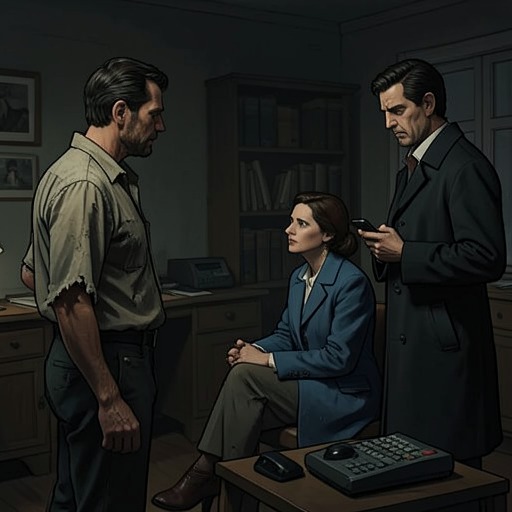
Cap’s private response makes the limits of his composure plain. In the darkened office, he repeats his lifelong motto, “Nothing has happened that can’t be fixed,” but the report has shaken the conviction behind it. He regards agents and cars as replaceable equipment, yet cannot dismiss Steinowitz as hardware; he wonders who could replace him and vows that the McGees will pay. His anger at the loss sits beside a more strategic anxiety: Charlie herself may not be manageable by the methods that have served him before.
Confidence, Loss, and the Shop’s Plan
By March 24, Charlie’s birthday, Cap is waiting for Rainbird with a sense of dread. He thinks of Rainbird as fundamentally ungovernable, a hired killer likely to destroy himself spectacularly, and wonders how much he knows about the McGee operation. Cap even considers arranging an accident for him after the affair is over. This suspicion is not merely professional caution: the Shop’s power rests on secrecy, and Rainbird’s knowledge makes him dangerous from within the institution as well as to its targets.
Cap’s private life has also narrowed. His wife, Georgia, died of cancer three days after Christmas, following a mastectomy that had slowed but not stopped the disease; his secretary, Rachel, died a little over a month before the March meeting. Cap had known Georgia was gravely ill, but Rachel’s death surprised him. He remembers joking that she needed fattening up and her returning the jokes, a small recollection that gives their working relationship a warmth absent from the increasingly impersonal machinery around him. Now, he thinks, all he has left is the Shop—and even that may not last. He describes his vulnerability as a cancer of confidence, linking his own weakening position to a wider crisis of credibility among powerful institutions.
The file on the McGees shows how Cap tries to turn private fixation into administrative control. It contains six letters Andy McGee mailed less than two weeks earlier, photographs documenting the family’s life at Tashmore Pond, and a report of more than three hundred pages prepared by eleven doctors and psychologists under Patrick Hockstetter’s direction. The study cost the taxpayer eight hundred thousand dollars. Cap reads its argument as confirmation that Andy must be kept alive: the Shop’s working theory is that such powers depend on the possessor’s willingness to use them. Charlie’s pyrokinesis can cross the barriers of her will, the report says, but she still chooses whether to set it in motion. Cap treats the Manders farm as evidence of that choice, made when Charlie understood that the agents meant to kill her father.
The Bargain with Rainbird
When Rainbird offers to keep Cap in the saddle longer, he does so by invoking their shared knowledge of buried bodies, both literal and figurative. Cap, tired and at a loss, accepts the deal. The exchange exposes how far his practical authority has eroded: the official who once dispatched teams and summoned senior government figures now needs the cooperation of the man he has privately considered eliminating.
Rainbird proposes to become Charlie’s orderly, an inconspicuous role that will let him approach her outside the established scheme of authority. He also insists that she must never learn that he fired the rifle. The concealed fact is essential to the arrangement: Rainbird’s access depends on Charlie’s ignorance, while Cap accepts a plan built on deception because it serves the Shop’s effort to retain her. Cap asks why Rainbird has gone to such lengths, but the available exchange does not give Rainbird’s answer. What it does establish is that the bargain binds them through mutual leverage, not trust.
The Stable and the Limits of Control
At the stable confrontation, Cap is present while Rainbird faces the McGees. The mental ricochet leaves Cap’s eyes moving vacantly around the shadowed space until they settle on a partially fused green plastic hose hanging beside a burst water pipe. The hose, still partly obscured by drifting steam, recalls a snake to him. Earlier, a snake had slithered across his foot and disappeared into the high grass; now the remembered image overwhelms his ability to distinguish the hose from the danger he fears.
Cap’s terror freezes him before it releases as a scream. He does not flee. Instead, he grabs a rake and rushes the hose, convinced that he must beat the snake and save Lennie. The scene sharply reverses his usual posture: the man who plans containment and manages other people’s risks acts on a mistaken perception he cannot master. His scream and sudden rush break Rainbird’s concentration for a moment. Rainbird’s gun jerks away from Andy McGee toward Cap, and that instinctive movement gives Andy the opening to use the push.
Cap reaches the hose and beats it wildly with the rake, unable to speak coherently. His interruption does not resolve the confrontation, but it alters its course: Rainbird’s aim shifts, Andy acts, and Rainbird is thrown from the loft and breaks a leg. Cap’s attempt to confront an imagined snake thus becomes an unintended intervention in the struggle. Across his arc, the same belief that once sustained him—that every disaster can be fixed—gives way to a less secure position. He can marshal cars, agents, reports, and political allies, but he cannot guarantee that Charlie will be controlled, that Rainbird will remain governable, or even that his own perceptions will hold steady when fear takes over.