Andrew McGee
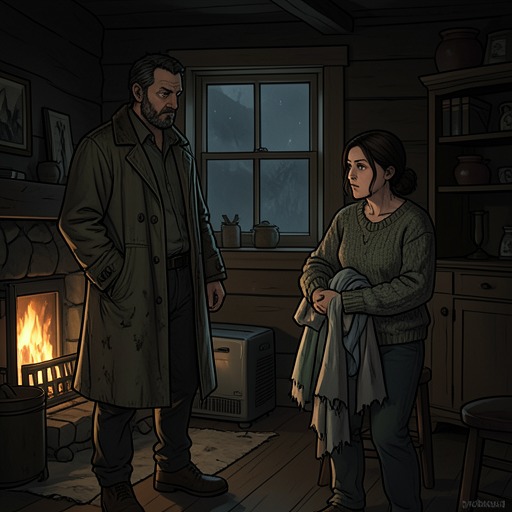
FirestarterAndrew McGee is a former English instructor and a fugitive whose ability to influence others with the push offers a precarious defense for himself and his daughter, Charlie McGee. The power can change the course of a moment, but it is never a secure resource: as he runs, he fears that those pursuing him have learned its limits, and when he uses it at the climax, the effort leaves him gravely incapacitated. His final actions turn protection into a last appeal to Charlie to end the threat around them.
Identity and Background
At thirty-four, Andrew remembers himself as someone with an ordinary professional life: until the previous year, he taught English at Harrison State College in Harrison, Ohio. The recollection sets his former identity against his present circumstances. He contrasts the familiar image of a respectable instructor in a quiet college town with life on the run beside Charlie, where each decision is shaped by danger and the need to keep moving.
His memories do not make the past feel safely distant. In a cab, as a headache gathers, his thoughts return to the life he has lost, while the image of a riderless black horse gives the pain a frightening, advancing presence. The juxtaposition makes the journey more than physical flight: Andrew is carrying both the pressure of pursuit and the bodily cost of the ability on which he depends.
The Push and Its Costs
Andrew’s use of the push is not always presented as a fully considered tactic. When he asks a night security guard to let him look around, he tells the man that he will not remember the encounter. Andrew then feels as if he has pushed the guard with his mind; the guard retreats and releases the door. Only afterward does Andrew register the sharp pain in his head. It subsides to a throb and is gone within half an hour, but the episode makes clear that the power affects its user as well as its target.
Later, while fleeing with Charlie in New York, Andrew watches a green car draw closer. He has little money and fears that the men following him may know how little of the push he has left. His thought that they may have been charting him is a suspicion, not a confirmed account of their methods. Still, he has noticed a pattern: after he obtains money, the strange events that had drawn their interest stop for a while. His immediate response is to keep walking. The scene presents his power as a diminishing resource within a larger contest of observation and pursuit, not as a dependable solution.
Protection of Charlie and Final Confrontation
At the final confrontation, Andrew acts when Rainbird’s gun shifts away from him toward Cap Hollister. Andrew calls to Rainbird and uses the push with greater force than he ever has before. The effort triggers what Andrew recognizes as a blowout. He staggers, loses sensation on the left side of his body, and cannot rely on his left leg. His intervention briefly changes the immediate balance of the scene, but it also exacts a decisive cost from him.
Rainbird falls from the loft and is badly hurt, yet retains his gun. He raises it toward Andrew and fires; Charlie cries out for her father. Andrew remains alive after the shooting, but only weakly. When Charlie comes to him, he recognizes her and draws her close. His speech is reduced to a husky croak, and she sees that his face is altered. The contrast with his earlier use of the push is stark: a power that could briefly direct another person’s actions cannot now restore his own strength.
Relationship with Charlie and Legacy
Andrew’s last exchange with Charlie remains focused on her safety and what she can do after him. As the fire spreads through the structure, he tells her to make sure the Shop can never do anything like this again and urges her to burn it down. Charlie says she cannot leave him. He draws her closer and kisses her, then begins to tell her that he loves her before he dies. His final appeal therefore joins a father’s intimacy with a demand placed on his daughter: she is to escape, survive, and prevent the institution’s violence from continuing.
Andrew’s ending brings together the limits and meaning of his actions. The push can buy an opening, as it does when Rainbird turns his weapon aside, but using it at full force leaves Andrew unable to protect himself from what follows. He does not survive to carry out the destruction he asks for; that responsibility passes to Charlie. His final significance lies in this transfer: the fugitive who once relied on the push to keep moving leaves his daughter not a way out of the conflict, but a clear purpose within it.