Dr. Karl Hofferitz
FirestarterDr. Karl Hofferitz is the nearly eighty-year-old physician who treats the injured girl sheltering with Irv Manders and Norma Manders. His importance lies in the choice that follows his examination: he understands that the child is concealing something serious, yet agrees, for the time being, not to expose her. A practical doctor with a dry, sometimes abrasive humor, Hofferitz becomes a test of whether professional duty will mean reporting the case or protecting people he believes may be in danger.
Identity and Character
Hofferitz enters the scene from the back bedroom, slowly, brushing back his white hair with a gnarled hand. Irv and Norma are glad to be pulled out of their memories when he appears. The description gives him the bearing of an old man, but his age has not made him vague: he has been examining the girl and can report both her condition and her account of how she was hurt.
He is also a lifelong smoker, and the narration notes that he once told colleagues he did not care what the surgeon general thought. At the kitchen table he lights a cigarette, later stubs it out, and then lights another. Smoking and medicine sit side by side without ceremony. So does his humor: when he notices the plates, he dryly observes that they need not prepare anything new, and he repeats an old joke about gin as a clear liquid. Irv and Norma have heard it many times before. The familiar joke briefly makes the exchange ordinary, even as its subject is a sick and frightened child.
Examination and Care
Hofferitz tells the couple that the girl is awake but in poor condition, though not in immediate danger. She has an infected cut on her arm and another on her back. She says she got the back injury by crawling under a barbed-wire fence to escape a mad pig. Hofferitz does not present this explanation as established fact; it is the girl's account, one piece of a story he will soon question.
His assessment is specific. The girl has a fever of 101 degrees caused by the infection, as well as malnutrition and dehydration. He says she ought to be taken to Albany for observation, leaves penicillin and antibiotic ointment, and emphasizes food, drink, and rest. He approves of Norma's decision to give her chicken broth, reasoning that anything heavier would likely have made her sick. For the next day he recommends only clear liquids, including broth and plenty of water. His care is not merely a diagnosis: it gives the child a practical chance to recover while the adults confront the danger surrounding her.
Suspicion and Disclosure
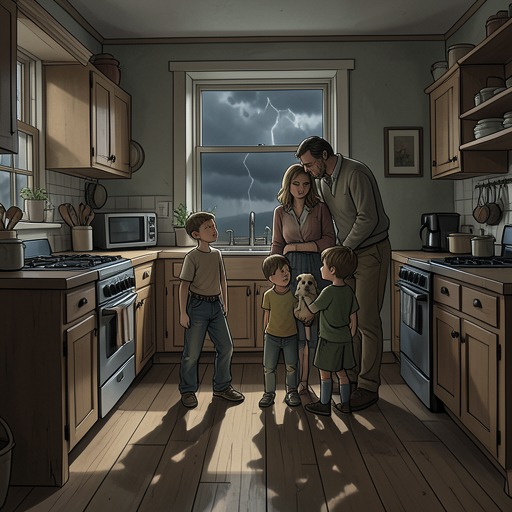
The possibility of notifying the police changes the tone of the kitchen conversation. Hofferitz says he ought to report the case; Irv and Norma answer no at the same time, then look at each other in surprise. Their shared refusal tells him more than either has yet explained. He asks whether the girl is in trouble and whether it has something to do with the trouble Irv had the previous year.
Irv invokes the distinction between the letter and the spirit of the law, pointing out that gunshot wounds are what he understands a physician to be legally required to report. Hofferitz replies that the law has a spirit as well as a letter. He doubts that the girl is really Roberta McCauley, the name Irv has given him, and finds her account of crawling beneath barbed wire on the way to relatives implausible. By contrast, he believes her when she says she remembers little of the preceding week or so. His suspicion is discriminating rather than absolute: he doubts the identity and explanation, but credits the memory loss.
Asked directly who the girl is, Irv finally admits that she is part of the trouble from the previous year. He does not provide a full account. Instead, he reminds Hofferitz that they have known one another for twenty-five years and asks him to consider the consequences of disclosure for people who have not earned the danger that would follow. Irv names Norma, their relatives, and the girl herself, then leaves the decision to the doctor. Norma, frightened, looks to her husband; afterward, she gives a bewildered shake of the head and lowers her eyes. Hofferitz has been entrusted with only part of the truth, but the appeal to their long acquaintance gives that partial disclosure weight.
Decision and Significance
Hofferitz agrees to keep quiet about the girl for the time being. He says she is stable and that the medicine will deal with the infection, but his promise is accompanied by a warning to Irv to think long and hard. The child, he reminds him, is not a parrot. The remark rejects any easy assumption that a young person can simply be managed, silenced, or treated as an object in the adults' decisions.
His final judgment remains deliberately incomplete. As he picks up his black bag, Hofferitz says there is something strange about the girl, something he could not see or identify but could feel. That intuition does not amount to a diagnosis or an explanation; the text leaves its content unresolved. It does, however, confirm that his silence is not the result of being fooled. He recognizes the oddness of the situation, weighs the risk of reporting it against the people Irv has asked him to protect, and chooses temporary discretion. His combination of medical competence, skepticism, and restraint makes him more than a helpful country doctor: he is an informed witness who knows enough to be wary, but not enough to claim the whole truth.