Patrick Hockstetter
FirestarterPatrick Hockstetter is a clinical psychologist and psychotherapist whose work gives the Shop both a research framework for Charlie McGee’s abilities and a means of pressuring her to demonstrate them. He oversees an expensive, classified study of extraordinary powers, repeatedly urges Charlie to make fires, and eventually offers access to Andy McGee as a reward for a test. When the results of Charlie’s fourth test alter his estimate of what she can do, Hockstetter recognizes that the Shop may no longer be able to contain her.
Identity and Institutional Role
Hockstetter directs a large research effort assembled by eleven doctors and psychologists. Its product is a report and prospectus of more than three hundred pages, bound in a blue TOP SECRET cover and costing the taxpayer eight hundred thousand dollars. Captain Hollister considers Hockstetter one of the Shop’s most astute minds, a judgment the expense seems to confirm in his eyes. The work is not merely an account of Charlie’s abilities: it is intended to help the Shop decide what those abilities mean and how they might be studied.
The project also reflects the Shop’s practical priorities. Hockstetter’s analysis supports the view that Andy should be kept alive, because the institution believes the powers it is studying arise from the possessor’s willingness to use them. In the report’s reasoning, will is the crucial first cause. This framework gives the Shop a way to interpret extraordinary ability as something linked to choice, rather than simply as an uncontrollable force, and therefore something it might try to elicit, measure, or manage.
A Theory Tested by Charlie
Hockstetter’s study distinguishes Charlie’s case from a simple model of voluntary control. Her abilities, with pyrokinesis as their central expression, can escape the barriers of her will; nevertheless, the accumulated evidence leads the report to conclude that Charlie herself decides whether to initiate an act. The Manders farm incident is presented as support: she set events in motion when she understood that Shop agents were trying to kill her father. For Hockstetter and the researchers, this is evidence not only of power but of agency under extreme pressure.
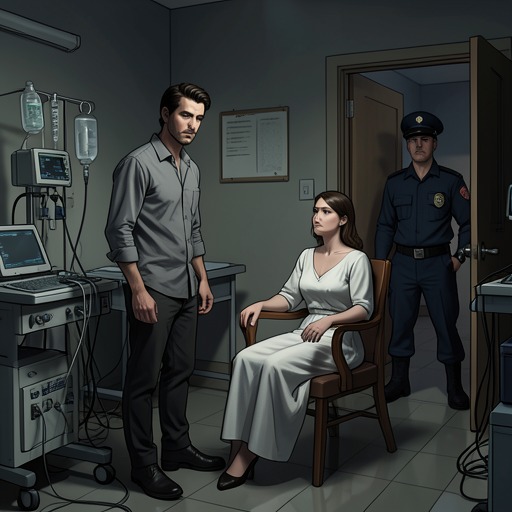
That interpretation makes Charlie’s cooperation central to the Shop’s work. Hockstetter repeatedly takes her to a testing room where the materials vary—crumpled newspaper, small dishes of oil, or other objects—but the request remains the same: she is to set something alight. Charlie fears that he will find some way to make her comply, yet resists the repeated demands. Her refusal exposes the tension in the Shop’s theory: the institution studies willingness while attempting to obtain it through pressure.
Testing and Pressure
Hockstetter’s most direct bargain follows Charlie’s request to see her father. He points her toward a steel tray heaped with curly wood shavings and makes the visit conditional on her lighting them. He promises that she could be with Andy within minutes if she does so, while insisting that no match is necessary because she can ignite the material by thinking about it. Charlie asks for a match, with tears close, rather than simply accepting his account of how the test should work.
The exchange shows Hockstetter turning a family relationship into leverage for an experiment. Charlie’s demand to see Andy is not incidental to the testing: it is the circumstance he uses to press for a demonstration. Later, she repeats that she wants her father and tells Hockstetter to pass the demand on before further tests proceed. She says she is willing to be tested again if she can see Andy, but warns that if she cannot, she will make something happen. Hockstetter leaves without resolving the demand, and the encounter leaves him unsettled rather than restored to authority.
Institutional Conflict and Reassessment
The tension around Charlie’s treatment surfaces in Hockstetter’s confrontation with John Rainbird. After the blackout, Rainbird’s actions have crossed into what Hockstetter regards as his privileged domain. In Captain Hollister’s office, Hockstetter angrily challenges Rainbird over what he has done. Rainbird initially reads the outburst as boldness dependent on Hollister’s presence, then recognizes that Hockstetter’s flushed face, white knuckles, and anger suggest a more serious reaction. The scene places Hockstetter between the Shop’s internal power structure and the increasingly unstable control of Charlie’s testing.
His institutional confidence also appears in a memorandum about Andy. Hockstetter objects to an earlier decision that treated Andy as effectively dead and proposes that another, abbreviated series of tests could begin with Charlie. Because her cooperation may not last, he argues, having her father present could be useful. The proposal treats Andy both as a person the Shop may need alive and as a possible means of securing Charlie’s continued participation. Hockstetter’s scientific program and the institution’s tactical interests remain closely joined.
Change and Significance
After Charlie’s fourth test, Hockstetter’s assessment shifts sharply. He has authorized converting a chapel into a testing room and installing additional air conditioners around Charlie’s apartment—twenty are planned, though only six are in place—but now doubts that even two hundred could impede her. He no longer sees the question as only whether Charlie might harm herself. He considers whether she could destroy the Shop installation, perhaps extending the danger across eastern Virginia. His earlier confidence in procedures and equipment has given way to a recognition that the institution may be facing a power it cannot effectively restrain.
Hockstetter identifies John Rainbird as the only effective check on Charlie, but immediately recognizes the danger in that dependency: Rainbird is unstable. The realization makes Hockstetter’s position especially precarious. He has helped build a system that seeks to elicit and measure Charlie’s will, has used her longing to see Andy to press her into testing, and now fears the scale of what her will might set in motion. His arc is therefore a reversal from expert interpretation to alarm: the researcher who helped make Charlie an object of institutional study becomes aware that the Shop’s instruments and its human controls may not be enough.