Joseph Wanless
FirestarterJoseph Wanless is the physician who leads the Lot Six experiment and later warns that the Shop’s pursuit of Charlie McGee could make her far more dangerous. His history binds together the experiment’s confident beginnings, its catastrophic human cost, and a late, urgent attempt to make Cap Hollister understand what the institution is setting in motion.
Identity and the Experiment
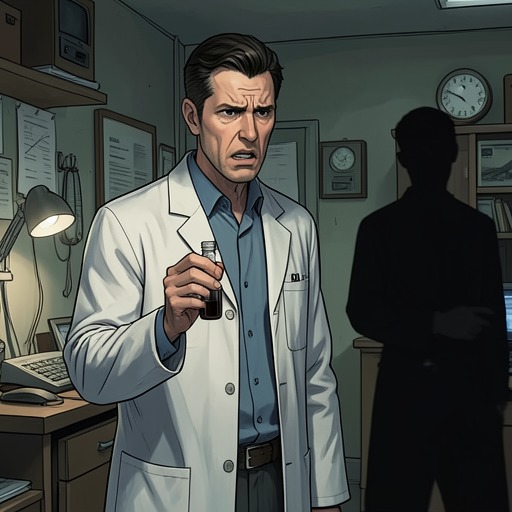
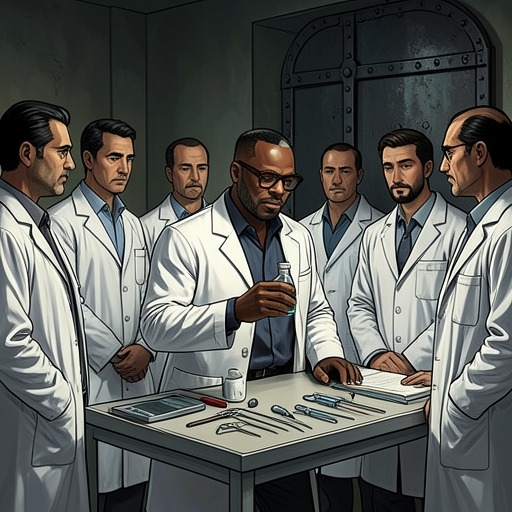
At the experiment’s briefing, Wanless is described as fat and balding, with the unusual habit of shredding cigarettes while he speaks. He explains that twelve students will receive injections under a double-blind procedure: six will get water, and six water mixed with a small amount of Lot Six, described as a hypnotic and mild hallucinogenic. The participants are to be supervised for forty-eight hours, while the compound’s exact nature remains classified. His careful explanation of the procedure sits beside the secrecy surrounding the substance itself.
A September 12, 1968, memo reveals that Wanless understood the experiment’s potential importance to the study of controllable psychic phenomena. He argued that further animal testing would be counterproductive and warned that testing convicts or people with what he called deviant personalities could create serious problems if Lot Six proved as powerful as suspected. Instead, he recommended controlled groups of college students, with contingency plans for failure. Cap Hollister later reads the memo as evidence of Wanless’s earlier confidence: in Cap’s judgment, Wanless had pressed ahead without wavering, despite the risks he had identified.
The Human Cost
The experiment involved twelve people, and Cap’s review of the files makes its consequences grimly concrete. Two participants died, one during the test and one shortly afterward. Two others became irreversibly insane and were left disabled—one blind, the other suffering psychotic paralysis—at the Maui compound. Of the remaining eight, one died in a 1972 car crash that the Shop considered almost certainly a suicide; another jumped from the roof of the Cleveland Post Office in 1973, leaving a note that he could no longer bear the pictures in his head. Cap and the Shop attributed that death to a lethal Lot Six aftereffect.
Three more participants died by suicide between 1974 and 1977. Cap’s accounting gives four definite suicides and a probable total of five among the twelve. The files could record deaths and circumstances, but they could not establish what the apparently normal victims had experienced before their deaths. Wanless’s early recommendations therefore acquire a terrible retrospective weight: the experiment he promoted as a route to understanding psychic control left a trail of death, severe disability, and lasting mental harm.
Stroke and Obsession
Wanless suffered a moderately severe stroke on August 8, 1974, the day Richard Nixon announced his resignation. He never fully recovered physically, and Cap believed he had not fully recovered mentally either. The stroke marks a change in Wanless’s relation to the experiment: only afterward, in Cap’s account, did his interest in Lot Six and its follow-up become constant and obsessive.
When he later comes to see Cap, his condition is visible in his dependence on a cane, his drawn-up left hand, and the fixed expression caused by the left side of his mouth. The frailty of the man contrasts with the urgency of what he has come to say. His warning is not that Andy McGee is powerful without limit; Wanless describes Andy’s ability as small, difficult to use often or well, and constrained by some physiological factor. He says Andy has used it to help overweight women lose weight and timid executives gain confidence, rather than to make a fortune or rule others.
Warning About Charlie
Wanless identifies Charlie, not Andy, as the greater danger. She is frightened and on the run with her father, and Wanless sees their situation as one of survival. In his view, the Shop is making matters worse by forcing Andy to retrain his daughter and change her understanding of the power within her. That pressure also forces Charlie to use the power. Wanless’s warning to Cap thus shifts the question from what Charlie can do in isolation to what the Shop’s pursuit may provoke in a frightened child and her frightened father.
The warning exposes the cost of treating people as instruments in a program of control. Wanless once advocated the college-student trials that produced the Shop’s record of deaths and lasting injuries; later, he insists that institutional pressure can transform a limited ability into a greater threat. He cannot undo the experiment or stop the pursuit by himself, but his appeal asks Cap to recognize the causal chain before the next catastrophe: coercion, fear, and forced use of power.