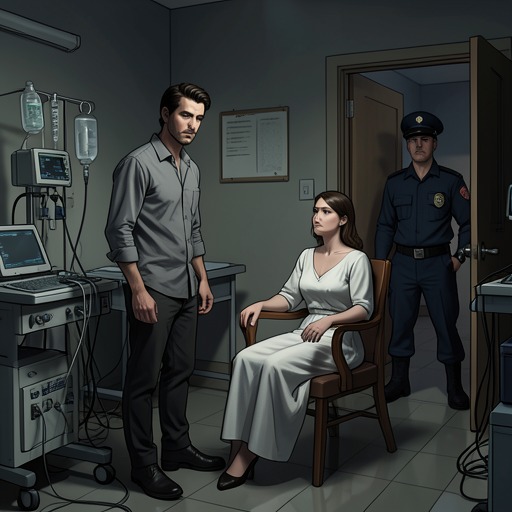
Herman Pynchot
FirestarterHerman Pynchot is the Shop physician chiefly responsible for testing Andy McGee, an outwardly ordinary man whose persistent grin makes Andy uneasy. His role places him at the point where the Shop tries to measure and direct Andy’s mental push. The tests expose a crucial limit: Andy’s ability can fail, and when it does work, its effects can turn inward with consequences Pynchot cannot survive.
Identity and Work
Pynchot is in his late thirties and is described as unremarkable apart from grinning too much. For Andy, that grin is not reassuring; its persistence makes him nervous. An older doctor, Patrick Hockstetter, occasionally visits, but Pynchot is the one who ordinarily conducts Andy’s tests and speaks to him about his progress.
The testing takes place under controlled conditions. Before a session, Andy is taken off his usual drug regimen over an eighteen-hour period, examined by a doctor, and given an EEG to check that his brainwaves are sharp. He is then brought to a small white cubicle with drilled-cork paneling. Pynchot’s work is part of a broader Shop program that has been testing human volunteers since April, while keeping Andy under observation and threatening consequences if he uses his power too forcefully. Andy considers the threat against Charlie McGee implausible because he believes she is the Shop’s prized subject and he is secondary to the program.
Testing Andy’s Ability
For one test, Pynchot lays out a bottle of grape Kool-Aid labeled as ink, a fountain pen, notepaper, a pitcher of water, and two glasses. He explains that the volunteer will believe the bottle contains real ink and asks Andy to push the volunteer into pouring water, adding a substantial amount of the supposed ink, and drinking the mixture. The arrangement makes the test a direct measure of whether Andy can induce a person to act against ordinary judgment.
Andy is already missing Thorazine and the calm it gives him. He refuses to perform the requested test as instructed and instead makes a hard push for the volunteer to put ink in the water. The volunteer recognizes the proposal as unreasonable and does nothing. Pynchot keeps grinning, but Andy can tell he is dissatisfied. Andy, too, is troubled: this attempt lacks the familiar sensation of mental doubling and produces no headache. Though the push appears not to have worked, Andy fears that his ability may have deserted him. He insists he was not holding back or pretending; his frustration is intensified by loneliness for Charlie and anxiety about what may be happening to her.
Surveillance and Private History
After a blackout, Andy spends three weeks tense but privately exhilarated by the secret he is keeping from the Shop. Pynchot is due to meet him in the garden to discuss his progress, and Andy intends to push him, or at least try. He has delayed because the facility is covered by television monitors and listening devices; the extra time allows him to revise his plan repeatedly. At night he reminds himself that he is being watched and fears that he might reveal his deception while asleep. His effort to conceal his recovery therefore turns Pynchot’s routine progress meeting into a high-stakes encounter.
A September 12 memo shows Pynchot considering what should happen next. Having reviewed his notes and tapes and spoken with Andy, he proposes postponing the plan to send him to the Maui compound until a final series of tests is completed. He estimates that testing could take about three months and asks for advice before beginning the paperwork. The recommendation presents Pynchot as cautious about the transfer, even as Andy is secretly preparing to test his control over him.
Pynchot’s own past is also disclosed. In high school and college he secretly wore women’s clothing, believing it made him look pretty. Two fraternity brothers discovered this and used the discovery to subject him to a humiliating ordeal in exchange for their silence. Pynchot left the fraternity, disturbed both by the treatment and by his own response to it, and never repeated the behavior. He later had a wife and two children and used them as evidence to himself that he was not gay. The episode had not entered his thoughts for years, but its return reveals a private history sharply divided between concealment, shame, and an excitement he could not comfortably acknowledge.
Death and Consequences
Pynchot dies by suicide. Captain Hollister tells Andy the news, and Andy’s surprise is genuine. Relief and horror arrive together: he understands that the death changes the situation, but not yet what that change will mean. Hollister watches him as if suspecting that Andy knows more than he has said.
At Pynchot’s funeral, Andy recognizes his part in what happened. He had not liked Pynchot, whom he regarded as arrogant and as taking pleasure in having power over another person. Because Charlie remained his overriding concern, Andy had felt little guilt about the mental ricochet he had inadvertently set in motion. The funeral makes the cost harder to keep at a distance: the push’s consequences have culminated in Pynchot’s death.
Andy understands the episode through the echo effect. A push makes its target highly suggestible; if the suggestion follows an existing fear, guilt, or destructive impulse, it can intensify into a lethal ricochet. In earlier cases, Andy had been able to interrupt the process with another push. He stopped a woman’s frightening catatonic lapses and broke a businessman’s dangerous association between a service pistol and a story he remembered from school. With Pynchot, he never had the opportunity to undo the echo. Pynchot’s death thus marks the difference between influence that can be repaired and influence that escapes its user’s control: the physician who designed Andy’s tests becomes the irreversible consequence of Andy’s power.