Authority
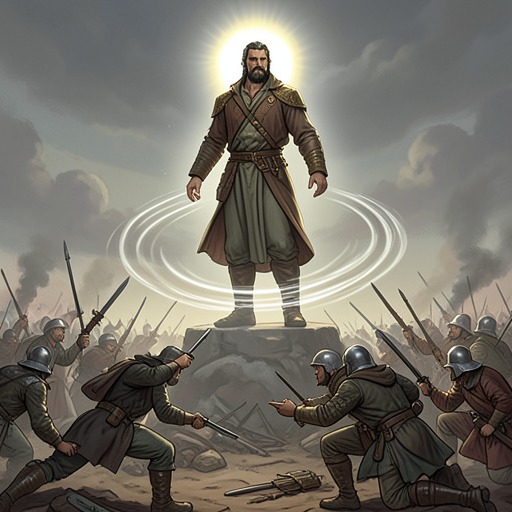
GunsoulAuthority is a cultivator’s soul and core made consequential in the physical world: at the Fifth Coil, the cultivator can project their core beyond the body, overwrite the world’s qi, and temporarily claim Authority over part of the Dao. Its significance is both metaphysical and practical. An Authority does not merely display a wielder’s power; it imposes that wielder’s particular self and chosen Path on the surrounding world, sometimes on a scale that reshapes a place or decides a battle.
The Fifth Coil and the Authority wall
A lesson Yuan recalled from a Stoneskin Elder describes the threshold: crossing the Fifth Coil requires a cultivator to expand their core outside the body and paint over the world with their soul. The feat is difficult and dangerous, approaching the divine, and grants only temporary Authority over a portion of the Dao. The language of painting captures the combination of personal will and environmental change: the cultivator’s inner core becomes an external force that alters the world’s qi.
This threshold also marks a difficult point in cultivation rather than an automatic reward for advancing through earlier Coils. Arc warns Yuan that he is approaching the Authority wall. A cultivator might blaze through the Coils beforehand, she explains, but crossing that wall can take years, if it happens at all; most Elders remain there for decades. Arc’s assessment of Yuan nevertheless changes over time: she comes to believe that, given effort and time, he could eventually create an Authority of his own. The prospect is therefore neither a routine next step nor beyond his reach.
The stages before that threshold involve their own transformation. As Yuan works toward the Fourth Coil, Arc explains that his body has become a base template, which must be customized to his chosen Path when he engraves an innate technique. That process is not itself the creation of an Authority, but it clarifies the broader principle behind one: cultivation develops a form that must ultimately become particular to its practitioner. Authority carries that individualization beyond the body and into the world.
A personal Path made physical
Authorities are unique because each represents both its user’s chosen Path and true self. Arc explains that they are physical manifestations of a cultivator’s core and will. The story also presents a theory that a Wayfinder’s cosmic influence may result from their Authority becoming part of the universe’s natural laws. This remains a theory, but it suggests how a temporary, personal claim on the Dao might have consequences beyond a single confrontation.
The Ammobog makes the idea of an Authority visible as a place. Yuan senses an Authority approaching and recognizes that the swamp is not merely terrain: it is the physical expression of someone’s soul, a Gunsoul’s core overwriting the universe. A landscape can therefore act as the outward form of an individual’s cultivation, rather than as a neutral setting around it.
Arc’s Headshot Forge offers another example, as well as a warning that an Authority’s visible state can be affected by conflict. Arc tells Yuan that she no longer controls her Authority and that the gunsmoke fog and muzzle-shaped mountain he sees are not the Forge’s natural state. She points to another cultivator’s Authority manifesting in the same place and asks what happens when two such manifestations overlap. The scene presents their coexistence not as a simple display of two powers, but as a contest between cores and wills that can change what the location becomes.
Manifestation, conflict, and misidentification
Not every constructed or altered space is an Authority. When Yuan examines an arena, he considers whether it might be one, then rejects the idea: it lacks the oppressive, awe-inspiring aura he associates with Arc’s Headshot Forge. He identifies it instead as a modified Barrier combined with a technique. This distinction matters because visual alteration alone does not establish an Authority; its relationship to a cultivator’s core and will is decisive.
The Authority associated with Czar Zoa shows how rapidly its manifestation can transform a scene. During the events at Battletown, neon and fire rings flicker out, and the gathered figures stop as the surroundings change. Yuan recognizes that an Authority is being used. The skull cloud then dissipates, exposing a smoking crater where Battletown stood. Arc identifies the atomic cloud as Czar Zoa’s Fukushima Paradise, describing it as a gift of death from the Nuclear Buddha. The Authority is thus not simply a personal emblem: its manifestation accompanies the city’s destruction and reveals the scale of the power confronting the survivors.
The example also connects Authority to the Nuclear Path without making all Authorities alike. Fukushima Paradise takes a nuclear form, while the Headshot Forge belongs to Arc and the Ammobog expresses a Gunsoul’s core. Their forms and effects differ because the power is bound to its individual wielder. In Battletown, the sudden disappearance of the rings and the devastation revealed beneath the skull cloud make the change legible through its consequences: an Authority has not merely entered the scene; the world around its target has been remade by force.
The Gun Path and the limits of power
Yuan learns that different Authorities can arise even among cultivators following the same Gun Path. Arc and Revolver both use Authorities, but each has chosen an interpretation suited to their skills and personality. Their wills are strong enough to overwrite the Dao itself. Revolver’s Authority even temporarily defeats the Gun, showing that the principle can matter in a struggle against a power that seems otherwise overwhelming. Shared allegiance to a Path does not produce identical manifestations; the practitioner’s individual interpretation remains central.
Revolver’s Authority also changes under the Gun’s influence. During the clash at Fleshmarket, it takes the form of a saloon. With the Gun present inside him, however, that space is corrupted into a concrete jail held by barrel-bars and trigger locks. Bloodstains mark the gray floor, and the cell carries the stench of a fresh grave. The transformation turns an Authority’s personalization into a site of conflict: its form reflects Revolver, but the Gun’s presence alters that expression into an image of confinement and death.
For Yuan, Authority is at once a distant cultivation threshold and a standard against which he learns to understand power. He can recognize its manifestations, distinguish one from a modified Barrier, and see how Arc and Revolver give different forms to the same broad Path. Yet Arc’s warning remains: understanding and earlier advancement do not guarantee that a cultivator can cross the Authority wall. The concept’s central tension lies there. Authority is the fullest external expression of an individual will, but attaining it demands a dangerous transformation that even experienced Elders may fail to complete.