Slavery in the Unmade World
GunsoulSlavery in the Unmade World is a system that makes vulnerable people available for sale, forced labor, bodily exploitation, and sacrifice. Its violence is visible in collars and auctions, but it also persists through respectable institutions and difficult medical choices. Against that order, the novel sets smaller acts of protection and a train community that offers security and basic necessities without making people themselves the price of survival.
Bodies made into property
The Human Pillar encountered by Yuan Guang embodies the system at its most explicit. Bound and gagged in a car trunk, the girl is no older than ten, gaunt and dirt-streaked, with an explosive slave collar locked around her neck. Her abnormal qi marks her not merely as a captive but as a resource prepared for use by others.
Human Pillars are specially prepared people whose bodies can strengthen a region’s qi flow, fuel feng shui rituals, suppress evil spirits, or serve as payment to supernatural entities. Amoral sects and warlocks pay high prices for them. The girl’s trafficking also explains why the Rad-Hag’s servants attacked the caravan: the spirit may have wanted to consume her for power, or to prevent someone from using her to cleanse the Thunderlands. Even the possibility of rescue is entangled with competing claims over what her body can provide.
Gayak recognizes the danger around the child and links it directly to the trade. A Human Pillar was expected to pass through town on the way to Furyland, but the sellers never arrived; the girl was meant to come from the east, as Yuan Guang had. Gayak uses this coincidence to pressure Yuan Guang, asking whether he wants to keep her safe and ensure that no one comes after her again. Protection therefore means more than getting her away from one captor: the market has created a continuing threat of pursuit and resale.
Battletown’s market and authority
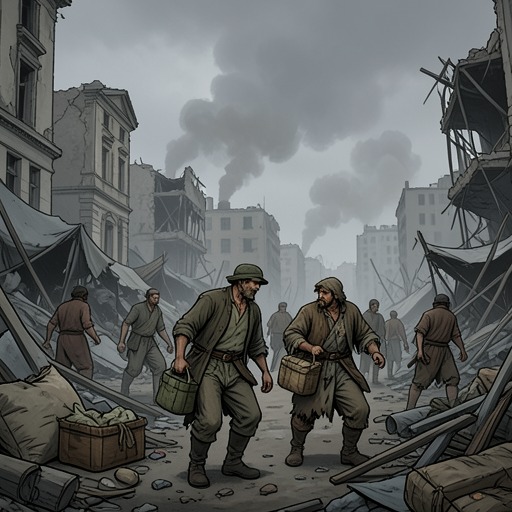
Battletown gives this economy a civic scale. Steel buildings do not conceal its foundations in suffering and exploitation: its streets are lined with taverns, gambling dens, brothels, drug shops, restaurants, and venues for violent spectacle. Screens show gladiatorial matches, while smaller games make enslaved people’s deaths into betting entertainment. Yuan Guang sees slaves thrown before a Firewheel as spectators wager on the order in which the monster will crush them.
The city’s order is coercive as well as commercial. Oni thugs and Yaoguai warriors bearing the Yinyang Khan’s insignia patrol the streets and respond to disturbances. Thieves may have their hands nailed to walls; many other criminals are enslaved and sent to die fighting spirit-beasts in arenas. The system thus converts both captured people and those punished by the authorities into disposable bodies, even as the patrols make Battletown feel safe in an oppressive way.
Near the docks, flesh auctions bring the wider trade into view. Yaoguai slavers from beyond the Oil Sea bid gold and pills on flesh-crafted workers advertised as among the finest available from the Fanged Coast. Yuan Guang sees Human Pillars younger than Holster being forced aboard a ship run by giant spiders. Their age makes the institution’s reach especially stark: childhood offers no protection from a market that classifies people by their usefulness and price. The sight leaves Yuan Guang struggling against the urge to destroy the city, though he restrains himself and keeps a low profile.
Medicine inside the system
Holster’s predicament shows how enslavement can persist even after a captive is out of immediate reach. Mordiggian offers Yuan Guang two alternatives for her: rebirth as a normal girl or a better reincarnation, both involving Mordiggian eating her first. Holster clings to Yuan Guang when he explains the options; having nearly been devoured by a Rad-Hag, she is not willing to accept another solution that begins with being eaten. Her reluctance is a response to what she has endured, not a failure to understand the proposed remedies.
Mordiggian says that only the Flesh Mansion Sect has the knowledge to repair a Human Pillar’s core without disabling it outright. He points Yuan Guang toward Jared LaChaire, a surgeon in Battletown who might operate for the right price. Jared explains why Holster’s age matters: a Human Pillar’s core accumulates qi while its bearer grows, raising instability and the risk of an explosion during surgery. Because Holster has not reached puberty, her chances of full recovery are good, but repairing the core is an Elder-level operation, especially if she is to survive it, and will cost heavily.
Jared’s own history reveals the proximity of treatment to exploitation. He came from a southern offshoot of the Flesh Mansion Sect devoted to crops and animal husbandry rather than human experimentation and slavery. Sent to Elder Polio to study fleshcrafting, he lasted less than a year before the misery and torture drove him away. He says he tried to provide medical assistance without creating Human Pillars, but Elder Polio pressed him to harvest organs from dying slaves or repair them so they could return to work. Jared left when he saw that an ultimatum was inevitable and has not touched the slave trade since. His clinic offers a possible route to Holster’s recovery, but his account makes clear that medical skill can be recruited to preserve a captive’s usefulness as readily as to heal.
Jared also remembers Revolver as a slave. Elder Polio’s hunters raided the man’s village and collared him; Jared never learned his true name. He recalls that the captive was already good at shooting people with a revolver, and that this ability supplied the nickname by which he was known. Yuan Guang is saddened that even someone who knew Revolver early in life cannot restore his name. The memory shows slavery stripping away identity as well as freedom: a skill useful to others survives in the record, while the person’s own name does not.
Alternatives to ownership
The novel contrasts these transactions with the arrangements aboard Orient’s train. Its passengers are promised reliable food and clean water, private spaces, and protection from wasteland threats—a better deal for Scraps than most sects provide. Ten bi-level sleeping cars divide their cabins between individual rooms and larger family spaces, with a shared washroom and shower. The accommodation is modest, but its stated terms are shelter and necessities rather than ownership of the passengers.
That distinction is not an abstract ideal detached from material life. Yuan Guang searches the train’s dining car for supplies while Holster rearranges its tables and chairs; the pantry has rotted, but the wine remains drinkable, the silver utensils can be sold, and the oven and grills still work. On another occasion, Mordiggian’s cut releases an extraordinary quantity of meat—sausages, kidneys, meatballs, and entrails—which his skin then stitches closed around. He presents a fruit to Yuan Guang and offers the produce of his labor. These scenes do not erase the slave economy, but they place food and bodily resources in a different relation: provision can support a group without requiring another person to be bought and consumed.
Mordiggian’s offer also draws people who want to begin again. Scraps without prospects, people traumatized by losses in the Fleshmarket Sect War, former Bullet Church cultists, and fugitives from karmic justice accept his offer, while Bucket does not. Yuan Guang observes that people who have lost everything may find it easy to restart from nothing, and connects that wish to Sky-Biter’s consumption of the Lost Age. Their choice is not equivalent to the coercion of a collared child or a slave auction, but it carries the same stark question of what a person must surrender to escape an unbearable life.
Transformation and agency
The story distinguishes enslavement from bodily change by attending to who controls the transformation. A Metallist preacher presents the body as a vehicle that can be improved and repaired, recounting how his diseased flesh was replaced with metal and his previously inactive core began to cycle. Yuan Guang recognizes similarities between that path and the Gun Path, but the resemblance does not make the conditions identical: the speech describes the preacher’s own account of transformation, whereas a Human Pillar’s body is prepared and traded for other people’s purposes.
Arc’s silver bullet-core offers a harsher image of bodily alteration. It has woven into and cannibalized her flesh, replacing her right shoulder and arm with barrels and cylinders and turning her hand into a sniper rifle. She warns Yuan Guang to abandon the Gun Path, and his later Third Coil changes likewise replace scar tissue with black metal, convert veins into conduits carrying liquid gunpowder, and make his muscles feel mechanical. By the time he awakens in his perfected Gun Demon Incarnation, his arms end in miniguns and cannons and his body no longer needs a human-shaped safety vessel. These transformations are not evidence that slavery has disappeared; they sharpen the difference between an altered body as a cultivator’s path and a captive body designated for labor, ritual, or sale. The institution’s defining violence is not change alone, but the denial of a person’s claim over what their body is for.