Gun God Incarnation
GunsoulGun God Incarnation is the Gun’s full transformation into a gigantic mechanical horror, a demigod of ultraviolence whose body embodies the firearm’s capacity for indiscriminate destruction. Its emergence escalates Yuan Guang’s struggle to free Revolver from the Gun’s curse into a battle against the Gun itself. Though Yuan meets this divine-scale form with his own Gun Demon Incarnation, the two states are distinct: the Gun becomes a monstrous engine of mass death, while Yuan transforms to fight it and reach the soul trapped within.
Identity and Context
The Gun God Incarnation belongs to the Gun, whose conflict with Yuan is bound up with Revolver’s transformation and the Gun’s recurring curse. The Gun speaks its transformation aloud after Yuan challenges its delight in violence. Each of its three words is punctuated by a trigger pull; then its body tears open and Hell bursts out. The declaration is therefore both an activation and a threshold: what had worn Revolver’s face gives way to something vast and unmistakably inhuman.
The appearance follows an already catastrophic attack on Fleshmarket. The Gun had announced its arrival with millions of qi-charged bullets falling like rain, while Yuan and Revolver sheltered beneath two layered Barriers. Later, Yuan blamed himself for arming the rival sects in hopes that they would destroy one another, and wondered whether his plan had helped draw the Gun there. He could not establish that it had, but the devastation gave his earlier calculation a terrible consequence to confront. This context makes the Gun’s manifestation more than a display of strength: it is the culmination of violence that Yuan had hoped to manipulate and could no longer control.
Transformation and Appearance
The Gun manifests in a parody of divine glory, accompanied by a Recoil Shockwave powerful enough to vaporize the building beneath it and sweep away a city block in dust and concrete. Yuan forms a Barrier against the blast and flying debris, but the transformation’s scale is plain even before the Gun attacks. It descends from the heavens as a steel nightmare at least twenty meters tall, dwarfing Yuan’s human-sized opponent and turning the battlefield into a confrontation between radically unequal bodies.
Its mechanical anatomy makes its purpose legible as weaponry. Armored legs hang beneath a trigger-shaped chest, whose hungry maw is lined with serrated artillery-shell teeth. One arm ends in a clawed metal gauntlet; the other carries a cannon as long as Orient’s locomotive. Smoking rifle barrels jut from its back like twisted wings. Its faceless helm, ringed with sharp golden spikes, resembles a crown of thorns, but no trace of Revolver’s former face remains. Above it floats a halo of black smoke reflecting countless screaming visages and skulls. Yuan recognizes among them Yinyang Khan, Gayak, Slash, and other victims of firearms. The halo makes the Gun’s present violence inseparable from its accumulated history: the monster carries the dead as its witnesses and its chorus.
Firepower and the Battle
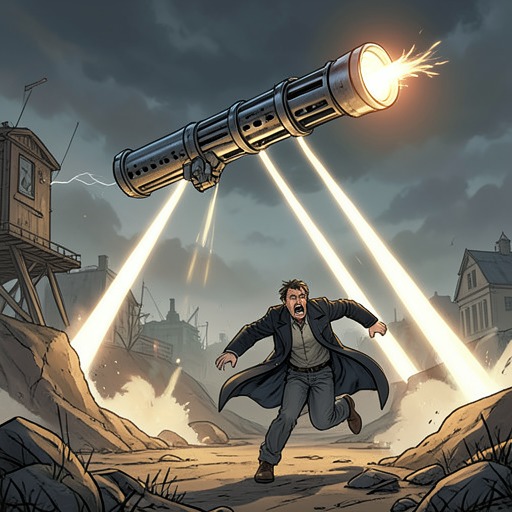
The Gun’s cannon attack demonstrates how little the enormous transformation needs to rely on close combat. It fires a projectile the size of a house, which strikes distant mountains and shatters them in a flash. It reloads quickly and fires again and again. Each shot creates district-sized craters and towering smoke plumes; the heat turns sand to glass and sets the Unmade World ablaze. The destruction is immense even when the Gun’s attacks are poorly suited to hitting a small, fast-moving target.
That mismatch shapes Yuan’s response. He circles the Gun at extreme speed, firing volleys when he can but prioritizing movement because he cannot afford to slow down. The Gun continues charging its cannon, reveling in destruction rather than adjusting its attacks to its evasive opponent. Yuan uses the repeated volleys to observe how its qi moves, applying the kind of close attention that had helped him locate Gatling Man’s core. The barrage is thus not only an assault to survive; it gives Yuan information about the opponent he must overcome. The Gun’s overwhelming size and firepower force him into a strategy based on speed, observation, and endurance rather than a contest of scale.
Yuan’s Counter-Transformation
Yuan does not answer the Gun God Incarnation by trying to imitate its proportions. His purpose is to drag Revolver’s soul out of the monster. He activates his own sutra-circuit and calls upon Gun Demon Incarnation: his revolver merges into his metal flesh, his limbs become weapons, his face becomes a gun, and thrusters give him flight. The contrast is sharp. The Gun is a towering, artillery-laden figure; Yuan is hardly larger than a toy beside it, yet refuses to let that disparity deter him. The ensuing clash is framed as a demon shooting a god, but Yuan’s stated objective is rescue as well as combat.
The cannon remains lethal throughout the encounter. The Gun fires again as Yuan flies around the city, and its later shots continue to devastate the landscape. Yuan keeps moving and studies the flow of its qi, turning survival into a means of finding an opening. The scene therefore distinguishes the Gun’s vast capacity to destroy from Yuan’s more focused use of transformation: the Gun’s power serves its appetite for violence, while Yuan’s form is directed toward reaching Revolver and ending the curse’s hold over him.
Significance and Outcome
Gun God Incarnation gives the Gun’s inherited violence a spectacular physical form. Its divine parody, weapon-built body, and halo of firearm victims make it at once a combatant and a monument to deaths accumulated across the story. The state also sharpens the contrast between destruction at scale and the personal obligation that keeps Yuan fighting. He has seen Revolver struggle against the bloodlust overcoming him, knows that Revolver saved his life, and refuses to abandon him to the curse.
The Gun God Incarnation is not the form Yuan ultimately claims. After the conflict, Revolver senses the Gun within Yuan but describes it as quelled; Yuan answers that the Gun is part of him, yet that he is greater now, and names himself the Gunman. The final distinction clarifies the significance of this state: the Gun’s incarnation externalizes the curse as an immense engine of slaughter, whereas Yuan’s eventual mastery means the Gun no longer defines him outright. Its manifestation is the terrifying peak of the confrontation, not the form in which Yuan ends it.