The Village’s Declining Population
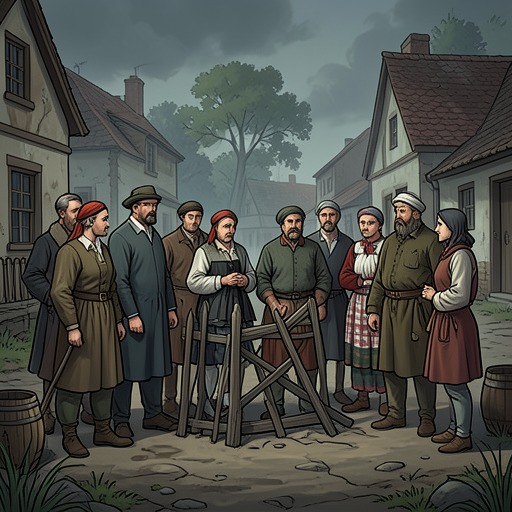
HarvestThe Village’s Declining Population is a gradual loss of people and working capacity that weakens the community’s ability to sustain its shared life. The village is small and getting smaller: its residents are aging, few children seem likely to inherit their place, and poor harvests make each remaining worker more necessary. This contraction is not only a matter of numbers. It changes how work is shared, how neighbors imagine their future, and how they regard newcomers who might otherwise replenish the community.
Scale and Causes
The decline is apparent in the account of a harvest observed and counted by Philip Earle, who is marking the land at Charles Kent’s request. When he turns from measuring fields to counting the people, the total reaches fifty-eight. The figure gives a precise measure of a settlement whose residents had already sensed its smallness: their village is remote, and, as Walter Thirsk observes, it is getting smaller. The count makes visible what the daily pressures of work had already revealed.
The contraction has accumulated over years rather than arriving as one sudden calamity. Walter describes the loss of good friends without a corresponding success in raising sturdy successors. The residents are growing old and faltering, while harvests have become niggardly. In winter, there are days when the cattle eat and the people do not. Scarcity therefore compounds demographic decline: a smaller, older community must sustain itself from a less dependable yield, leaving little margin when either labor or food runs short.
Labor Under Pressure
The harvest shows what fewer residents means in practice. The crop is poor in the lower, shaded ground and on neglected, stony slopes, and the higher barley field must be gathered if the grain is to last through the year. Because the village’s numbers have been reduced, every useful person is expected to work. Children go ahead to clear weeds; the strongest workers cut the stalks; women and girls bind sheaves; and older men build the stooks. The work is organized across ages and abilities, but its success depends on nearly everyone being present.
Harvest labor also makes the community visible to itself. Neighbors work together within common ditches, sharing the same field and the same hopes for the crop. Their jokes and gossip belong to that collective effort, as do their silences when anxiety about the land’s future takes hold. In an expanding settlement, a missed worker might be less consequential; here, the reduced population means that the absence of even one useful person is felt as a practical loss. Collective labor remains a source of solidarity, but dwindling numbers make that solidarity harder to maintain.
Empty Homes and Close Kinship
The village’s demographic weakness can be read in its houses as well as its fields. Walter surveys dwellings that have become makeshift byres or ruins: a cottage beside the Carrs’ home is overgrown and deserted, a widow’s garden is no longer tended, and the tenement where Cecily was raised has become rubble. These places are not simply remnants of an earlier village. They show how lives and households have disappeared without being replaced, leaving usable space amid a settlement short of people.
The remaining residents are bound together through an unusually dense web of kinship. One family’s daughter may be another’s niece, aunt, or daughter-in-law; many villagers belong to the same few family networks. Walter likens the community to a rookery and a cousinry, where people have begun to resemble one another in appearance and manner. This closeness can sustain mutual familiarity, but it also reinforces the boundary between those who belong by birth or marriage and those who do not. The village’s small population does not automatically make it welcoming: its kinship structure helps explain why a newcomer may remain an outsider even after living among the residents.
Newcomers and the Contradiction of Scarcity
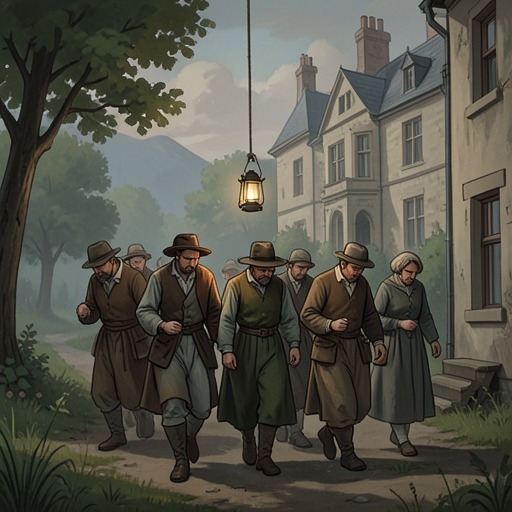
That boundary is especially visible when newcomers arrive. Walter recognizes that the settlement has tenancy to spare and that additional working hands could be valuable, particularly because his injured left hand will be of little use and the village lacks younger men and women. Empty dwellings and labor shortages make a practical case for receiving people. Yet his neighbors, worn down by scarcity and distrustful of those arriving from outside, fear that strangers will take resources or bring danger. Their caution grows from material vulnerability, but it risks refusing the very help their declining numbers demand.
Walter is implicated in that contradiction. He arrived as Charles Kent’s manservant and counts himself among the outsiders who have made a home in the village. Over time, he has become part of its local habits and has learned to share its suspicion, even while remembering other places and recognizing how difficult the village is for strangers to enter. His position gives the population decline a personal dimension: the community needs new people, but belonging is guarded by customs of kinship and familiarity that are difficult for newcomers to satisfy.
Consequences for the Village’s Future
The village’s shrinking population also narrows its ability to preserve customary routines. Its annual harvest and boundary practices depend on coordinated participation, local knowledge, and enough hands to divide work and resources. During the bounds walk, Walter anticipates the ordinary complaints households will bring about shares of common grazing, geese, compost heaps, and the timing of field labor. Such negotiations presume a continuing community whose needs can be balanced through familiar practices. Declining numbers do not erase those customs, but they make the work of maintaining them more precarious.
The same shortage of people makes the proposed change from grain-growing to sheep-raising consequential. Charles Kent presents wool as a more predictable source of wealth than crops exposed to bad weather, while the villagers’ current system depends on strenuous seasonal labor and an uncertain harvest. Wool may appear to answer the insecurity of subsistence, but the contrast also reveals how little resilience the village has left: fewer people must perform the work, and the crop cannot be relied upon. The planned change is therefore not just a new use of land; it threatens to reorganize the means by which this small population lives.
The population decline remains a gradual pressure rather than a single defining incident. Its force appears in the tally of fifty-eight, the empty cottages, the aging workforce, the poor harvests, and the anxious debate over whether newcomers should be admitted. Together, these details show a community caught between the need to preserve its inherited bonds and the need for people who can help sustain it. The village’s contraction makes both its mutual dependence and its defensiveness more visible.