The village’s abandonment
HarvestThe village’s abandonment is both an escape from impending retaliation and the breaking apart of a community whose work, food, and identity have been bound to the same fields. After villagers attack Jordan’s Groom, families leave rather than wait for the estate’s authorities to answer the violence. Their departure gathers momentum throughout the afternoon until the cottages are emptied; later, fires consume homes and working buildings. Walter Thirsk remains to witness the loss of the neighbors and shared life that once made the village intelligible to him, then faces a quiet landscape in which crops continue to grow without the people who tended them.
A community rooted in work and place
Before the exodus, the village’s collective life is visible in the harvest. The barley crop is uneven: plants on shaded, stony ground are weak, while the higher field promises a better yield. That difference matters in a community where grain must last through the year. Harvesting is not simply a task assigned to isolated households. Children clear weeds, stronger workers cut the stalks, women bind sheaves, and older men make stooks. The customary division of the crop reserves most sheaves for the commons and leaves a smaller portion for gleaning. Shared labor makes the fields a meeting place as well as a source of food: neighbors work within common boundaries, exchange gossip, and respond together to weather and wildlife.
Walter’s memory of arriving in the countryside shows how this attachment develops. At first, he sees beauty in the flowers and plants around The Bottom, while established neighbors judge them by their practical uses, including food for pigs or remedies. After finding Cecily and taking up husbandry, he learns that the land demands attention rather than contemplation alone. Its seasons leave no dependable pause for reverie: survival requires sustained work against hunger. The contrast between Walter’s early delight and his later knowledge gives the village’s departure more than a material cost. Families are leaving a place whose difficult demands have also shaped their habits, skills, and sense of belonging.
That established life is already under pressure from Charles Kent’s proposal to replace cultivation with sheep farming. At a feast, he presents wool as a more dependable source of prosperity than crops exposed to bad weather, disease, and other risks. His promised future depicts villagers tending flocks, shearing sheep, and making cloth rather than plowing and reaping. Walter recognizes the change concealed by this attractive prospect: the sheaf is giving way to sheep. The proposal makes the land itself a point of conflict, since a shift in its use would displace the shared agricultural routine on which village life depends. The later flight therefore takes place amid both immediate danger and an uncertain future for the community’s customary livelihood.
The attack and the decision to leave
The immediate crisis follows the assault on Jordan’s Groom. Once the groom has been attacked, villagers understand that the conflict has crossed into a more dangerous register: estate authorities may now seek punishment, and the community cannot assume that its customary limits will protect it. The Carrs and Saxtons leave first. Their families have particular reason to fear consequences because their members inflicted much of the harm. John Carr and his wife, Emma, also depart, joining his brother’s family. John leaves carrying bundles and the burden of separation from the life he has built in the village; his family has made peace with Walter before going, but their departure does not resolve the danger facing Lizzie Carr, who remains behind.
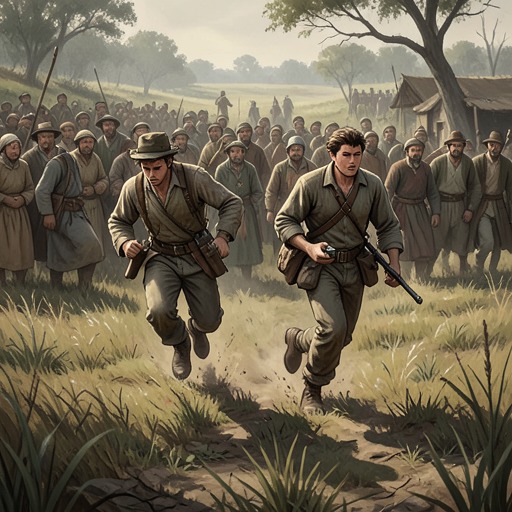
The Higgs and Derby families follow. Their sons have already gone ahead, so the parents set out to reunite with them. Four men carry old mother Derby on a winnowing screen adapted as a litter, along with the family’s luggage and clothes. Their departure is careful and practical rather than ceremonially final: they judge it safer to leave before the threatened response arrives. Other families hesitate, weighing unfinished work, hens, stored barley, ancestral ties, and the loss of fields against the risk of staying. Some have worked this land across generations and cannot treat departure as a light choice. Yet they recognize that property and harvest cannot compensate for a life lost or a future spent imprisoned. The departures swell until everyone Walter has known in the cottages accepts that distance from the estate’s men offers the safer course.
Leaving brings grief, but it also produces an unexpected release. Some younger villagers set out with relief and hope, facing a future they cannot predict rather than remaining within a danger they can. Families use the broad lane so they can bring animals and possessions: cows, goats, poultry, carts, and barrows. The Kips manage to harness an ox to a hay wagon and carry much of what they own, including cordial and gleaning sacks. They take their names with them as well as their belongings, carrying the village’s social identity beyond its familiar paths and boundaries. What appears from within the cottages as a sudden dispersal is thus also a mass attempt to preserve family life and the means of starting again elsewhere.
Emptiness, fire, and the remaining landscape
After the departures, Walter counts those still within the village and finds that almost no one who belongs to its customary community remains. His reckoning includes four men from Jordan’s party, Charles Kent and his dissenting cousin, and Walter himself; the man confined at the pillory has no roof. Kitty Gosse, Anne Rogers, and Lizzie Carr may still be alive, but the people who have stayed are not, in the main, those born and rooted there. A missing couple further marks the disorder. The count turns abandonment into something concrete: not merely a thinning of the population, but the loss of the village’s ordinary network of families and neighbors.
Walter’s subsequent work in the barley field preserves a small counter-image to that emptiness. He and Mistress Beldam’s husband take the plow and oxen across the stubble, using a tapered oak beyond the hedgerow as their line. The whole field would normally require twelve days, four oxen, and twenty men; the two men intend only a single length down and back, a narrow furrow rather than a completed plowing. The modest scale matters. It does not restore the village’s workforce or undo the departures, but it makes a mark in the soil and leaves a task that reaches beyond the immediate crisis. The abandoned community is not represented as a landscape without human consequence: the furrow records labor even as the workers around it have scattered.
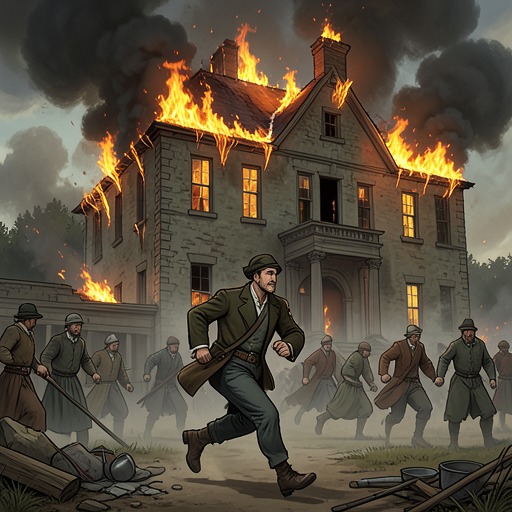
Fire makes the rupture more visible. From the turret, Walter sees smoke on the tool barn and whitehouse, then smoke rising from cottages, including the home of Anne Rogers and the house of Kitty Gosse; flames spread through buildings as the fires take hold. The Beldams are visible with a cart and oxen, carrying goods taken from village homes and the manor house, among them furnishings and parts of the plow used in the field. The burning thus follows the exodus but intensifies its effects: the homes and equipment that might have supported a return are being lost, and the remnants of village life are being carried away or consumed.
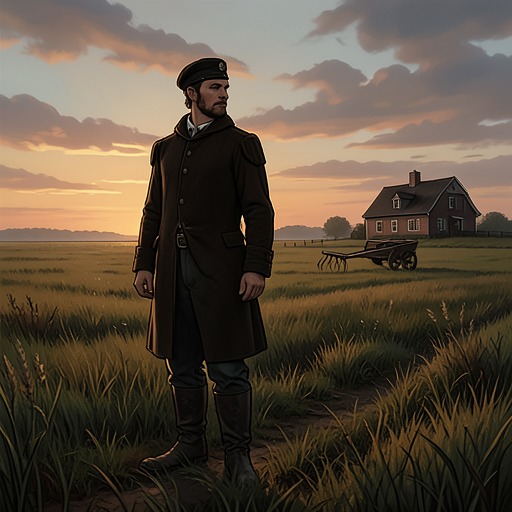
At his final look inward, Walter sees a silent village, without the familiar clatter of tools or sounds of animals. The manor house has stopped cracking, though smoke still hangs above blackened roofs and trees. In the fields, winter wheat is swelling, and the furrow cut into the former barley ground will soon show green. That growth does not cancel the abandonment: the earth and seeds continue their work without witnesses, while the cultivated place that held a community becomes quiet. The ending leaves the village’s future unresolved, suspended between destruction and the persistence of what was planted.