The captivity of Kitty Gosse, Anne Rogers, and Lizzie Carr
HarvestThe captivity of Kitty Gosse, Anne Rogers, and Lizzie Carr turns an accusation of witchcraft into a means of controlling the village: the three are held and questioned by Young Edmund Jordan’s agents, while their answers are shaped by the threat of continued punishment and then used to build a case against Philip Earle. Their planned release is conditional, bound to the estate’s future and to Charles Kent’s promise to stay behind.
Detention and the Village Crisis
The three are in Young Edmund Jordan’s custody as the village fractures around them. When Walter Thirsk first reports their detention, Kitty Gosse and Anne Rogers are said to be held with Lizzie Carr, who is singled out as a child and as the Gleaning Queen. Their absence becomes part of a broader crisis: villagers debate how to respond, some leave, and suspicion gathers around Mistress Beldam. These circumstances place the women’s captivity inside a struggle over who can define the village’s disorder and decide what it means.
The account of what happened in custody is not a direct record. Walter learns of it from Charles Kent, who was himself prevented from intervening. Young Edmund Jordan’s groom was stationed at Charles’s door to keep him in his room, and Charles heard the questioning and disturbances from inside the house. Walter therefore reconstructs events from what Charles says he heard, distinguishing the reported proceedings from anything he personally witnessed.
Interrogation and Accusations
Charles reports that the women endured a night of punishment before the villagers had even begun to consider marching on the manor house. According to his account, Kitty confessed to the accusations Young Edmund Jordan wanted established. The interrogators treated physical features on her body as supposed evidence of witchcraft and questioned her more fiercely. Walter understands the proceedings as coercive, but his description remains an inference from Charles’s report rather than eyewitness testimony.
Kitty’s answers broadened the accusation beyond herself. She insisted, according to Charles, that neither she, Anne, nor Lizzie had led the alleged activities; the women were only followers. Pressed to identify others, Kitty and Anne named several villagers, including John Carr. Walter notices that his own name was not among the names he heard reported and wonders whether Kitty had deliberately spared him, though he recognizes that this may be wishful thinking. The account gives no basis for treating the resulting list as a reliable or voluntary statement: it was produced after prolonged questioning, when the two women were exhausted and cooperating under pressure.
When the interrogators asked who was most responsible, Anne identified a gentleman. Charles heard her indicate Philip Earle without needing to say his name. The agents then presented their questioning to Young Edmund Jordan and his steward as having uncovered a witchcraft conspiracy. Their report transformed the women’s pressured accusations into an apparent finding, despite the absence of an independent account or a formal record of the villagers’ names.
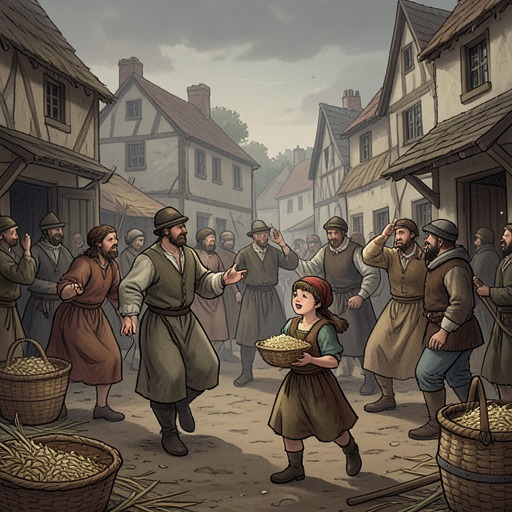
Lizzie’s questioning supplied the corroboration the agents wanted. Brought before the men after being tied for the afternoon, she was promised that she could keep her green sash if she proved herself a wise and honest child. She then accused Philip Earle of making her Gleaning Queen and attempting unwelcome contact. Young Edmund Jordan’s party treated this as confirmation of the women’s allegations. The episode turns a village custom that had once publicly honored Lizzie into material for an interrogation, with her sash functioning as both a reminder of that earlier ceremony and a bargaining instrument in custody.
Conditional Release and Departure
Charles Kent negotiated for the captives’ release by agreeing to remain and watch over the estate until the sheep took possession of the land. Young Edmund Jordan accepted this arrangement but barred the Rogers, Gosse, and Carr families from his estate. Under the agreement, Kitty, Anne, and Lizzie were to be escorted away in custody and freed only when they reached a marketplace three days away. Charles intended to accompany them and witness their release. The evidence records the agreement and their departure from the manor, not their eventual arrival at the marketplace, so the promised freedom remains an announced outcome rather than a witnessed one.
The exchange makes Charles’s continued presence the price of the women’s release. He is to stay behind as the estate moves toward sheep pasture, while they are removed from the land and denied permission to return. Walter understands that he, too, is part of the bargain: Charles’s intervention has made him a kind of ransom price. The resolution thus does not restore the village or undo the accusations; it separates the captives from the estate while tying Charles to the land Young Edmund Jordan is preparing to change.
The Captives at the Manor Door
When the prisoners emerge, they are bound at the wrists and waist. Walter sees Kitty, then Anne and Lizzie, but remains in the shade rather than crossing the yard to comfort them. He knows they may soon be freed elsewhere through Charles’s intervention, yet he is too shocked by their altered appearance to approach. Lizzie still wears the green sash, now dirty and torn. Walter recalls the earlier Gleaning Day when her father and John Carr had lifted her so she could begin gathering grain and become Queen for a year. The contrast is stark: the sash that once marked communal recognition now accompanies her as a captive.
Anne and Kitty leave alongside a child whose family and village ties are being broken by the departure. Walter notes that Anne cannot know that her son has gone with the other Rogerses, and that he is the only neighbor present as the prisoners are led out. Their captivity therefore ends in the evidence not with a return to ordinary village life, but with a forced journey away from it. The promised release in another town may end their immediate confinement; the exclusion imposed by Young Edmund Jordan leaves their place in the community unresolved.