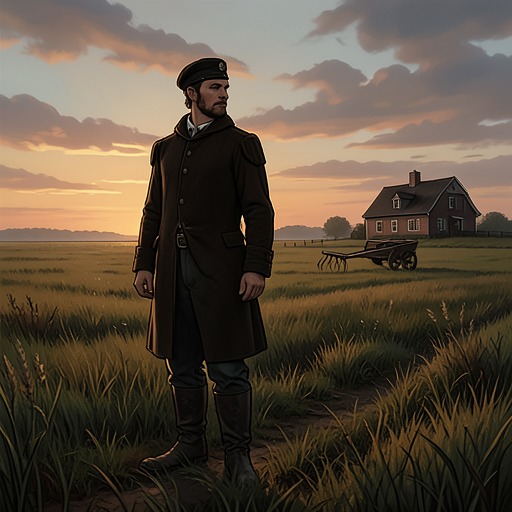
Walter Thirsk’s Widowhood
HarvestWalter Thirsk’s widowhood is not simply a biographical loss but a change in the meaning of work, home, and intimacy. After Cecily dies of fever, the countryside that he chose with her remains his daily world, yet no longer feels fully like home; labor continues, but the love that once animated it is gone. His memories of his wife become a measure against which later desire is felt, judged, and sometimes resisted.
Identity and Background
Before settling in the village, Walter Thirsk served Charles Kent, whose family had employed Walter’s parents. The two men were nearly the same age and had grown up together in Charles Kent’s father’s yards; Charles Kent shared books with him and allowed him to learn reading, writing, and arithmetic. Walter became Charles Kent’s serving man while both were young, and was the only person Charles Kent brought when he took charge of the estates and married Lucy Kent.
Walter’s departure from direct service followed his meeting Cecily. He told Charles Kent that he loved her and the earth of the village; Charles Kent’s answer was that Walter should go and plow it. Walter then made a life with Cecily through work beside her in the fields. Their marriage joined affection to husbandry: his labor was not merely what village survival demanded but a way of loving her and making a future together.
Loss and the Changed Meaning of Home
Cecily’s death from fever breaks that union between affection and labor. Walter describes the fever as a midnight thief, severe and sudden in its taking. Although he has a portion and a place, twelve years in the village have not made him feel entirely at home. Without Cecily, he says, he has not truly had a home; his work, once an act of love, has become dutiful.
His sense of belonging is also complicated by the villagers’ rootedness. Families such as the Rogers, the Derbys, and the Higgs seem woven into the place, whereas Walter considers himself a visitor who stayed. His earlier arrival had been full of discovery: he touched the trees at the forest’s edge, studied ants, and saw the land as a treasury. The loss of Cecily changes the emotional force of that landscape. The fields remain fertile and demanding, but they no longer hold the future he once imagined building with her.
The distinction between beauty and necessity sharpens with experience. On his first visit to The Bottom, Walter was captivated by cowslips, celandines, irises, and young leaves before the place’s bodily discomforts and hard uses became apparent. Once he joined village life and learned what the plants and ground were for, the land’s demands displaced the leisure of contemplation. It required work from dawn to dusk and offered no season set aside for reflection. This practical knowledge does not erase his early wonder; rather, it places that wonder alongside the exhaustion and subsistence that now shape his days.
Work, Community, and the Lost Partnership
The village’s agricultural routines continue to bind its people together, even as they make visible what Walter has lost. In harvest, children clear weeds and thistles, workers cut the barley, women bind sheaves, and older men build the stooks. The work is collective and necessary: a reduced population leaves no useful person free to stay away, and the harvest must provide grain for the year. Walter belongs to this common labor, but its companionship cannot restore the particular partnership that made his own work meaningful.
Harvest also briefly makes room for shared pleasure. Neighbors gossip and tease while cutting, and the clatter of tools and the gathering of familiar faces create a kind of openness that ordinary toil does not. Yet this communal rhythm is not proof that labor has become easy or secure. The barley yield can be poor, and shaded, stony ground produces weak crops. The workers’ sociability takes place inside their effort to defend themselves against hunger, not outside it.
Charles Kent’s proposed shift from crops to sheep makes that vulnerability newly consequential. He presents wool as less dependent on sun, rain, and seasonal uncertainty, promising shepherding, shearing, and household weaving in place of plowing and reaping. To the villagers, the vision is offered after a feast of veal and ale, when they are fed and inclined to trust their master. Walter recognizes the concealed exchange: the sheaf is giving way to sheep. For a widower whose labor has already lost its intimate purpose, this projected transformation also threatens the forms of work and collective life through which he still belongs to the land.
Intimacy After Cecily
Walter’s relationship with Kitty Gosse reveals the limits of replacing the lost marriage. Their encounters are secret and recurrent: sometimes Walter goes to Kitty’s door, and sometimes she comes to his, using the pretext of borrowing candle or grease. He regards this as a mutual transgression rather than a one-sided pursuit, but does not describe them as friends. Their physical relationship coexists with low mutual regard and sharply different assessments of one another.
The contrast with Cecily is most palpable in Walter’s bed. He remembers that Cecily shared his life for more than eleven years and left hollows in the mattress where her shoulders and hips had rested. In moments of melancholy, he reaches across the bed and finds comfort in those impressions, which hold the memory of both her sleeping and her dying. The bed remains a material trace of a shared life, not merely a setting for grief.
Walter describes his feelings for Kitty as physical, and her manner of touch differs in his recollection from Cecily’s tenderness. That difference does not make Kitty simply a substitute: Walter recognizes her appetite and the intensity of their coupling, even as he feels shame about the arrangement. His widowhood therefore persists within intimacy itself. The new relationship can answer bodily desire, but it does not reproduce the emotional history, companionship, or sense of home attached to Cecily.
Memory, Desire, and Continuing Attachment
Walter’s later attraction to Mistress Beldam further shows that bereavement has not made him incapable of desire, but neither has it dissolved his attachment to Cecily. He distinguishes Cecily’s comforting, hopeful presence from the unsettling force of his first sight of Mistress Beldam. Approaching the place where he expects to find her, he feels fearlessness followed by fear and recognizes that his long widowhood has left him vulnerable to this new fascination. His response is charged with longing, but remains uneasy and self-questioning rather than a declared new commitment.
Cecily’s memory also reaches back to the beginning of Walter’s life in the village. He recalls first encountering the commons and then seeing in Cecily the chance to build a future there; he courted her by working beside her and attending to her soil. In that recollection, physical effort and affection are inseparable. The later Walter still works the land, but knows that duty is not the same as love. Widowhood thus names both an enduring absence and a continuing attachment: Cecily is gone, while the remembered marriage remains the standard by which Walter understands home, labor, and the desire that survives her.