The Village’s Churchless Religious Life
HarvestThe Village’s Churchless Religious Life takes shape without a church building or resident priest. Its sacred center is an oak village cross at the unfinished church site, where Charles Kent conducts marriages and baptisms, commemorates the dead, and blesses seed and plow. The villagers describe their religious life as independent rather than irreligious: worship is woven into the work, losses, and seasonal customs they share, even as their account of the land leaves little room for the belief that divine care will do their labor for them.
An Unbuilt Church and an Independent Faith
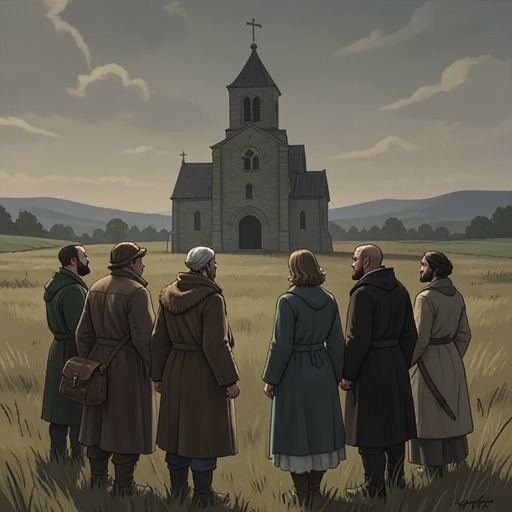
The plot set aside for a church remains largely unfinished. It holds many graves, a pile of stones intended for construction, and a flat foundation block hidden beneath bracken and weeds; no one has dug a building trench, chosen the flint for the walls, or mixed mortar. The nearest steeple is a lengthy day’s journey away, and The Village cannot afford to support a priest. Its people therefore remain at a distance from formal church life without declaring themselves outside the Kingdom of God. Their faith is present, but not organized around a nearby institution or regular clerical authority.
That distance has a material and theological dimension. The villagers work among animals and crops, and their account of farming emphasizes how much depends on their own exertion. They do not expect the Lord to plant barley, lighten the plow, or spare the fields the weeds and pests that make cultivation difficult. Nature is not a gentle provision: crops can be weak, harvests uncertain, and the land demanding. The villagers’ religious independence grows alongside this knowledge. They acknowledge Heaven, Hell, and sin, but do not make frequent reminders of them the center of daily life.
The Cross as Village Institution
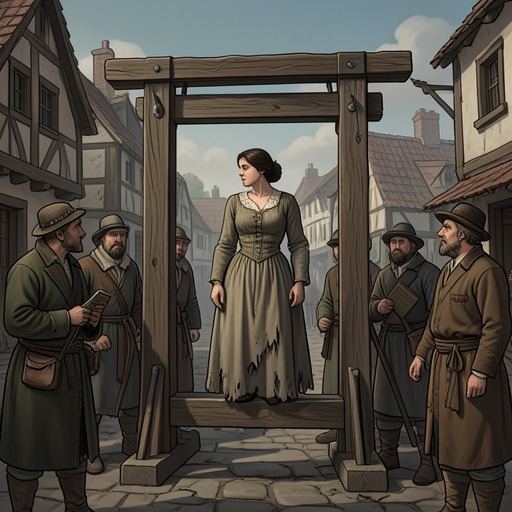
The Village’s wooden cross stands at the gateway of The Unbuilt Church Ground. Taller than a man, it is built from oak, with hinged crossboards wide enough to hold two prisoners. The openings for necks and wrists recall its punitive use, but the villagers have also found gentler purposes for them: rosaries and flower chains can hang where restraints might otherwise have been fitted. The same structure thus holds punishment and devotion in close proximity, without either use erasing the other.
Charles Kent makes the cross a focus of communal rites. He conducts marriages and baptisms there, delivers eulogies, and comforts the bereaved. Walter Thirsk’s wife, Cecily, and Charles Kent’s wife were both commemorated at this spot. The cross also serves the agricultural calendar: villagers gather to consecrate seed corn, give thanks for the harvest, and bless the plow. In the absence of a church building, the cross is not merely a substitute altar. It is a shared place where family loss, public recognition, and the conditions of subsistence meet.
Its double character is made sharper by its identity as the Village Pillory. The villagers remember that it once held offenders, but in more recent years it has served as their village cross. The structure’s capacity to punish remains visible even when it is used for prayer and ceremony. Their local religious life therefore occupies no separate, protected sacred precinct; it makes meaning at a place already marked by the community’s authority to discipline.
Harvest as Communal and Ritual Work
The agricultural year supplies both the villagers’ livelihood and many of their shared observances. At harvest, people across The Village take part: children clear weeds, stronger workers swing sickles and scythes, women bind sheaves, and older men set the cut grain in stooks. The work is demanding, but its common performance makes it an occasion for sociability as well as necessity. Grain is gathered through coordinated labor, and the villagers’ customary division of the crop reserves a share for the commons and another for gleaning.
The Gleaning Queen custom gives the transition from harvest to gleaning a ceremonial form. When the dance that should have preceded Gleaning Day ends before a queen is chosen, the omission unsettles the villagers; they regard it as a possible source of bad luck. The next morning, the girls dress in borrowed ribbons and flowers, and Charles Kent arrives in bright ribbons with Philip Earle. The selection falls on Lizzie Carr, a child not yet five. Her father and uncle carry her toward the field, and Charles Kent helps her remove her slippers and take the first steps barefoot. She finds an intact ear of barley, separates out the grain, and displays it in her palm as the villagers cheer. The rite makes the harvest’s abstract promise of bread and drink visible in a child’s hand, while affirming that gleaning belongs to the community’s seasonal order.
The ceremony’s meaning is inseparable from practical distribution. Charles Kent tells the villagers they may keep what they glean for their own kitchens, while describing the successive use of the stubble by cattle, geese, and hogs. A blessing of the plow and the public opening of the field for gleaning do not stand apart from food production; they give collective recognition to the labor, access, and expectations on which it depends.
Ritual, Disruption, and the Limits of Consolation
Music and dancing can briefly draw the villagers into a heightened sense of common life. At a harvest gathering, Philip Earle joins the piper with his fiddle, and the music carries children and adults onto the barn floor. The dancing approaches the communal pattern of a rite, gathering different ages and households into a shared celebration. Yet the arrival of Mistress Beldam interrupts the revelry. For a moment the villagers imagine welcoming her as their Gleaning Queen and restoring the village cross to holiness, but she withdraws into the dark. The music does not resume. The imagined reconciliation remains unrealized, and the gathering ends in embarrassed silence.
That failed welcome exposes the limits of ritual as repair. The villagers can use their ceremonies to reaffirm belonging, honor the dead, and bind subsistence to a calendar, but ceremony cannot by itself undo harm or restore trust. Their religious life is neither a finished institution nor a promise that suffering will be lifted. It is a set of shared practices maintained at an unfinished church site and through the work of the fields: local, material, and vulnerable to the very conflicts it seeks to hold within a common order.