Enclosure of the commons
HarvestEnclosure of the commons is the threatened transformation of The Village from a community sustained by shared fields and seasonal farming into a privately bounded sheep estate. The change is more than a new use for the soil: it would replace customary access, collective labor, and food-sharing with a commercial system whose land and decisions belong to Edmund Jordan. The narrative follows enclosure from rumor and persuasive promise to an announced program of fences and sheep, while leaving its future unsettled in the furrow cut back into the barley field.
The Commons and Its Working Customs
The threatened commons is not unused land waiting to become productive. The Village depends on a mixed livelihood: barley and other crops, livestock, wood, peat, reeds, and shared access to land and its produce. In a difficult summer, the difference between a successful harvest and a lean one is material. The stony, shaded ground yields little, while the higher barley field is watched as a prospect of winter ale and porridge. Harvest Labor Custom draws the community together to bring that crop in: children weed, stronger workers reap, women bind sheaves, and older people make the stooks. The labor is exhausting, but the harvest is also a public occasion in which neighbors work and talk within common boundaries.
Customary Common Rights make the harvest more than a private transaction between landlord and laborer. The community apportions produce for common use, while Gleaning Rights allow villagers to gather grain left in the field. The custom that ten sheaves go to the commons for every one reserved for gleaning expresses a practical balance between collective stores and household need. After gleaning, Charles Kent describes the order in which cattle, geese, and hogs will use the stubble; the field is also meant to be plowed for winter wheat. These uses are interdependent and seasonal. A field provides grain, gleanings, grazing, and the next crop, rather than a single commodity.
The land is governed socially as well as worked physically. Each spring, Walter Thirsk leads the beating of the bounds, a communal walk that renews knowledge of where the village belongs and what its members may use. The walk also makes room for moderate airing of disputes: who needs more common grazing, where household waste should be laid, and which land should be kept for peat, reeds, or fuel. The practice joins boundaries to obligations and local knowledge. Enclosure threatens not simply open space but the web of work, access, and negotiation that makes the landscape habitable.
From Rumor to a Persuasive Dream
Philip Earle’s measuring and chart-making first unsettle the villagers because his work seems to turn inhabited ground into a countable object. He measures the fallow field and later the people themselves, numbering The Village at fifty-eight. His charts represent land in lines and colored divisions, while the villagers fear that the measurements are preparation for a sale or some other change in ownership. Their alarm grows from the contrast between their own knowledge of land as work and sustenance and the surveyor’s view of it as something that can be recorded and reorganized.
Charles Kent initially presents the reorganization as a dream of relief. In his account, wool is less vulnerable than grain to unreliable sun and rain, crop disease, wind, and crows. Sheep would replace plowing and reaping with shepherding and shearing; household weaving would turn wool into cloth. The appeal rests on a promise that village labor might become easier and more secure. Yet the dream leaves its most consequential word unspoken: sheep. For Walter Thirsk, the change is already legible beneath the soothing account of leisure and prosperity. The sheaf is giving way to sheep, and the promise of a future without hard fieldwork conceals a transfer of control over fields and common land.
The difference between Kent’s presentation and the policy later announced by Edmund Jordan is sharp. Kent invokes hardship shared by neighbors and frames wool as a possible answer to it. Jordan speaks instead of improvement, profit, and foresight. His defense rests on his inherited authority and on a claim that a more commercial system will benefit those capable of directing it. Where Kent’s dream imagines villagers making and sharing prosperity, Jordan’s plan makes the estate a source of wool and cloth profits, with villagers retained only where their labor is required.
Jordan’s Enclosure Program
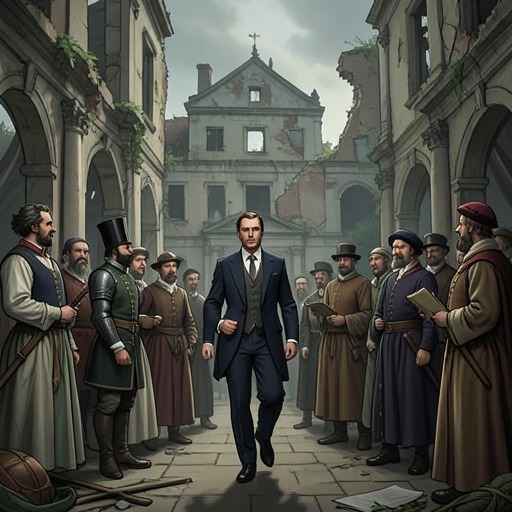
Jordan’s proposal gives enclosure a specific material form. Philip Earle is ordered to finish the maps, and Baynham, Jordan’s steward, is identified as the person who will prepare the land for sheep. Before the first snow, Baynham is to structure the ground within the estate’s bounds with fences, dykes, and walls. The commons are to be cleared and privately enclosed, while woodland is to be reclaimed. Jordan argues that trees which provide shade but no food should be cut down and their timber sold. The fields are to become pasture; in his declaration, the plow will no longer be needed.
This program does not merely exchange one crop for another. Its boundaries would restrict access to land on which households have depended, and its removal of trees and conversion of fields would reshape the physical landscape as well as its ownership. The agricultural calendar would change with it. Instead of sowing, reaping, gleaning, and returning the land to the plow, the estate would raise sheep for wool, which could then enter a wider chain of production and sale. Jordan speaks of hired women weaving cloth and of the merchants and tradespeople involved in processing and selling it; the scheme connects village land to a commercial economy beyond the village, while placing the profits and direction elsewhere.
Employment is offered as an answer to the villagers’ likely loss of livelihood, but the promise is limited. Jordan says there will be positions for shearers and sheep-boys, or for some of the villagers, according to the hands Baynham requires. He also anticipates economies. The proposed work is therefore not a guarantee that the community will continue as a community: it is a selective labor arrangement dependent on the new owner’s needs. The conversion from shared subsistence to wool production makes access conditional on employment.
Dispossession and the New Order
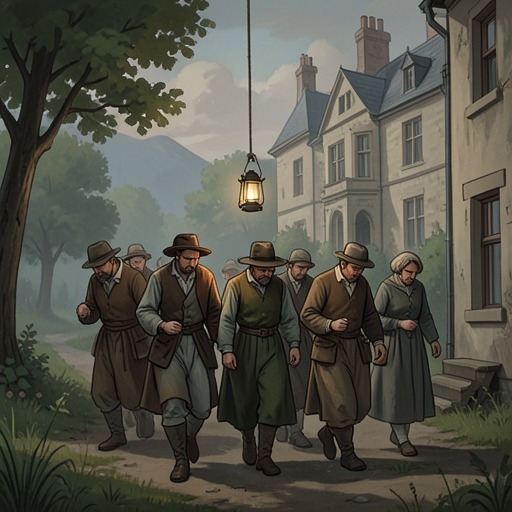
The risk of enclosure is made concrete by the story of Mistress Beldam’s family. Philip Earle explains that she and her husband are fugitives from sheep, driven from their own commons after land was hedged and fenced against their needs. Their arrival shows that enclosure is not merely a future possibility imagined by The Village; elsewhere it has already produced exiles. Their experience gives a human measure to Jordan’s neat language of improvement and reveals that the consequences may include separation from customary livelihoods and movement in search of a place to live.
The wider settlement also exposes the unevenness of Jordan’s promised prosperity. The villagers’ existing arrangements distribute work and produce across households, seasons, and livestock; the new estate instead sorts people according to their usefulness to sheep production. Jordan declares that villagers who might have benefited from his advances have left, treating their departure as a choice that restores the land to him. In his account, the failure is not the policy’s displacement of residents but their refusal to accept its terms. His language of order converts their customary subsistence into idleness and their departure into an opportunity to begin again on land he claims as his own.
Charles Kent’s position is compromised. Though his earlier account of wool had been framed as a dream for neighbors, he supports Jordan’s arrangement and remains connected to the estate’s transition. Walter Thirsk is asked to stay as Jordan’s ears and eyes, overseeing the property while hired workers arrive, trees are cut, and walls and winter folds are built. Shepherds may come later, bringing wages. The order of events matters: the old community is to be removed or dispersed first, while the new workforce is to be brought in according to the estate’s requirements.
Maps, Memory, and Resistance
Philip Earle’s maps capture both the force and the limitation of enclosure. His representation of existing ground flattens slopes, shadows, and the time needed to walk between places; Walter Thirsk recognizes that no person on the land could see it in quite this way. The proposed sheep fields appear still more patterned, divided into smaller bounded units, while the wooded darkness nearly disappears. The map can make the new arrangement beautiful and legible, but its orderly surface excludes the people, labor, and relationships that give the land its uses. Its precision is not neutral: it offers a view from which enclosure can be planned.
Walter’s understanding of the landscape is rooted in work, not detachment. His early delight in flowers and seasonal growth has been tempered by the demands of cultivation: the land will not wait for contemplation, and each year requires labor against hunger and crop failure. That knowledge prevents either the old agricultural order or the new pastoral scheme from becoming an easy pastoral ideal. Farming is arduous, yet the community’s practices give the labor a shared purpose and preserve access to the means of survival. Enclosure offers neither freedom from work nor guaranteed ease; it reorganizes who controls the work and who receives its benefits.
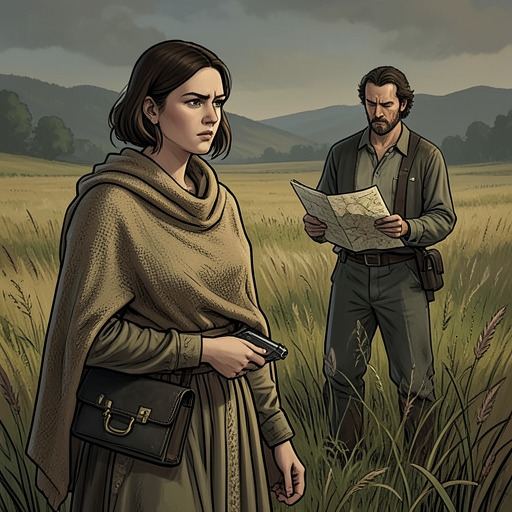
The later return to the barley field leaves the conflict open. The harvest has been gathered, and the silence of Charles Kent about the usual next steps had already suggested that the field might never be plowed again. Jordan’s declaration that the plow would be unnecessary seems to confirm the threatened end of cultivation. Yet Young Beldam takes the plow handles while Walter leads the oxen. Their intended work is modest: a single line down the field, a turn, and a line back, although a full plowing would ordinarily require twelve days, four oxen, and twenty men. The narrow furrow cannot undo the plan for enclosure, but it refuses to treat the field’s future as settled. Against the mapped, fenced sheep country, the plow marks a living claim to cultivation and to a future beyond the order Jordan has prescribed.