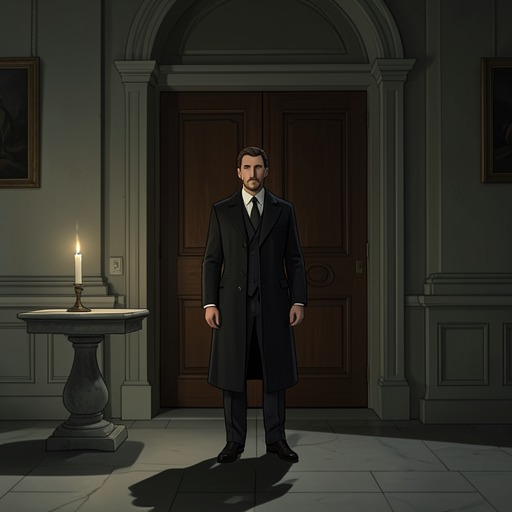
Charles Kent’s Widowhood and Childlessness
HarvestCharles Kent’s widowhood and childlessness are both private bereavements and conditions that unsettle his hold on the estate. Lucy Kent and their infant daughter died in childbirth, leaving him without a surviving child; because the inheritance is governed by blood descent, the loss also leaves a cousin able to claim the property. The narrative places this succession crisis beside the signs of Charles’s grief, making family absence a personal wound and a matter of land and power.
Marriage, Bereavement, and the Empty Household
Charles had married Lucy Kent, the daughter of the previous Edmund Jordan. She was the manor’s sole inheritance after her father died, but the legal arrangement did not simply pass the property securely to her husband. As Philip Earle explains to Walter Thirsk, Lucy’s inheritance was to be divided on her death among her male heirs by blood. Her husband was not a blood heir, and the daughter she bore him died with her in childbirth.
The household bears traces of the marriage without offering Charles a living family to succeed it. His wife had woven the sleeveless mandilion he wears when he comes to the stable fire; the garment, made in the winter of her death, accompanies him as he watches his stable disappear. Elsewhere, her looms are described as unattended. These details connect bereavement to the everyday material world of the estate: the work Lucy left behind remains, while Lucy and the child who might have continued the family line do not.
The narrative marks the depth of the loss through Walter’s recognition of Charles’s appearance. After the men in the pillory shout at him, Charles seems as sunken and reduced as Walter remembers him from the day Lucy and their infant girl died. The comparison makes his response to the present conflict legible through an earlier bereavement, without suggesting that the insults are equivalent to the deaths. The memory instead establishes how sharply loss remains part of Walter’s understanding of Charles.
Widowhood Among the Village
Charles’s bereavement also shapes his place in the community. Walter observes that Lucy left no child to him and that Charles values the fellowship the villagers provide. At the harvest feast, this dependence has a practical consequence: Walter thinks Charles may be willing to forgive the men responsible for the fire if they confess, because the villagers’ company matters to him. Widowhood is thus not only an inward state; it leaves Charles relying on a wider circle for companionship.
That reliance is presented with complication rather than as a simple virtue. Walter imagines Charles as more inclined toward harmony as he drinks, and sees the possibility that communal ties might temper punishment. But the men responsible do not tell the truth, and Walter himself chooses not to expose them. The village’s silence cannot repair Charles’s losses or restore his household; instead, it reveals the fragile social fellowship on which he depends, capable of offering a kind of belonging but also of sheltering wrongdoing.
The contrast between the dead family and the living community recurs in the account of the fire. Charles comes down wearing Lucy’s garment and stands near the mare rescued from the burning stable, while the guilty men make a conspicuous show of helping. His home and peace of mind are described as scorched. The scene places the vulnerability of his property beside the memory of his wife: the fire is a new loss, but it falls upon a man already bereaved and without a child to anchor the household’s future.
Childlessness and the Succession Crisis
The legal consequences emerge when Philip Earle privately tells Walter why Charles is so troubled. Lucy inherited the manor and property from her father, but the terms specified division on her death among male heirs by blood. Charles and Lucy had no surviving son; their infant daughter also died. Charles may be Lucy’s husband, but marriage alone does not make him a blood heir under the arrangement Earle describes.
Walter initially reasons that Charles is Lucy’s single heir, then learns that this understanding is mistaken. A cousin, Edmund Jordan, has a competing claim and is expected to arrive that day to assert what he considers his entitlement. The distinction matters: Charles’s widowhood is not merely the loss of a spouse, and childlessness is not merely the absence of a successor. Together, under the inheritance terms presented to Walter, they leave the estate exposed to a claim from outside Charles’s immediate household.
This revelation also changes the apparent meaning of the estate’s planned alterations. Earle tells Walter that the changes Charles has employed him to map, including the plans involving sheep, are not Charles’s own wishes but are demanded by the cousin. The evidence therefore does not present Charles’s circumstances as a straightforward choice to remake the property. His bereavement and lack of a blood heir coincide with a threat to his position, while the coming claimant presses changes on the estate that Charles himself may not want.
Narrative Significance
The account gives Charles’s family loss two connected forms. Walter sees its emotional persistence in the comparison between Charles’s present appearance and the day Lucy and their daughter died; Earle’s explanation reveals its legal and material consequences. The movement from a familiar garment and an unattended household to an inheritance document makes the personal and political dimensions of the same absence visible without collapsing one into the other.
Charles’s widowhood also sharpens the contrast between his private vulnerability and his public authority as landowner. He can be surrounded by villagers and still have no child or spouse beside him; he can possess the estate’s present household while facing a blood relative’s claim to its future. The narrative does not resolve that conflict in these scenes. Instead, it establishes why the succession question weighs on him, and why his apparent decisions about the land cannot be read apart from the loss that has left his inheritance uncertain.