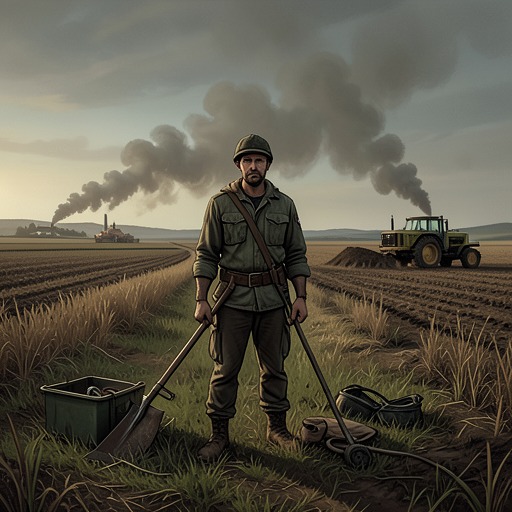
The Estate’s Planned Enclosure and Conversion to Sheep Pasture
HarvestThe Estate’s Planned Enclosure and Conversion to Sheep Pasture is a program of land and economic change advanced by Edmund Jordan and prepared through maps made by Philip Earle. Its stakes extend beyond the substitution of sheep for crops: enclosure would redraw the boundaries of shared land, redirect labor toward wool, and weaken the customs through which the village feeds and organizes itself. The plan is presented as prosperity, but Walter Thirsk recognizes in it the possibility that the community’s established life will be made obsolete.
Inheritance and the plan’s authority
The proposal emerges from a dispute over who may control the estate. Lucy Kent inherited the manor and property from her father, but the legal instrument stipulated that, after her death, the estate was to pass equally to her male heirs by blood. Lucy died in childbirth, and her child was also a girl. Charles Kent, her husband and the person managing the property, is not a blood heir; Edmund Jordan, his cousin, asserts a claim to the inheritance. Philip Earle explains to Walter Thirsk that the proposed changes are not Charles Kent’s own wishes: the sheep and the maps are demanded by the cousin, who is expected to arrive and assert what he regards as his entitlement.
This distinction changes the meaning of Charles Kent’s earlier presentations. He had described a reorganization that would benefit the community and had introduced the conversion through a dream of easier work and steadier returns. Yet Walter Thirsk had already suspected that the dream concealed a plan to close and engross the fields. Edmund Jordan’s arrival confirms that the projected transformation is not simply an anxious landowner’s speculation. It is tied to an inheritance claim and to a new authority over the estate.
The promised wool economy
The proposed landscape is specific: fields and commons are to be enclosed with walls, hedges, ditches, and gates; trees are to be cleared; and the land is to become pasture. Edmund Jordan appoints Baynham, his steward, to prepare the property for sheep and says that fences, dykes, and walls will be established within the estate’s boundaries before the first snow. Forest is treated as an economic resource to be reclaimed: an oak that shades the ground but produces no food for people is, in this calculation, more profitable felled and traded than left standing.
Agricultural production is to give way to a chain of wool production. Sheep would graze the land; some villagers might work as shearers or sheep-boys; women hired to weave would make cloth for sale. Edmund Jordan names products including worsted, twill, fustian, pickthread, and petersham, and describes the estate’s output as part of a distant market in which merchants, processors, and sellers all claim a share. Against this commercial system, he dismisses the village’s existing economy as irrational because it produces without coin and benefits commoners, particularly in productive years.
Charles Kent’s earlier account had made the change sound like release from uncertain toil. He contrasted the vulnerability of crops, which can be damaged by poor weather, disease, or birds, with wool, which he presented as more dependable and less bound to the seasons. In this projected future, villagers would shepherd rather than plow, shear rather than reap, and earn through textile work rather than laboring in the fields. The agricultural cycle is rhetorically recast as burdensome effort, while the wool economy appears as both leisure and security. Walter Thirsk sees what the image leaves unsaid: the sheep are the purpose of the transformation, and the sheaf is to yield to them.
The threatened commons
The village’s existing livelihood depends on shared labor and customary access, not on a simple division between private property and unused land. A poor harvest makes this dependence particularly plain. The lower, shaded and stonier ground produces weak crops, while the higher barley field offers a better yield; the villagers must work together to secure enough grain for the year. At harvest, children weed ahead of the reapers, stronger workers cut the stalks, women bind sheaves, and older people make stooks. The customary division reserves most of the harvest for the commons and leaves a portion for gleaning. After the crop is gathered, the village’s livestock use the stubble in an established order.
Those practices make the proposed enclosure a change in access as well as land use. Charles Kent tells the villagers that they may keep what barley they glean, while describing cattle, geese, and hogs as the animals that will follow the harvest. But the omission of the usual reference to plowing unsettles Walter Thirsk: he wonders whether the plows will be needed again at all. The annual gathering therefore carries an altered significance. What ordinarily renews shared work and access to the fields becomes evidence that the familiar sequence of harvest, grazing, and cultivation may be ending.
The village’s spring boundary walk also expresses knowledge and responsibility that the new maps do not capture. Villagers mark the boundaries with their children, take stock of what may be grown or gathered, and air disputes about household needs and shared resources. Their practical knowledge includes where to find reeds and fuel, which walls and fences need repair, where peat should be cut, and what work the land requires. Philip Earle’s charts, by contrast, represent the place through measured lines and geometric divisions. Walter Thirsk observes that the mapmaker records plants and views but does not inventory the labor, claims, and obligations that make the landscape usable to its inhabitants.
Unequal costs and narrative significance
Edmund Jordan acknowledges that the new arrangement will not preserve work for everyone. Baynham will employ only the number of hands he needs, and the community will have to make economies. Charles Kent points out that just under sixty people depend on the place, but Edmund Jordan treats that number as a matter for the steward to manage. The proposed employment of shearers and sheep-boys is therefore not a promise that the existing population will retain its livelihood; it is an offer of limited work within a system designed around the new enterprise.
Edmund Jordan also presents charity, gratuities, and a church with a priest as benefits of his rule. He promises a steeple and a bell that will summon the remaining villagers to prayer and hurry them to work. The promise joins religious provision to the discipline of the estate: the bell’s calls serve both worship and labor, while the phrase about those who may remain acknowledges the reductions the plan anticipates. Such gifts do not restore communal control over land or guarantee employment; they accompany the enclosure rather than undo it.
The projected conversion is a slow reordering of everyday life, not merely a dramatic alteration of scenery. Its effects begin in charts, forecasts, boundary decisions, and the gradual redirection of work; the costs fall on people whose survival depends on access to land they have long cultivated and shared. Yet the later image of Walter Thirsk plowing with Young Beldam offers a counterpoint to the claim that the plow has no future. They mark a narrow, straight furrow across a field that would ordinarily take a large team twelve days to plow. That act does not establish that the enclosure has been defeated, but it preserves the labor and agricultural knowledge that the planned sheep pasture would displace. The conflict is thus between competing accounts of value: land measured for marketable wool, and land known through the work, customs, and subsistence it sustains.