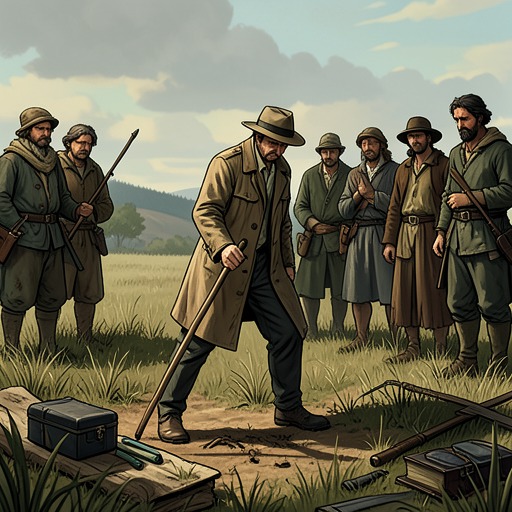
The Village’s Communal Subsistence Economy
HarvestThe Village’s Communal Subsistence Economy is a practical system of shared work, customary access, and food allocation, not simply a form of village sociability. Its inhabitants depend on uncertain harvests, but organize their labor and resources to sustain the community through the year. That arrangement gives working people a lived claim to the land even when deeds belong to Charles Kent; Edmund Jordan’s proposed enclosure and wool economy threaten to replace that claim with a commercial system whose benefits and decisions lie elsewhere.
Seasonal Work and Shared Provision
The economy begins in the fields, where the success of a harvest is never guaranteed. At one harvest, the lower, shaded ground and neglected stony slopes yield weak crops, while the higher barley field offers a more promising return. The differences matter materially: grain must last through the year, and a poor yield means that labor alone cannot ensure sufficient food. The community’s dependence on weather and soil makes every season a calculation of need as well as a cycle of work.
Harvest labor is organized across the village. Children move ahead to remove weeds; the strongest workers swing sickles and scythes; wives and daughters bind the sheaves; and older men set the harvested grain into stooks. The work is collective and inclusive: with the population reduced, there are too few people for anyone able to contribute to stay away. The reaping itself brings villagers together in one field, where labor is visible and conversation travels along the line. Its companionship and humor are part of village life, but they also arise from the shared necessity of getting the crop in.
The harvest’s distribution reflects the same communal logic. The workers bind the sheaves on the principle of ten for the commons and one for gleaning. In the village’s account of the wider economy, flour, meat, and cheese are divided into shares and portions for the larder, rather than weighed and sized only for sale. The distinction is not between work and generosity: shared provision is a customary arrangement that makes the harvest serve a population, rather than treating each product chiefly as a commodity.
Custom, Boundaries, and Stewardship
Customary Common Rights are grounded in use and labor, not in documentary title. The villagers recognize that Charles Kent owns the fields and possesses deeds, but argue that their own hands make the property productive. They therefore consider themselves entitled to be possessive of the ground and its associated common rights, despite having no muniments of their own. Their claim is practical and inherited through use: land must be worked, and those who work it rely on access to its resources.
Those rights are maintained through recurring communal practices. Each spring, the villagers beat the bounds together, taking stock of what they have and what they hope to have in bud or shoot. Children are brought to boundary stones so they will remember where they and their community belong. The same occasion provides a public, moderated setting for grievances about family allotments, common grazing, geese, composting places, and field attendance. These disputes are not evidence that the commons lack rules; they show how access and obligations are negotiated within the community.
The villagers’ knowledge of land is correspondingly specific. Their practical inventory includes the pond and its weeds, trees that may need cutting, ground to reserve for turbary, peat and turf, reeds for thatching, firewood, and walls and fences that require repair. Philip Earle’s survey, by contrast, records the parish for a different purpose: he notes views, plants, and details for his own natural-history book, rather than the labor and resource decisions the villagers need to make. The contrast is between ways of knowing land, but also between the uses to which knowledge can be put.
Ritual, Membership, and Mutual Obligation
Gleaning Rights extend the harvest beyond the gathering of sheaves. On the customary day after a rest day, the villagers expect to collect remaining barley for their own kitchen pots, where it can become stew, beer, or fodder. Charles Kent confirms that the gleanings may be kept by those who gather them rather than added to the common store. The permission recognizes gleaning as a customary part of village subsistence, not an incidental favor detached from the agricultural year.
The order of use continues after the gleaners: Cattle are to enter the field to reduce the stubble, followed by geese for fattening and then hogs to root through the soil. The sequence connects human gathering with the subsequent use of the same ground by livestock. The annual Gleaning Queen ceremony likewise gives the harvest a shared public form: the queen is to be the first to bend and pick a grain. These practices join practical access to a ritual of belonging, making the field a place where the community’s seasonal order is enacted as well as provisioned.
Collective labor also shapes social relations. During reaping, talk is open enough for neighbors to tease and gossip, while the coordinated work repeatedly gathers familiar faces in one bounded space. Yet the community’s solidarity is neither absolute nor free of tension: the harvest includes people whom the narrator knows but does not entirely like, and customary shares can be the subject of complaint. What holds the arrangement together is not the absence of disagreement, but the shared dependence that gives people reasons to work, negotiate, and account for one another.
Enclosure and the Contest over Value
The economy is vulnerable to a change in ownership and land use because its customary arrangements depend on continued access to fields and commons. Charles Kent’s first account presents sheep farming as a reassuring prospect: wool appears less exposed to weather and crop failure, and shepherding and textile work are imagined as easier than plowing and reaping. In that vision, the village might move from field labor toward sheep tending and weaving, with prosperity shared among its inhabitants.
Edmund Jordan gives the change a more openly commercial purpose. He describes the existing system as one that benefits commoners only in prolific years and calls agriculture without coin absurd to more rational observers. He intends to clear and enclose the commons, cut trees that do not produce food, and make the land pasture. He also directs Philip Earle to complete the maps and introduces Baynham, whose work is to prepare land for sheep. The maps and proposed fences, dykes, and walls would turn a customary landscape into an ordered estate, while the plow would no longer be needed.
That projected order makes the villagers’ claim to the commons precarious. Edmund Jordan says some inhabitants may find work as shearers or sheep-boys, but that economies will be necessary; the former system’s shared access and allocation cannot be assumed to survive as employment. The difference is therefore not merely between crops and wool. It is between a community that organizes land around shared subsistence and a profit-oriented plan that assigns value according to market returns and employs only the hands it requires. The communal economy’s significance lies in how tightly its rights, labor, seasonal knowledge, and sense of belonging are joined—and how enclosure threatens them together.