Charles Kent’s Threatened Dispossession
HarvestCharles Kent’s threatened dispossession begins with an inheritance rule that makes his marriage to Lucy Kent insufficient to secure the estate. After Lucy and their daughter die without a surviving male heir, the property passes to Young Edmund Jordan, Lucy’s cousin by blood. The claim unsettles Kent’s authority before the new heir has even begun to impose his plans: he remains master in name and is allowed to stay, but the decisions about the land increasingly belong to someone else.
Inheritance and the basis of the claim
The danger is first explained privately by Philip Earle, the mapmaker Kent has employed. Earle tells Walter Thirsk that another gentleman is expected, a Jordan with a claim over the whole estate. His gesture encompasses the bounds that the maps are meant to define, turning a family dispute into a claim upon an entire territory.
The inheritance descends from old Edmund Jordan and his wife to their daughter, Lucy. When Lucy married Kent, her father had died, and the manor and property became her inheritance. But the legal document governing the estate directs that, on Lucy’s death, it be divided equally among her male heirs by blood. Earle’s explanation therefore distinguishes inheritance from marriage: Kent may be Lucy’s husband, but he is not a blood heir.
The succession leaves no son to inherit. Lucy died in childbirth in the spring, and the child was a girl. Kent is described as Lucy’s sole immediate heir, but that status cannot overcome the condition attached to the property. Young Edmund Jordan, the cousin, is the surviving blood claimant; Earle makes clear that Kent’s proposed changes to the estate are not truly Kent’s own, but are required by the cousin who is arriving to assert what he considers his entitlement.
Authority under pressure
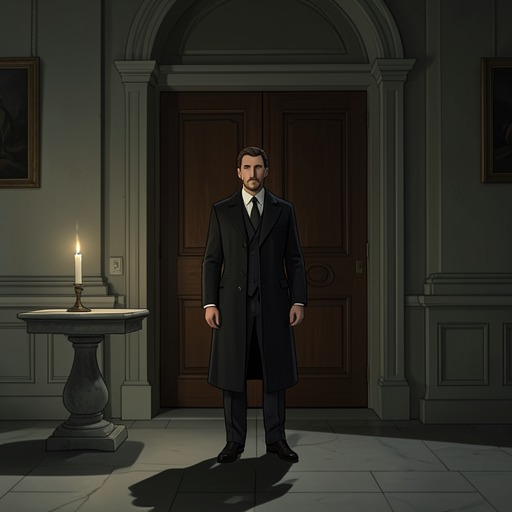
Kent’s threatened loss is visible in his changing relation to power. The village has been accustomed to a master who exercises authority indirectly and even-handedly, more inclined to persuade through familiarity than to command. When Young Edmund Jordan appears, however, Kent stands with his hands behind his back and his head bowed, listening rather than directing. His deference is striking because it reverses the familiar order: the man who has appeared to govern the manor now seems subordinate to his cousin.
Kent’s position is not simply a private concern about title. Young Edmund Jordan treats the estate as a source of income and announces that the commons will be cleared and enclosed, the land turned to grass, and plowing brought to an end. He assigns Baynham the work of preparing the land for sheep, guided by Earle’s charts. The proposed enclosure would reorganize the landscape that sustains the village, so Kent’s loss of control carries consequences for people whose work, food, and homes depend on the existing arrangement.
The scale of that dependence is made explicit when Kent says that a little under sixty people must be fed in the area. Young Edmund Jordan replies that employment will be limited to the hands needed for shearing and tending sheep, and that economies will be necessary. His proposal thus puts the residents’ continued livelihood in doubt even as he presents the changes as improvement. He also promises charitable payments and a church with a priest, but describes the remaining population as only a few who can stay. The promised expenditure does not remove the prospect of dispossession; it accompanies it.
Kent’s effort to resist or delay change
Kent does not welcome the transformation. Earle’s account establishes that the maps, the sheep, and the planned alterations arise from the cousin’s demands, not from Kent’s wishes. Kent nevertheless remains on the estate for the moment, a limited foothold that matters because it gives him some opportunity to contest what is to come.
After the new heir has made his intentions known, Kent asks Thirsk to keep the reason for the cousin’s visit and the coming changes from the neighbors. He wants time to argue with Young Edmund Jordan before speaking openly to the people who will be affected. His immediate aim is to blunt the cousin’s plans: he hopes to preserve at least some common ground where the village’s future shepherds and shearers may graze animals, and to retain some woodland. He imagines residents having secure work, food, and dwellings throughout their lives as the condition under which the estate’s sheep might be welcomed.
That appeal joins Kent’s own struggle to remain master with a defense of the community’s means of subsistence. The two interests are not identical, but the evidence shows him trying to use his remaining position to secure both. His silence toward the neighbors is therefore strategic: he seeks first to negotiate with the person whose legal claim gives him power, rather than announce a plan he has not yet managed to change.
A threatened estate and an uncertain outcome
The conflict exposes the gap between possession in daily life and authority under inheritance law. Kent has occupied the role of master and is still allowed to stay, while Young Edmund Jordan can claim the manor through descent and dictate the estate’s future. Earle’s maps give practical form to that transfer of power: they are to guide fences, dykes, walls, and the conversion of common land into private pasture.
Kent’s efforts remain unresolved in the available account. He hopes to win further arguments before the sheep leave their first marks on the land, but the cousin has already presented enclosure as a settled program and delegated its implementation to Baynham. The threatened dispossession is consequently broader than Kent’s possible loss of the manor. It is the looming removal of his authority to protect a way of life, at a moment when the legal basis of that authority has already failed.