Event 1
Thobela Mpayipheli assassinates Dorffling
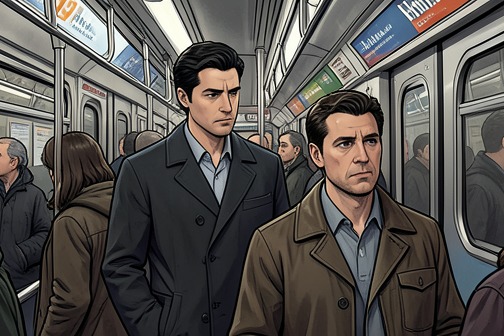
[Thobela Mpayipheli](entity:character-recall-character-thobela-mpayipheli-bde650756e15)’s assassination of [Marion Dorffling](entity:character-recall-character-marion-dorffling-bf74c89c1f79) in [Paris](entity:location-recall-location-paris-c02b439ce220) in [1981](entity:time-recall-time-1981-4636cc9b7e75) is both a completed mission and a defining memory of the violence he later tries to leave behind. Mpayipheli recognizes his target on the Métro, follows him through the Latin Quarter, and kills him after a brief face-to-face encounter. The scene gives the act the shape of an assignment carried out with deliberation, while its later return in Mpayipheli’s thoughts exposes the distance between his trained readiness to kill and the life he hopes to make for himself.
## Assignment and Recognition
The encounter begins on a crowded train. Mpayipheli stands close behind the American, but his thoughts are far from Paris, at the [Transkei](entity:location-recall-location-transkei-5de5d1b41ae3) coast. The memory of the waves and the silence between them places the approaching violence beside an image of stillness and ancestral belonging. He imagines that, when his own life ends, he will return to those quiet intervals. The contrast does not make the Paris scene peaceful; it shows how far inward he has withdrawn while remaining physically close to his target.
Mpayipheli identifies the man as Dorffling and addresses him with contempt, making clear that he knows whom he has been assigned to kill. The assignment has been accepted, and the dossier studied and memorized. Dorffling, in turn, does not react visibly to the recognition. At St Michel, Mpayipheli says that they have reached their station, and the two leave the train together. The apparently ordinary movement through a station and up into the Latin Quarter carries an unmistakable double purpose: Mpayipheli is guiding the encounter toward its conclusion.
Dorffling then runs toward familiar territory near the Sorbonne, where he has an arsenal of weapons. Mpayipheli had expected the American’s ego to prevent flight; Dorffling’s escape changes his assessment of him. He recognizes the ex-Marine’s capacity to act rather than assume that the man will submit to the confrontation. That recognition does not stop the pursuit. It makes the pursuit a contest between two trained adversaries, each reading the other’s choices.
## The Confrontation in Paris
The chase carries the men through the streets and into the quieter University alleys. Mpayipheli catches up and forces Dorffling to turn and face him. Their exchange is not extended: Dorffling’s confidence and practiced movements are set against Mpayipheli’s readiness, while the surrounding city briefly registers the sight of a white man pursued by a Black man. The racialized attention of Parisian onlookers makes the pursuit visible as more than a private contest, even though the decisive encounter takes place away from the crowds.
Mpayipheli reaches for the [short-handled assegai](entity:object-recall-object-assegai-b2159316afa6) carried in a scabbard against his back and says [Mayibuye](entity:expression-recall-expression-mayibuye-6491524a7fe5). When Dorffling asks what language he is speaking, Mpayipheli identifies it as Xhosa. The exchange makes language part of the confrontation: Mpayipheli names his own identity at the instant he closes on his target, rather than allowing the encounter to be described solely in the terms of an intelligence assignment. The two men circle and assess one another before Mpayipheli acts quickly, bringing the struggle to an end with the assegai.
The killing is followed not by triumph but by a deliberate acknowledgment of the dying man. Mpayipheli corrects Dorffling’s pronunciation of [Umzingeli](entity:expression-recall-expression-umzingeli-a133400ded02), then watches him die and lowers his body gently to the ground. That composure and courtesy complicate the scene without softening its outcome. The act is lethal, yet Mpayipheli treats the encounter as a process governed by attention and respect, including respect for an opponent who does not plead. His manner suggests a personal code operating inside the assignment, not an absence of violence or consequence.
## Memory and Moral Consequence
The Paris killing does not remain sealed in 1981. Years later, in the [Karoo](entity:location-recall-location-karoo-3c1c4108d0e9), Mpayipheli lies awake as a different confrontation with soldiers replays in his mind. He searches for the point at which his wish to become a new person gave way to the reflexes of his former life. He recalls how quickly battle-readiness returned and how readily his hands and knowledge could serve violence. The memory of Dorffling belongs to this larger reckoning: it is part of a history Mpayipheli cannot simply dismiss by declaring himself changed.
In that later reflection, Mpayipheli recognizes that his accusation that another person made him act was displaced blame. The guilty party he was looking for, he understands, was within himself. The recognition changes how his past actions can be narrated: responsibility cannot be transferred to an opponent, an order, or the immediate circumstances of a fight. His response to [Captain Tiger Mazibuko](entity:character-recall-character-captain-tiger-mazib-aaad0ca05cc5)’s hatred reinforces the connection. Mpayipheli recognizes that kind of hatred because it had accompanied him for nearly forty years, making the pursuit of Dorffling one point in a much longer life shaped by violence.
A separate recollection of an earlier assassination shows the limits of that readiness. When Mpayipheli has a shot lined up, the sight of a woman and child stops him from pulling the trigger. This is not the Paris encounter, but it provides a telling contrast: a trained killing response can be interrupted, and recognition of the lives beyond a target can alter what happens next. The novel places such moments beside Mpayipheli’s memories of violence, not as proof that the past is undone but as evidence that action is not wholly beyond choice.
## Place in Mpayipheli’s Change
The assassination’s lasting significance lies in the way it returns during Mpayipheli’s effort to imagine a future not governed by his past. In another memory, he sees his younger self expressing a wish to become a healer. The recollection confronts him with the possibilities of choices he did not make and with grief for the hatred, violence, and death that followed. He cannot undo what happened or erase who he has been; he can, however, determine how to proceed. His aspiration to become a farmer and nurturer gives that decision a practical direction rather than making it a claim that change will be easy.
The 1981 encounter therefore holds two meanings at once. At the time, Mpayipheli completes the assignment through pursuit, tactical judgment, and a final act of violence. In retrospect, the same event becomes part of the history he must face honestly if he is to reject the habits that once defined him. Its quiet gestures—the recalled coast, the brief naming of Xhosa identity, the respectful lowering of Dorffling’s body—stand beside the irreversible fact of the killing. The memory neither absolves Mpayipheli nor fixes him permanently as an assassin; it clarifies the burden from which his later attempt at a different life must begin.
Event 2
Soweto uprising
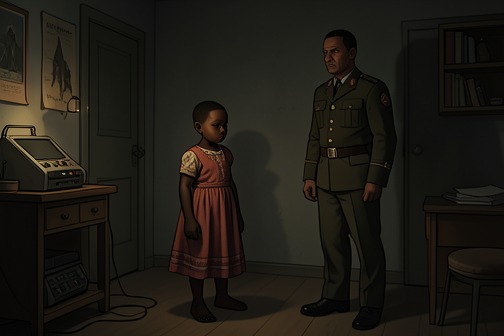
The [Soweto uprising](entity:event-recall-event-87991ad7e436) is the historical marker in [Lawrence Mpayipheli](entity:character-recall-character-lawrence-mpayipheli-596c1330b028)’s account of a decisive family rupture: in [1976](entity:time-recall-time-1976-8252a801911c), while [Thobela Mpayipheli](entity:character-recall-character-thobela-mpayipheli-bde650756e15) was fourteen, his uncle [Senzeni](entity:character-recall-character-senzeni-b819a88d4a75) came for him at night and took him away. The recollection links the upheaval of the period to Thobela’s early departure from home and the beginning of a long separation between father and son, without recounting the uprising’s events themselves.
## Historical Setting
Lawrence places the episode in 1976, at the time of the Soweto uprising. In his account, the uprising establishes the moment in which Thobela’s childhood changed course; the focus is not on the protest or its immediate history, but on its place in the family’s memory. Thobela was fourteen when Senzeni arrived, making the episode an early turning point in the boy’s life.
## Senzeni Takes Thobela Away
Senzeni was Lawrence’s brother, but his influence had led to him being forbidden from the house. He nevertheless came at night and took Thobela. He later phoned to say he would bring the boy home when he had become a man. Senzeni had Thobela initiated somewhere and took him to places where Xhosa people had been killed, drawing him toward the armed liberation struggle.
## Return and Estrangement
Thobela and Senzeni were away for three months. When they returned, Lawrence felt that he no longer knew his son, and that Thobela no longer knew him. The two then lived under the same roof for two years, but Lawrence remembered them as strangers: Thobela kept to his own paths, quiet and secretive. Thus the episode’s consequence extended beyond the night of Thobela’s departure. His return did not restore the former relationship; it left father and son separated within their home.
Event 3
Senzeni takes Thobela away to join the struggle
[Senzeni](entity:character-recall-character-senzeni-b819a88d4a75) takes Thobela away to join [The Struggle](entity:time-recall-time-the-struggle-ed36d71425ee) in [1976](entity:time-recall-time-1976-8252a801911c), when Thobela is fourteen: his uncle enters the family home at night and carries him from the life his father, [Lawrence Mpayipheli](entity:character-recall-character-lawrence-mpayipheli-596c1330b028), had hoped to give him. The episode is both a literal separation and the beginning of a formative journey. Lawrence recalls that Senzeni had Thobela initiated and took him to places where Xhosa blood had been shed; when they returned three months later, father and son no longer recognized one another. The rupture would deepen when Thobela left for war in 1979, but the novel’s later movements toward honour, care, and homecoming keep the departure from being the final word on his life.
Event 4
Thobela leaves home to fight in 1979
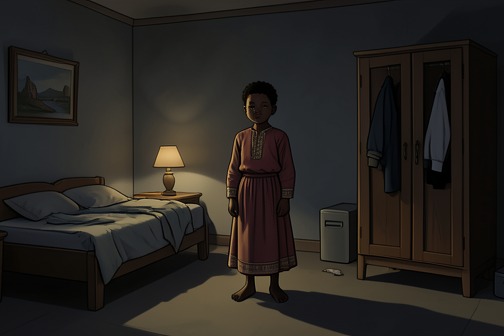
[Thobela Mpayipheli](entity:character-recall-character-thobela-mpayipheli-bde650756e15)’s departure in 1979 is a family separation as much as a departure for war: after a rare goodnight to his father, he vanishes from the rectory, and [Senzeni](entity:character-recall-character-senzeni-b819a88d4a75) confirms that he has gone to fight. [Lawrence Mpayipheli](entity:character-recall-character-lawrence-mpayipheli-596c1330b028)’s account gives the moment its lasting weight, revealing grief sharpened by helplessness and by the conviction that his brother has taken his son from him.
## The Empty Room
The evening before Thobela left, he said goodnight to Lawrence, an unusual gesture. By morning his room was empty. The bed had not been slept in, and some clothes were missing from the wardrobe: small, concrete signs that the departure had been planned, even though Lawrence had not been told of it.
Senzeni came to say that Thobela had gone to the war. His confirmation turned the evidence of absence into a rupture Lawrence could no longer mistake for a passing disappearance. The account gives no destination or description of the journey; its focus is the sudden knowledge that Thobela had chosen a life beyond his father’s reach.
## A Father’s Anger
The news provoked a terrible quarrel. Lawrence directed hard words at Senzeni, whom he blamed for having stolen his son, but recognized that his rage reached beyond his brother: he was also angry with God. He felt wounded by his inability to be a father and by the loss of a child whose departure he could not prevent.
Lawrence understood the division through the contrast between his own calling as a man of peace and a shepherd and the son he describes as a wolf in the fold. The departure therefore exposes more than a disagreement over Thobela’s choice: it leaves Lawrence struggling to reconcile his faith and vocation with a family divided by the path to war. His recollection preserves the departure as both a physical absence and the moment his sense of fatherhood failed him.
Event 5
Senzeni is tortured and killed by the security police
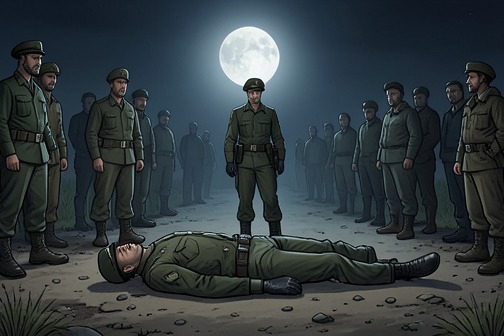
[Senzeni](entity:character-recall-character-senzeni-b819a88d4a75)’s torture and killing by the Security Police is recalled by [Lawrence Mpayipheli](entity:character-recall-character-lawrence-mpayipheli-596c1330b028) as the devastating break between the family’s last reports of Thobela and the silence that followed. Taken to [Grahamstown](entity:location-recall-location-grahamstown-7a69d250b89f), Senzeni was beaten for eight days and left dead beside a road; the account makes his death both a state-inflicted act of violence and the loss of the family’s remaining connection to Thobela.
## Before the Killing
The event comes after Thobela’s departure in 1979. He had left home for the war, a decision that provoked a terrible argument between Lawrence and Senzeni: Lawrence felt unable to be a father to his son and blamed his brother for taking him away. In the years that followed, Senzeni sometimes sent word about Thobela, reporting that he was well, had attracted notice, and had gone abroad to learn to fight for his country.
## Detention and Death
The news that the Security Police had taken Senzeni to Grahamstown turned that fragile channel of communication into catastrophe. For eight days they beat him until he died, then left his body beside the road. The account gives no further circumstances of the detention or killing; its stark sequence—abduction, prolonged beating, abandonment—defines the violence Senzeni suffered.
## Aftermath and Significance
Lawrence’s recollection closes with the family never hearing from Thobela again. Senzeni’s death therefore carries a consequence beyond his own loss: the person who had sent news of Thobela is gone, and the family’s already painful separation becomes silence. Recounted through Lawrence’s grief and his sense of having failed as a father, the event binds political violence to intimate family rupture without suggesting that the two are the same injury.
Event 6
Johnny Kleintjes secretly backs up intelligence files

[Johnny Kleintjes](entity:character-recall-character-johnny-kleintjes-bf98fd1e4a42) secretly backed up intelligence files while [South Africa](entity:location-recall-location-south-africa-49123e8bd978)’s newly integrating intelligence services struggled to combine records and colleagues removed material from the systems. The backups became both a safeguard against institutional erasure and a source of suspicion: [Monica Kleintjes](entity:character-recall-character-monica-kleintjes-ddb490033632) could not say what her father intended to do with the data, and later evidence suggested that some of it may never have been formally returned.
## A records project in a divided service
After the elections, Johnny was brought back to help consolidate intelligence records across institutions that had operated separately and often distrusted one another. The task was immense. The project encompassed material from Infoplan in [Pretoria](entity:location-recall-location-pretoria-6b0a39acc851), Denel, the Security Police and [Military Intelligence](entity:organization-recall-organization-724601e0c2de), as well as the Secret Service and the [African National Congress](entity:organization-recall-organization-1cd3963560dc)’s systems in [Lusaka](entity:location-recall-location-lusaka-2dc45c5fc46b) and London. The accumulated data amounted to an estimated four or five hundred gigabytes, ranging from personal information about members of the public to weapons systems, informants and double agents.
Johnny was placed in charge of combining computer records into a central, uniform database. The work involved more than collecting files: he was expected to identify material that could cause trouble, erase it, and preserve information considered useful. Those decisions made the new database a contested account of the past as well as a technical project. What survived depended on officials’ judgments about what should be kept, and the various branches’ competition and mutual concealment made a complete, trustworthy record difficult to create.
## Why the backups began
Monica’s account places the copying within that unstable transition. She said her father had encountered orders he believed Nelson Mandela and Alfred Nzo would not approve of, and that he was initially unsure how to respond. As colleagues obstructed one another, protected their careers or tried to prevent information from disappearing, Johnny became afraid of what the system’s disorder could conceal. He began making copies of some material on hard disks and sometimes worked on it at home through the night.
A second account, given by Groenewald in testimony, describes the same breakdown from inside the team. Years of institutional secrecy had conditioned some employees to treat records as liabilities; operational material began to disappear when individuals feared it might count against them. When Johnny realized files were being deleted, he started making backups. Groenewald said they worked together as quickly as they could. After one backup tape vanished, Johnny began taking work home. The two accounts establish repeated copying and the movement of work beyond the office, while leaving the precise sequence and the full extent of the material uncertain.
Monica was close enough to keep house for her father while her mother was ill, but she said she stayed out of the work. She knew he was troubled by what he found and that he had taken data home; she did not know what was on the disks. Her testimony therefore records both the persistence of the backups and the limit of what the family could know about them.
## What the files contained—and what copying could not settle
Groenewald identified several kinds of records Johnny retained. These included X-lists containing compromising information about politicians, judges and intelligence personnel, such as their political connections or financial difficulties; E-lists, which recorded people already killed or marked for elimination; and the [Zulu Dossier](entity:object-recall-object-zulu-dossier-616d18d2098b), concerning Zulu nationalists. The files were not a neutral store of administrative facts. They joined private information, political surveillance and records of intended violence in an archive whose handling could affect people’s safety and reputations.
The copying also reflected a broader vulnerability in the service’s information practices. Digital files and magnetic media could be duplicated and circulated with ease, while networked systems could be penetrated. The organization’s response elsewhere was to restrict access and produce a single controlled paper copy: typists transcribed material in a monitored room, signed tapes in and out, and the digital tapes were deleted after transcription. Against that model of tightly managed custody, Johnny’s private backups preserved alternate copies outside the official chain of control. They could retain material that would otherwise vanish, but they also created uncertainty about who possessed it and how it might be used.
## Unresolved custody and consequences
Monica suspected that her father had not handed the disks back in and might have been trying to sell the data, but she presented this as an inference, not something she knew. The distinction matters: the evidence supports that Johnny copied files, worked on data at home and retained at least some material; it does not establish his final purpose or the complete contents of the disks. His precautions could be read as resistance to deletion, yet the same unaccounted-for copies invited suspicion that the records had become private property or potential leverage.
The backups acquire further significance when Monica explains that Johnny instructed her to involve [Thobela Mpayipheli](entity:character-recall-character-thobela-mpayipheli-bde650756e15) if something happened to him. [Janina Mentz](entity:character-recall-character-janina-mentz-374453134b98) later recognizes that Johnny’s involvement of Thobela was not accidental, but the reason for the instruction remains unresolved. The hard disk’s contents become a clue in the search for whoever had knowledge of the wider operation, not a complete explanation of Johnny’s motives. The episode leaves the archive suspended between preservation and misuse: files survive outside the institution, while their meaning, custody and intended destination remain contested.
Event 7
Johnny Kleintjes is held hostage to force the retrieval of the hard disk
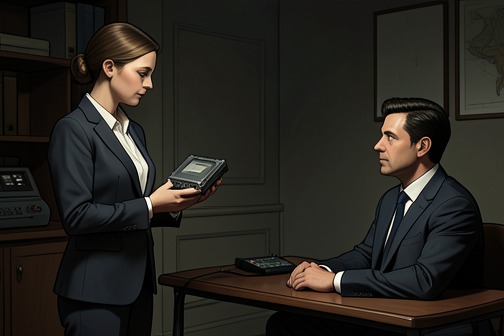
[The Director](entity:character-recall-character-the-director-ac067526026f)’s coercion of [Monica Kleintjes](entity:character-recall-character-monica-kleintjes-ddb490033632) over her father [Johnny Kleintjes](entity:character-recall-character-johnny-kleintjes-bf98fd1e4a42) makes the hidden hard disk the price of Johnny’s safety. After [Janina Mentz](entity:character-recall-character-janina-mentz-374453134b98) brings the matter to the Director, Monica is told that her father is in his custody and that she must retrieve the drive from the safe in his study. She obtains it, but the demand does not end there: she must carry it to a specified meeting in [Lusaka](entity:location-recall-location-lusaka-2dc45c5fc46b) within seventy-two hours.
## Background and leverage
Mentz places a laptop on the Director’s desk and identifies Johnny as the trouble requiring his attention. The Director’s response is notably composed: Mentz sees him smiling, and later observes that his expression and posture remain calm as the situation develops. That surface ease contrasts with the pressure being applied to Johnny’s daughter. His daughter is drawn into the affair not as a willing participant in an intelligence exchange, but because the Director presents her father’s safety as dependent on her cooperation.
When the Director addresses Monica, he first frames Johnny’s predicament obliquely, saying that her father had promised something he could not deliver. Monica responds with immediate worry and asks what has happened. The explanation soon becomes explicit: Johnny has told her that a hard-disk drive is in the safe in his study. The drive’s location gives Monica a task she can carry out, while Johnny’s presence in the Director’s custody gives the demand its force.
## The threat and retrieval
Monica asks where her father is. The Director tells her that Johnny is with him and makes clear that refusal to cooperate will place Johnny’s life in danger. He also presents cooperation as a way for Monica to save him, turning her fear into leverage. The exchange leaves little room for genuine consent: she is being asked to act under a threat directed at someone she loves.
Monica later reports that she has the disk. This is a decisive change in the immediate situation: the item the Director demanded has been retrieved, but Johnny is not thereby shown to be free or safe. Instead, the Director introduces a further condition. He tells her that she has seventy-two hours and stresses that the journey is long, making the deadline part of the coercion rather than a minor logistical detail.
## The Lusaka ultimatum
The Director specifies the meeting place as the foyer of the [Republican Hotel](entity:location-recall-location-republican-hotel-0fbbda229c17) in Lusaka, [Zambia](entity:location-recall-location-zambia-ee8409d63d6a), and repeats the seventy-two-hour limit. Monica checks the destination, and he confirms it. His final instructions warn her not to be late or act foolishly, invoking Johnny’s age to sharpen the threat. The line then goes dead. The conversation therefore ends not with confirmation of a completed exchange, but with a destination, a deadline, and the unresolved danger to Johnny.
## Consequences and significance
The episode converts a concealed intelligence object into a means of controlling two people at once. Johnny is held as leverage; Monica is compelled to retrieve and transport the drive. The sequence moves from the discovery of the drive’s location to its recovery, then immediately shifts the burden onto a cross-border delivery to Lusaka. Each apparent step toward compliance produces another demand rather than reassurance.
The Director’s calm manner intensifies this contrast. He manages the exchange with measured instructions while Monica’s worry is immediate and visible in her questions and pauses. The event establishes [the hard disk](entity:object-recall-object-94f8ccdf6fc6) as more than property to be recovered: possession of it determines who can impose terms, and the threatened harm to Johnny makes those terms urgent. The evidence does not establish whether Monica reaches the hotel, whether the disk is handed over, or what happens to Johnny after the call.
Event 8
Monica entrusts Thobela with delivering the hard disk
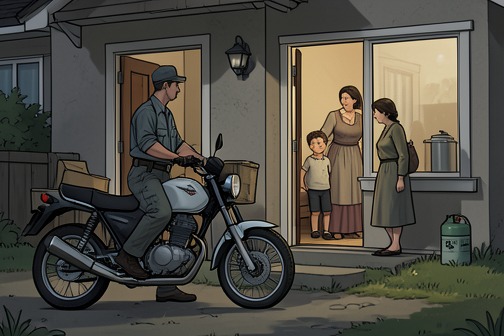
[Monica entrusts Thobela with delivering the hard disk](entity:event-recall-event-monica-thobela-5321433d961b), setting in motion a journey that tests whether he can leave his violent past behind without abandoning the obligations that still define him. The request comes not as an abstract mission but into the fragile domestic life he has begun to build with Miriam and [Pakamile](entity:character-recall-character-pakamile-db01684d694b): [Johnny Kleintjes](entity:character-recall-character-johnny-kleintjes-bf98fd1e4a42) has chosen him as the one man he trusts, and Monica needs his help before a threat from [Lusaka](entity:location-recall-location-lusaka-2dc45c5fc46b) becomes fatal.
## An interruption at Miriam’s house
Thobela arrives at Miriam’s house expecting to meet Pakamile, but the boy is not waiting at the street corner. A Toyota Cressida bearing the Peninsula Taxis sign stands conspicuously outside, its presence out of place in the neighbourhood. Thobela turns up the dirt driveway on his motorbike with a tin box and fungicide tied behind him. The front door is open; Miriam rises from an armchair, and Monica is seated in the small room. The ordinary details of his arrival—his work materials, the expected child, the familiar house—make the interruption tangible before anyone explains it.
Miriam introduces Monica, who identifies herself as Johnny Kleintjes’s daughter and asks to speak privately. Thobela’s immediate question is where Pakamile is. When Monica says she is sorry, then tells him that Johnny is in trouble, his response is shaped by a history that reaches back beyond this meeting. The name brings memories with it; Thobela understands why Johnny would have selected him. Miriam leaves them alone, although her straightened posture registers the strain of a stranger’s arrival and the private conversation it requires.
## Johnny’s trust and the deadline
Monica explains that her father had repeatedly instructed her to find Thobela if anything happened to him, because Thobela was the only man he trusted. The request is therefore not simply Monica’s appeal to a capable escort: it carries Johnny’s confidence in Thobela and the weight of a relationship that has survived years apart. Monica says callers from Lusaka have some disks but want another one, which she had to retrieve from her father’s safe. She has seventy-two hours to deliver it in Lusaka.
The deadline clarifies the danger and the urgency, but Monica also makes clear why she cannot manage the journey effectively alone. She lifts the hem of her skirt to show Thobela her artificial legs and describes herself as slow and not very effective. Her appeal is practical and direct: she needs his help to deliver the data and save her father, whom she believes will otherwise be killed. The evidence does not specify what the data contains or how the delivery is to be carried out. What it establishes is the immediate choice placed before Thobela: act within a narrow period, or leave Johnny exposed to the threat.
## A debt weighed against a new life
The request collides with the life Thobela has promised himself. Miriam reminds him that he had said he could no longer live as he once did and had finished with that life. He does not deny it. He tells her that he meant what he said, and that refusing is possible: the decision remains his. His answer makes the conflict ethical as much as practical. Accepting the commission will pull him away from the lawful, nonviolent routine he wants, yet refusing would mean disregarding the trust Johnny placed in him.
Thobela frames his obligation as a debt of honour. In his understanding, honour includes caring for Miriam and Pakamile, coming home each afternoon, and doing work that is lawful and nonviolent; it also requires paying debts. The two claims are not easily reconciled, and he does not pretend that his choice is painless or inevitable. He chooses to help because he believes that keeping faith with Johnny is part of being an honourable man. The scene gives his return to danger a specific cause: not a renewed appetite for violence, but a personal obligation he cannot dismiss without betraying his own code.
## The larger journey and its unresolved promise
The commission forms a hinge between Thobela’s former identity and his hope of becoming someone else. Later, he considers the possibility that a person who finds his former life abhorrent can change, and that one person’s change might begin a wider recovery. He imagines taking Miriam and Pakamile to the Cala River to make a new beginning, away from poverty, crime, and corruption. That imagined future gives the choice at Miriam’s house its cost: the mission is undertaken in the name of an old bond even as Thobela is trying to build a life no longer governed by violence.
The journey also places him among other people whose actions and voices complicate the image of solitary flight. At the bridge, [Little Joe Moroka](entity:character-recall-character-little-joe-moroka-691d62ffb2af) begins singing Shosholoza after the pilots challenge him to prove he can sing; other voices join, and Thobela, listening from beneath the bridge, recognizes the song as something rare. The episode does not erase the danger of the mission, but it sets individual survival against an audible, shared presence. Later, [Allison Healy](entity:character-recall-character-allison-healy-35acfe29d17c) tries to reassure Pakamile while the boy grips her hand and says he wants to stay with her. The child’s need for a trusted adult echoes the care that Thobela has tried to make central to his new life.
At the book’s close, Reverend [Lawrence Mpayipheli](entity:character-recall-character-lawrence-mpayipheli-596c1330b028) works among his tomatoes when a motorbike arrives carrying a large man and a small boy. He thinks he cannot believe what he sees and waits for them to remove their helmets before calling his wife. The ending leaves recognition just short of confirmation, but returns the story to the hoped-for homecoming that Thobela’s choice had placed in jeopardy. Monica’s appeal thus matters beyond the delivery itself: it tests the reach of Thobela’s loyalty, the limits of his renunciation, and whether a future with Miriam and Pakamile remains possible after he answers an old debt.
Event 9
Thobela escapes at the airport
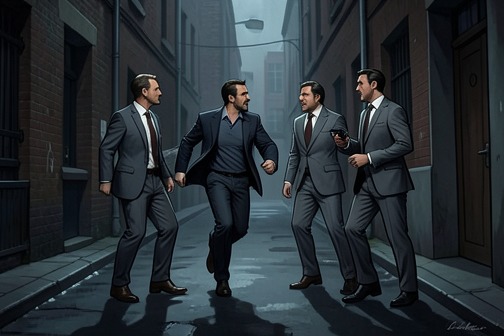
[Thobela escapes at the airport](entity:event-recall-event-thobela-3963bbbbb7b7) when two State agents confront him and try to remove him and his blue sports bag without attracting attention. The encounter turns on a fast reversal: the agents believe they control the situation, but Thobela reads their need for discretion, takes one man’s pistol, and makes them give back the bag. He leaves through the passenger exit and runs into the darkness beyond the building’s lights, transforming a quiet attempt at detention into a public flight and an intelligence operation’s pursuit.
## The Interception
Before the agents approach, Thobela is preoccupied with the task he has undertaken and with [Johnny Kleintjes](entity:character-recall-character-johnny-kleintjes-bf98fd1e4a42). He cannot reconcile the prospect that Johnny might have sold out with his conviction that the older man is loyal and principled. Thobela intends to ask him what happened when the data is handed over and Johnny has received his money, but that plan depends on everything going as expected. His wish to avoid trouble accompanies him into the confrontation; it does not mean he has stopped assessing danger.
Two men in grey suits appear beside him before he has seen them coming. The narration marks the surprise as more than a failure to notice two approaching men: Thobela recognizes that his skills have dulled while he has been absorbed in thought. They know him by name, stand close enough to prevent him from getting up, and say that they want him to come with them. When he asks why, one says they represent the State and displays a plastic identification card bearing a photograph and the national coat of arms. Their authority is asserted, but the scene offers no warrant or explanation beyond the card and their demand.
The agents’ attention soon turns to the blue bag. One taps it and refers to its contents, making clear that the bag is part of what they want to control. Thobela pleads with them to listen and says that he does not want trouble. The agent interprets his pleading as fear and attempts to exploit it, threatening him while opening his jacket enough to show a pistol in a black shoulder holster. The threat sharpens the imbalance between the agents’ apparent authority and Thobela’s immediate vulnerability, but the exposed weapon also gives him an opportunity.
## The Reversal
As the agent reaches for the sports bag, Thobela decides to act. He has noticed that the two men want to get him out quietly rather than cause a scene; he treats that preference as a constraint he can use. He takes the pistol from the reaching agent’s holster, turns it, and rises, pointing its barrel at the man’s heart. The move is sudden enough to shock the agent, who is left holding the bag, while the second man remains behind him. Nearby passengers have not noticed anything amiss, so the encounter is still contained within the agents’ intended quietness.
Thobela does not respond to the threat with a demand to hurt or kill either man. He says he wants his bag back. When the second agent asks what he is doing, the first reports that Thobela has his pistol. Thobela then orders the second agent to take the bag from his colleague and put his pistol inside it. He keeps the weapon hard against the first man’s chest, using him as a barrier between himself and the other agent. The command is practical as well as coercive: returning the bag and placing the weapon in it lets Thobela recover what the agents had taken while limiting their immediate ability to use another gun.
The standoff holds with Thobela and the first agent close together and the second about a metre away. The second agent urges his colleague to comply, observing that Thobela has nowhere to go; the remark shows that they still assume the situation can be contained. At last, the agent identified as Alfred takes the bag from Willem, unzips it, slips his pistol inside, zips it closed, and places it carefully on the floor. The careful handling contrasts with the threat that began the encounter. The agents have yielded the bag, but Thobela still has to leave without giving them a chance to regain control.
## Through the Exit
Thobela orders both agents to sit. They obey, moving slowly, while he takes the bag and keeps Willem’s pistol in his trouser pocket, his hand still on it. He walks and then jogs toward the passenger exit, turning to check behind him. The agents remain where they are, staring at him with unreadable expressions. That backward glance gives the escape a final measure of uncertainty: he has made them sit, but he does not know from their faces whether they will follow or how quickly the confrontation will spread beyond the room.
At the exit, a woman tells him that he cannot go through. He is already past her and onto the runway. A security man shouts and waves, but Thobela runs out of the ring of light cast by the building and into the dark. The route makes his escape visible and dangerous: he has left the controlled passenger area, yet he has not reached safety. The pistol and the recovered bag have enabled him to break the immediate detention, not to end the pursuit or resolve the task that brought him there.
## The Pursuit Begins
The scene cuts from Thobela disappearing into darkness to the response inside the intelligence operation. Someone shouts that he has got away, and [Janina Mentz](entity:character-recall-character-janina-mentz-374453134b98) strides to her computer monitor. [Rahjev Rajkumar](entity:character-recall-character-rahjev-rajkumar-c42d2052c9b0) then reads out identifying details: Thobela’s birth date, his birthplace of [Alice](entity:location-recall-location-alice-fd6328bbac86) in the Eastern Cape, his parents’ names, his identity number, and his registered address in Mitchell’s Plain. The abrupt shift from the runway to the monitor changes the scale of the escape. What began as two agents’ attempt to take one man and a bag quietly is now an organized effort to locate him through the personal information held by the state.
The episode establishes Thobela’s resourcefulness without presenting the escape as a clean victory. His old skills have seemed blunted, yet the moment the threat becomes immediate he observes the agents’ caution, acts on it, and avoids turning the confrontation into a shooting. He gets away with the bag and a pistol, but the agents’ access to his identifying records shows how exposed he remains. The escape is therefore both a reversal of control and the opening of a larger pursuit: he has crossed the threshold from attempted quiet detention into flight, while the people seeking him begin converting a name into a location.
Event 10
Thobela steals a BMW GS to flee Cape Town
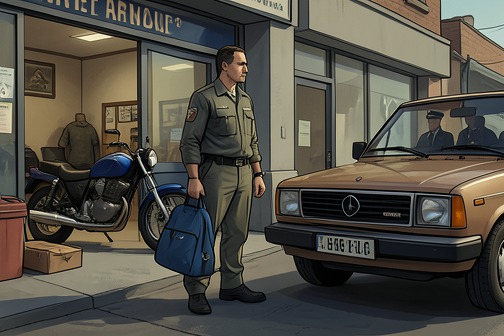
[Thobela Mpayipheli](entity:character-recall-character-thobela-mpayipheli-bde650756e15) steals a [BMW R 1150 GS](entity:object-recall-object-bmw-r-1150-gs-806a26725aa3) from Mother City Motorrad to flee [Cape Town](entity:location-recall-location-cape-town-f6ea4334d11c), turning his knowledge of the shop into a means of escape. The taking is both practical and precarious: he knows the building and its alarm, but has never ridden a motorcycle of this size. He leaves money and an explanation for the owner, yet once he rides away, the act sets him onto a route where speed, surveillance, weather, and the limits of his own experience determine whether he can stay ahead.
## The watched shop
Thobela approaches the shop by taxi, getting out near the Media24 building and walking through the city streets without haste. From the petrol station opposite Mother City Motorrad, he spots a car with intelligence officers inside. The sight changes his immediate plan: rather than remain in the open, he enters the attendants’ room and waits. When the car has gone, he leaves, checks the street, and reaches the service alley behind the building.
His access depends on the ordinary routine that has made him familiar to the garage. He opens up each morning, sweeps before the mechanics arrive, switches on the kettle and lights, and cleans the display windows. He has a key and knows the alarm code. On this night, however, that routine serves a different purpose. He unlocks the door and disables the alarm but leaves the lights off, judging that an illuminated showroom would draw attention. The familiar workplace becomes a temporary passage out of the city.
## Choosing and learning the motorcycle
The choice of vehicle is constrained by the bag he must carry and by his limited experience. He considers the faster 1200 RS and the much larger LT, then selects the demonstration GS, whose fixed cases can hold his belongings. He has ridden a Honda 200 but has not been allowed to ride the machines he tended at the shop; his work had been to push them outside, wash and polish them, and return them to the showroom. Taking the GS therefore means leaving on a machine he knows mostly by sight and maintenance.
The first turn exposes the gap between familiarity and control. The GS’s power catches him off guard, and he nearly loses it on Oswald Pirow. Its size and weight make it feel difficult to manage; when he brakes near the [N1](entity:location-recall-location-n1-a1425420691b), the ABS engages sharply and he nearly tips again. He proceeds cautiously through the gears, aware that the bike can reach 100 kilometres per hour before he is properly into third. On the freeway he rides slower than the traffic flow while learning how the machine balances, keeping to the left lane and trying to adjust to its broad handlebars and large tank. The escape begins not with mastery but with a dangerous period of adaptation.
## A note left behind
At the showroom, the agents and the owner discover that the demonstration model is gone and find Thobela’s note. He says he is borrowing the bike for two or three days to help a friend urgently, records that he has also taken a suit, helmet, and gloves, and leaves money in the desk drawer. He promises to pay for wear, tear, and any damage. The note does not undo the unauthorized taking, but it distinguishes his departure from an attempt simply to profit from the shop: he accounts for what he has taken and acknowledges an obligation to repay it. The owner’s response is a loss of trust; the familiar employee has become the person who has carried off the machine.
By the time Thobela passes the Stellenbosch turn-off, anger at [Johnny Kleintjes](entity:character-recall-character-johnny-kleintjes-bf98fd1e4a42), the intelligence officers, and his own carelessness has overtaken some of his fear of the motorcycle. The theft has secured transport, but it has not brought safety. His route becomes a succession of calculations about distance and exposure. Beyond Touws River, he studies the fuel gauge and plans to refuel at [Laingsburg](entity:location-recall-location-laingsburg-a71091e6a985) before the long stretch to [Beaufort West](entity:location-recall-location-beaufort-west-9fae3c0c9a72) through the [Great Karoo](entity:location-recall-location-great-karoo-960d979bec6d). From there, [Bloemfontein](entity:location-recall-location-bloemfontein-91939396c37f) remains hundreds of kilometres away. He weighs whether he can reach it before sunrise and expects to need a place to rest in a Black township during daylight. The motorcycle’s range and his schedule are now part of the same problem as avoiding pursuit.
## Pursuit and concealment
The pursuit later becomes airborne. Two helicopters follow behind Thobela as he rides at more than 200 kilometres per hour. He recognizes that they are faster than the motorcycle, but the weather ahead offers a possibility: rain reduces visibility and forces him to slow behind traffic. When he enters the heavy rain, he struggles to see through the wet visor and has to adjust his speed around a truck. The helicopters’ noise eventually fades. The weather does not remove the danger so much as interrupt the pursuers’ advantage, giving him a chance to continue.
Later, [Koos Kok](entity:character-recall-character-koos-kok-066addcf08aa) carries Thobela and the GS in the back of a [Chevrolet El Camino](entity:object-recall-object-el-camino-8f7db27b66c4) under a dirty tarpaulin, with the motorcycle lying on its side among furniture, suitcases, clothes, and documents. The baggage cases have been removed. Thobela lies on an old mattress in the cramped load space as the vehicle turns towards [Loxton](entity:location-recall-location-loxton-2d6c12ce7354). This improvised concealment marks a change from the exposed speed of the road to hidden transport: the motorcycle remains essential to the journey, but it can no longer safely carry him at every stage.
The flight also carries practical risks beyond the immediate chase. While hiding beneath a bridge, Thobela calculates the time lost and the borders still ahead. He has a passport but no papers for the GS; bribing officials might consume time or fail, while crossing a fence would not solve the problem of the [Zambezi River](entity:location-recall-location-zambezi-river-69f6bcda64ca). The bridge offers shelter only while darkness lasts, so remaining concealed also threatens to make escape harder. The stolen motorcycle has opened a route out of Cape Town, but the journey it enables is neither direct nor secure.
## Significance of the escape
The event links Thobela’s former work to his changed circumstances. The same habits that made him the first person at the garage each morning—knowing the key, the alarm, and the shop’s routines—allow him to take the GS, while his unfamiliarity with riding it nearly undoes that advantage. His note and the money left behind preserve a measure of accountability without disguising the fact that he has taken the vehicle without permission.
As the chase unfolds, the motorcycle becomes more than transportation: it is a conspicuous means of movement whose speed can be countered by helicopters, whose passage depends on fuel and road conditions, and whose legal status complicates border crossings. Thobela’s progress instead depends on adapting—slowing in the storm, using concealment, and reconsidering his route as circumstances change. The escape from Cape Town is therefore the beginning of a longer contest over movement and control, not a clean break from danger.
Event 11
Reaction Unit raids Arendse’s drug hideout
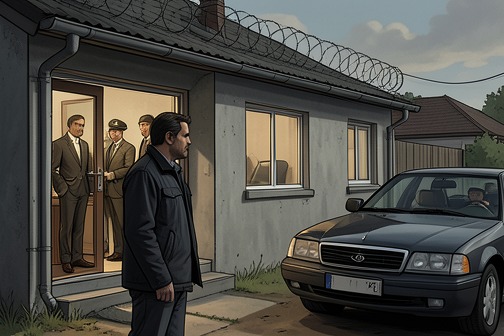
The raid on [Orlando Arendse](entity:character-recall-character-orlando-arendse-97db8c7453be)’s hideout turns a heavily defended house into a scene of controlled surrender in seven minutes. [Tiger Mazibuko](entity:character-recall-character-tiger-mazibuko-c3f21f32c499) and the [Reaction Unit](entity:organization-recall-organization-4127e5cc1cfa) breach its defenses by stealth, coordinated movement, and sudden violence; once inside, Mazibuko makes clear that the force is not operating as the [South African Police](entity:organization-recall-organization-f4010c2f2736). The capture is decisive, but the method shifts the scene’s emphasis from the house’s apparent security to the coercion that establishes control within it.
## Defenses and Approach
The house is protected by concrete walls topped with razor wire, a high gate, and people watching along the street as an early-warning system. Eight men are inside with a collection of weapons. These defenses suggest that an assault should be difficult to conceal and costly to attempt, yet the operation takes only seven minutes. The contrast between the preparations and the speed of the capture gives the raid its central reversal: barriers and armed occupants do not prevent the attackers from taking the house.
The Reaction Unit approaches in darkness, divided into three teams of four, four, and five. Two unmarked cars leave them a block south of the target. From there, they move through gardens and over walls, reach the yard from three sides, and quietly cut the rusty razor wire. The account stresses both preparation and coordination: the teams arrive by separate routes, scale the perimeter, and use hand signals visible in the street light. Their approach turns the house’s defenses against its occupants by avoiding a direct, noisy confrontation at the gate.
## Breach and Capture
The windows are burglar-proofed, but their large panes are not protected. The attackers exploit that opening, entering at three separate points within seconds of one another. They break through, dive, and roll into the house in practiced movements. The occupants scramble to respond, but the simultaneous entries leave them too little time to organize a defense. Thick camouflage paint, battledress, and Heckler & Koch machine pistols pressed to the captives’ temples mark the forceful change in the room: panic and movement give way to stillness, and a single voice takes command.
Mazibuko has the captives brought into the front room and forced to lie on their bellies with their hands behind their heads. He assigns Weyers and Zongu to watch the street, then addresses the bodies on the floor: “Who’s in charge here?” No one answers at first. The pause, and the slight trembling of one or two captives, register the fear produced by the assault without yet identifying a leader. Mazibuko responds by ordering Da Costa to shoot one man in the knee. When Da Costa asks which one, Mazibuko points him toward a target and specifies the injury he wants inflicted.
## Coercion and Identification
An appeal is made to the rules governing the South African Police: “There are rules for the SAPS.” Mazibuko laughs and orders Da Costa to shoot. The shot sounds through the confined room like a thunderbolt; the man makes a deep, curious noise, and cordite fills the air. The narration records the immediate sensory consequences of the order, making the threat concrete rather than merely verbal. The shot is a means of forcing an answer, and it changes the captives’ silence from a standoff into a test of whether anyone will continue to resist.
Mazibuko then states the distinction on which his authority rests: “We are not police.” He repeats his demand, now asking who the chief gangsta is. The man in the middle identifies himself as the person in charge, his face creased with anxiety. Mazibuko tells him to stand; the man asks whether he will be shot too. The exchange ends with the leader identified but still under threat. The raid’s immediate result is therefore both tactical and personal: the Reaction Unit has taken the house, and Mazibuko has compelled its central figure to disclose himself. The scene leaves the consequences beyond that confrontation unstated, while making the unit’s methods and its distance from ordinary police procedure unmistakable.
Event 12
Intelligence services launch a manhunt for Thobela
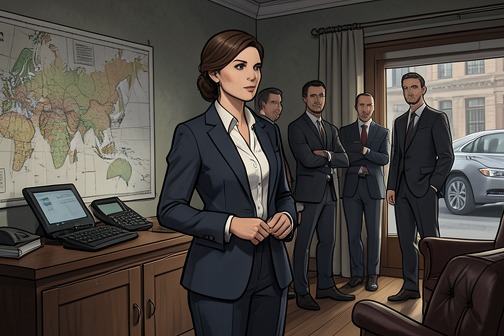
The manhunt for [Thobela Mpayipheli](entity:character-recall-character-thobela-mpayipheli-bde650756e15) begins as an intelligence failure that [Janina Mentz](entity:character-recall-character-janina-mentz-374453134b98) tries to turn into a coordinated national pursuit. Having lost track of his location and immediate movements, she plots a likely route north, mobilizes police and intelligence resources, and prepares an interception on the [N1](entity:location-recall-location-n1-a1425420691b). The operation gives the state formidable reach, but its dependence on incomplete information leaves room for Mpayipheli to escape the routes and conditions his pursuers anticipate.
## Loss of Control and the Search for Information
Mentz’s response begins with an admission that her unit had once believed it controlled the situation: it knew where Mpayipheli and [Monica Kleintjes](entity:character-recall-character-monica-kleintjes-ddb490033632) were and how he intended to travel. That confidence has collapsed. Mentz identifies the failures as a lack of information, intelligence, and judgment, including at the airport, and insists that the immediate priorities are to find Mpayipheli, locate the disk, and understand why Monica went to him. Her anger is directed at an operation that has lost its advantage, not simply at the fugitive who has escaped it.
The search is therefore also an effort to discover who Mpayipheli is. Mentz orders investigative teams to pursue information about Monica, [Miriam Nzululwazi](entity:character-recall-character-miriam-nzululwazi-394be6ca6495), and Mpayipheli’s family and friends. The instructions broaden the pursuit beyond the road: relatives and personal connections become possible sources of intelligence. The fugitive is still largely unknown to the people hunting him, and Mentz’s demand for a fuller account of his identity reflects the difference between knowing his likely direction and understanding the person whose choices may defeat their plans.
## Mapping the Route and Preparing the Net
Mentz’s operational method is guided by a principle of seeing reality as it is rather than as she wishes it to be. While the operations room works around her, she considers the route and the limits of what can be inferred about Mpayipheli’s motivation. She sets aside the still-unanswered question of why he is so single-minded and concentrates on practical measures: where he might go, what forces can be positioned there, and how the pursuit can be constrained.
She has a map of the country brought to the wall and draws Mpayipheli’s likely route in red. The [Reaction Unit](entity:organization-recall-organization-4127e5cc1cfa) is assigned the role of a net, positioned seventy-seven kilometres north of [Beaufort West](entity:location-recall-location-beaufort-west-9fae3c0c9a72) at a fork where the possible routes toward Johannesburg divide: one toward [Kimberley](entity:location-recall-location-kimberley-af7b699c7241), the other toward [Bloemfontein](entity:location-recall-location-bloemfontein-91939396c37f). The placement turns geography into an operational tool. Rather than knowing Mpayipheli’s exact destination, Mentz aims to place forces where the available paths multiply and the fugitive may have to commit to one.
Mentz also instructs the teams of [Quinn](entity:character-recall-character-quinn-2af072947d03) and [Vincent Radebe](entity:character-recall-character-vincent-radebe-d6a5ba81e5e3) to alert police stations and traffic authorities along the route. Their initial task is to gather intelligence, not to act. This restraint reflects uncertainty as much as procedure: Mpayipheli is an armed fugitive, but remains an unknown factor to the pursuing teams, who know he can shoot without knowing what he will do next. The order sets a boundary between surveillance and confrontation, while preserving the possibility of a later interception.
## The Pursuit Becomes Public and Aerial
The manhunt reaches beyond the operations room when an intelligence agency alerts local police and traffic authorities along the N1 to look for a Xhosa man on a large BMW motorcycle. [Allison Healy](entity:character-recall-character-allison-healy-35acfe29d17c), a crime reporter for the [Cape Times](entity:organization-recall-organization-2236348bd1c9), turns the sparse official notice into front-page news. Her report says that reliable sources place the alert at about 22:00 the previous night and identifies the pursuing agency only as a secret government intelligence body, rumoured to be the [Presidential Intelligence Unit](entity:organization-recall-organization-presidential-int-02952ccf70a3). It reports that Mpayipheli is allegedly carrying two firearms and riding an illegally obtained [BMW R 1150 GS](entity:object-recall-object-bmw-r-1150-gs-806a26725aa3), while hinting that these allegations do not explain why the authorities want to apprehend him so urgently.
At Beaufort West, Rooivalk attack helicopters wait for instructions. Mentz tells Quinn that they should rest and, if no further information arrives by dawn, begin patrolling the N1 southwards. They must consult the operations room before taking off: she does not want contact with the fugitive before her side is ready. At the same time, police and traffic personnel are already preparing a roadblock at [Three Sisters](entity:location-recall-location-three-sisters-a30c277e2b6b), despite rain in the [Karoo](entity:location-recall-location-karoo-3c1c4108d0e9). Mentz checks whether they know to inspect all vehicles and asks when [Captain Tiger Mazibuko](entity:character-recall-character-captain-tiger-mazib-aaad0ca05cc5) will arrive. The operation is assembling on several fronts—aircraft, roadblocks, local authorities, and intelligence teams—while its commander tries to control when those forces engage.
## A Network Tested by Movement and Terrain
Mpayipheli’s journey exposes the practical difficulty of predicting movement from a map. On the BMW, he initially struggles with its size, height, weight, power, and unfamiliar handling. At a turn onto Oswald Pirow Street, the bike nearly catches him out; at the N1 traffic lights, hard braking almost tips him again. He proceeds cautiously, aware of the surrounding traffic and still learning how the GS behaves. The machine that makes him conspicuous and difficult to manage at first also carries him onto the highway and sustains the northward journey the intelligence network is trying to anticipate.
The pursuit later becomes a direct contest between speed and weather. Two helicopters follow Mpayipheli at low altitude, but he presses on as the speedometer passes 200 kilometres per hour and a bank of rain approaches. Visibility collapses in the downpour; he slows behind a truck, wipes at his visor, then cautiously passes as the lorry moves aside. The helicopters’ noise fades and they are no longer with him. The episode demonstrates the gap between having surveillance in the air and being able to maintain it under changing conditions: the aircraft can overtake him, but cannot make the storm irrelevant to either side.
The pursuit also costs Mpayipheli time. Later, lying under a bridge while those watching for a signal remain in place, he calculates the lost hours against the distance still to [Lusaka](entity:location-recall-location-lusaka-2dc45c5fc46b). He has at least two national borders ahead and a passport but no papers for the BMW. Bribery might consume time and could fail; finding or making a gap in a border fence offers another possibility, while the [Zambezi River](entity:location-recall-location-zambezi-river-69f6bcda64ca) presents a more difficult obstacle. His hiding place is temporary, too: darkness shelters him, but the bridge’s deep shadow will not conceal him once morning arrives. The operation’s significance lies in this ongoing contest between a state assembling information and forces along likely routes, and a fugitive whose movement, delays, and evasions keep turning prediction into a provisional advantage.
Event 13
Zulu files and the Inkululeko lead are exposed
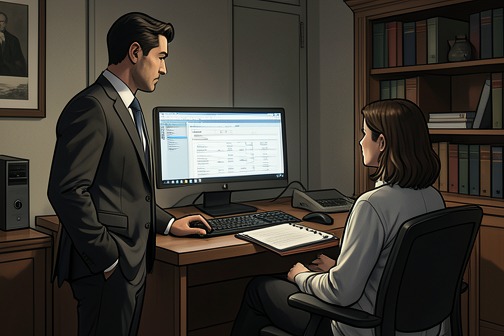
The exposure of the [Zulu Dossier](entity:object-recall-object-zulu-dossier-616d18d2098b) and the [Inkululeko](entity:character-recall-character-inkululeko-9ae708b27ee4) lead turns a hidden intelligence archive into evidence of the old regime’s covert relationships and the uncertain loyalties surviving its end. The account emerges through testimony about files that were being deleted, the backups [Johnny Kleintjes](entity:character-recall-character-johnny-kleintjes-bf98fd1e4a42) made to preserve them, and a dossier containing names, weapons information, strategy, and the identity of a suspected high-level infiltrator. The revelation is consequential but incomplete: the witness says Kleintjes knew Inkululeko personally, perhaps as a friend, while the mole’s identity itself remains undisclosed.
## Records at Risk
The files came to light against the disorder of intelligence-service integration after the elections. The branches did not readily cooperate: they concealed information, lied, and competed, while the cost of maintaining their systems exceeded what had been budgeted. The attempt to impose order involved dividing the work into projects and combining computer records. The scale was formidable: material from Infoplan in [Pretoria](entity:location-recall-location-pretoria-6b0a39acc851) alone was expected to take years to process, alongside records from Denel, the Security Police, the Secret Service, [Military Intelligence](entity:organization-recall-organization-724601e0c2de), and the [African National Congress](entity:organization-recall-organization-1cd3963560dc) systems in [Lusaka](entity:location-recall-location-lusaka-2dc45c5fc46b) and London. The combined information amounted to an estimated four or five hundred gigabytes and ranged from personal details about members of the public to weapons systems and informants.
The integration project required decisions about what to preserve and what to remove. Its remit included erasing material thought likely to cause trouble, retaining useful information, and creating a uniform central database. That process made the archive vulnerable not only to technical failure but also to human choices about what would survive. In testimony, Groenewald explains that some team members remained shaped by years of secrecy and an us-against-them outlook; operational records disappeared when individuals did not want them counted against them. When Kleintjes recognized the deletions, he began making backups. After one backup tape disappeared, he started taking work home. The dossier’s survival was therefore tied to an act of preservation prompted by evidence of loss.
## What the Dossier Contained
The preserved records included two different kinds of politically sensitive lists. The X-lists tracked politicians, judges, and intelligence personnel through information about relationships, financial difficulties, and alleged links to the opposition. The E-lists recorded people who had been killed and people marked for future elimination. The testimony identifies the Zulu Dossier as another distinct and more expansive body of material, not simply a roster of political sympathizers.
Groenewald describes the dossier as containing names of members of the secret [Organization for Zulu Independence](entity:organization-recall-organization-4225fe61e32c), including politicians, businesspeople, and academics. He recalls the University of Zululand as a recruiting ground and says that the head of its History Department had led the organization for years. The dossier also held information on weapons caches, strategy, and plans. Its contents connected political membership to practical preparations and made the archive potentially significant to anyone seeking to understand the organization’s reach and aims.
## The Inkululeko Lead
Among the dossier’s contents was the code name Inkululeko, identified in the testimony as the Zulu word for freedom. Groenewald describes Inkululeko as an OZI member who had infiltrated the African National Congress years earlier and risen to a high level. He also recounts talk that the same person had worked for the [Central Intelligence Agency](entity:organization-recall-organization-central-intellig-55def823fc61) during the [Cold War](entity:time-recall-time-cold-war-8b037806e152). A more recent rumor suggested that Inkululeko might still be assisting the Americans, in light of the present government’s position on Libya and Cuba. The testimony establishes these claims as reported intelligence and rumor, not as independently verified facts.
Asked whether he knew the person’s identity, Groenewald says he did not. He believes, however, that Kleintjes knew Inkululeko personally and may have been his friend. That proposed connection offers a possible explanation for why Kleintjes did not expose the name, but the exchange leaves both the identity and the reason unresolved. What the evidence does establish is narrower: Kleintjes saw the list, retained intelligence material others were allowing to disappear, and possessed knowledge that could have exposed an infiltration reaching into the African National Congress.
## Preservation and Its Limits
The event makes the archive’s physical and administrative handling part of the story. In a system where digital information could be copied, distributed, or accessed by intruders, Rajkumar’s approach was to restrict the authoritative record to paper. Typists transcribed tapes in a monitored room; each tape was signed out and returned, the paper copy was signed in, and the digital tapes were deleted. The paper record was then filed in an access- and temperature-controlled library alongside magnetic tapes. This procedure sought control through limited copies, but the account of disappearing backup tapes and Kleintjes taking work home shows that procedures could not guarantee what would be preserved or who could retrieve it.
The dossier’s exposure thus reveals both the reach and the incompleteness of intelligence archives. The records preserve the outline of covert networks, weapons preparations, and a suspected infiltrator, yet they do not supply Inkululeko’s name or settle the alleged foreign connection. Their contents have passed through deletion, private backup, and testimony; each stage shapes what can be known. The surviving lead is powerful precisely because it is not a complete answer: it makes the existence and possible importance of the mole legible while leaving the central identification unresolved.
Event 14
Mpayipheli’s flight and the national manhunt
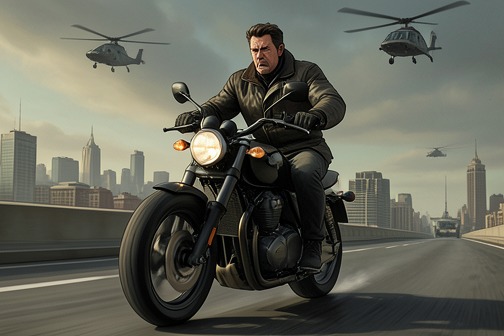
[Thobela Mpayipheli](entity:character-recall-character-thobela-mpayipheli-bde650756e15)’s flight and the national manhunt are a race over roads, information and control. As he rides a stolen [BMW R 1150 GS](entity:object-recall-object-bmw-r-1150-gs-806a26725aa3) away from [Cape Town](entity:location-recall-location-cape-town-f6ea4334d11c), [Janina Mentz](entity:character-recall-character-janina-mentz-374453134b98)’s team tracks him by air; yet the pursuit’s real stakes lie beyond the motorcycle. Mentz suspects that he has the genuine hard disk, and wants to prevent its data from reaching [Lusaka](entity:location-recall-location-lusaka-2dc45c5fc46b). The escape therefore becomes both a physical journey across southern Africa and a contest over who can control the evidence he carries.
## Background and Stakes
Mpayipheli begins the flight on a machine far larger and more powerful than the Honda Benly he knows. Turning onto Oswald Pirow Street and opening the throttle, he nearly loses control: the BMW feels heavy, high and unwieldy, and its acceleration catches him by surprise. At the lights by the [N1](entity:location-recall-location-n1-a1425420691b), he nearly tips again when the anti-lock brakes engage. He sets off cautiously, knees trembling, and discovers that the GS can reach 100 kilometres per hour before he is properly into third gear. On the freeway he initially rides below the traffic’s pace, trying to manage the broad handlebars and oversized tank. The machine that gives him speed and range is also, at first, a danger he has not mastered.
His route is shaped by the pursuit as well as by distance. Beyond Touws River, he calculates the fuel needed to reach [Laingsburg](entity:location-recall-location-laingsburg-a71091e6a985), then faces roughly 200 kilometres of highway to [Beaufort West](entity:location-recall-location-beaufort-west-9fae3c0c9a72) through the [Great Karoo](entity:location-recall-location-great-karoo-960d979bec6d). From there, [Bloemfontein](entity:location-recall-location-bloemfontein-91939396c37f) lies another 500 or 550 kilometres away. He hopes to reach it before sunrise, then rest in a Black township during the day. Meanwhile, those searching for him expect him to follow the N1; he understands that changing the pattern will require a road map and better knowledge of his options. The route is not simply a line toward safety: every kilometre must be weighed against fuel, visibility and the likelihood that his pursuers have anticipated it.
The hard disk gives this movement its political urgency. Mentz suspects that Mpayipheli has the real disk—the one prepared by her side—and makes clear that she does not want its data to reach Lusaka. Her preferred plan is to stop him at the airport and send the disk through one of her own people, preserving control of its handling. The pursuit is thus not merely an effort to catch a fugitive. It is an attempt to intercept information before it can pass beyond the intelligence service’s reach.
## The Aerial Pursuit
At a petrol station, Mpayipheli drinks coffee, eats a sandwich and asks how far it is to Bloemfontein and whether police are on the road. He tries to look like an armed and dangerous fugitive, though he cannot know whether the attendant will take the hint. Then he rides toward [Three Sisters](entity:location-recall-location-three-sisters-a30c277e2b6b) at 185 kilometres per hour, hoping to pass the area on his way to [Kimberley](entity:location-recall-location-kimberley-af7b699c7241) before the authorities can react. The newspapers have already reported that intelligence authorities are pursuing a man suspected of stealing a motorcycle in Cape Town and heading north. The public description of his flight is itself another form of surveillance: it can alert those ahead of him, and reaches [Miriam Nzululwazi](entity:character-recall-character-miriam-nzululwazi-394be6ca6495) at home, where she switches off the radio before [Pakamile](entity:character-recall-character-pakamile-db01684d694b) can hear the report.
In the Ops Room, a pilot reports that the fugitive has been intercepted 30 kilometres outside Beaufort West, on a yellow motorcycle at an estimated 200 kilometres per hour. The room erupts in applause; Mentz smiles, relieved that her prediction has been borne out. The command, however, is to stay behind him and make no contact. The instruction turns interception into a close but deliberately incomplete pursuit: the helicopters can shadow Mpayipheli without immediately forcing an encounter on the road.
He senses the aircraft before he can make sense of their intentions. One helicopter flies low over him, then returns behind him; when he looks back, he sees two flying side by side. Their engines vibrate through his body, and he knows that their speed makes escape by acceleration alone impossible. An oncoming truck, confused by the noise overhead, nearly swerves into his path. Ahead, the weather offers a different possibility. The cloud bank grows darker, the rain begins, and he wonders whether the helicopters will follow him into it.
## The Storm and the Change of Pursuit
The storm makes speed dangerous. Mpayipheli tries to pass a car, but the driver brakes beneath the aircraft’s noise; he swerves, receives spray across his visor and sees a truck ahead. As rain falls in sheets, the lorry’s tyres throw up mist and his view of oncoming traffic disappears. He closes the throttle and slows, then wipes at the visor, only to leave the water rearranged across it. When the lorry moves aside, he changes down a gear and passes, but visibility remains terrible. The aircraft’s noise begins to fade. The rain that has made the road nearly impassable has also broken the immediate aerial pursuit.
The encounter does not end the manhunt; it changes its form. Mpayipheli later identifies himself over a military frequency as the man being sought and asks who is pursuing him. [Captain Tiger Mazibuko](entity:character-recall-character-captain-tiger-mazib-aaad0ca05cc5) answers by name and calls him a dead man. The exchange makes the chase personal as well as operational: each now knows that the other is present, and the radio becomes a channel through which the fugitive and his pursuer can address one another directly.
## Evasion, Delay and Continuing Flight
After the storm, Mpayipheli’s escape relies on concealment and other people’s help as well as speed. He lies curled on an old mattress in the back of [Koos Kok](entity:character-recall-character-koos-kok-066addcf08aa)’s El Camino, beside the BMW, which has been laid on its side with its baggage cases removed. A dirty, paint-flecked tarpaulin covers the cramped load of furniture, suitcases, clothes and documents. The dirt road jolts the truck, but the mattress makes the journey bearable. Hidden from view, Mpayipheli thinks about a moment when he restrained an almost irresistible impulse, taking satisfaction in having chosen reason over instinct. He hopes to call Miriam and reassure her, and imagines the stories he might later tell Pakamile.
Hiding also costs him time. Under a bridge, he calculates the hours lost while he should have been making distance toward Lusaka. He has a passport but no papers for the BMW, and knows that bribing his way through Customs could consume time or fail if he meets the wrong official. A gap in a border fence might offer another route, but the [Zambezi River](entity:location-recall-location-zambezi-river-69f6bcda64ca) remains a formidable obstacle. Darkness protects him beneath the bridge; daylight will expose the hiding place. The journey therefore continues under pressure from a narrowing window of concealment, at least two national borders and a river that cannot be bypassed as easily as a roadblock.
The flight’s governing idea is unpredictability. Recalling [Otto Müller](entity:character-recall-character-otto-m-ller-b384d4f01327)’s explanation of protean behaviour, Mpayipheli thinks of the hare that survives by zigzagging rather than fleeing in a straight line. That principle describes his changing relationship to the BMW, his movement through the storm and his shift from open road to a covered truck and roadside concealment. The national manhunt can anticipate a destination or monitor a highway, but each change of vehicle, route or hiding place complicates its picture of where he will appear next.
Event 15
Three Sisters roadblock escape
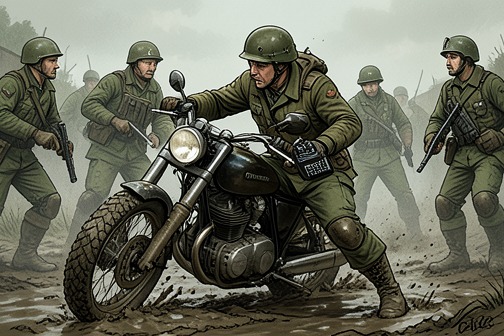
[Three Sisters roadblock escape](entity:event-recall-event-three-sisters-roadblock-0bc581dc559a) turns a high-speed pursuit into a close-range test of [Thobela Mpayipheli](entity:character-recall-character-thobela-mpayipheli-bde650756e15)’s control. Hunted by air and blocked on the ground, he loses command of his motorcycle in the mud and collides with the soldiers. He escapes with one of their firearms, but then uses a military radio not to taunt his pursuers, but to identify himself, acknowledge an injury, and ask for the pursuit to stop. The episode’s decisive tension lies in that contrast: Thobela has the means to inflict further violence, yet makes restraint part of his escape.
## Background and the road north
The flight is already dangerous before the cordon comes into view. When Thobela first takes the [BMW R 1150 GS](entity:object-recall-object-bmw-r-1150-gs-806a26725aa3), its power and bulk nearly throw him: turning onto Oswald Pirow, he opens the throttle too sharply, struggles to recover the bike, and nearly tips again when its anti-lock brakes engage. The machine is far more powerful than his Honda Benly; on the freeway, he is still learning its wide handlebars, heavy tank, and balance while trying not to impede the traffic around him. His escape therefore depends on a vehicle that gives him speed but initially demands more skill than he has had time to acquire.
Beyond Touws River, he takes stock of the distance and the fuel gauge. He expects to refuel at [Laingsburg](entity:location-recall-location-laingsburg-a71091e6a985), then face roughly 200 kilometres to [Beaufort West](entity:location-recall-location-beaufort-west-9fae3c0c9a72) across the [Great Karoo](entity:location-recall-location-great-karoo-960d979bec6d); from there, [Bloemfontein](entity:location-recall-location-bloemfontein-91939396c37f) lies another 500 or 550 kilometres away. He considers whether he can reach it before sunrise, then anticipates needing to rest in a Black township during daylight. These calculations make the chase more than a contest of speed: fuel, fatigue, darkness, and the need to avoid detection all shape the route.
## Air pursuit and the storm
The immediate pursuit intensifies when a helicopter flies low over Thobela, less than a hundred metres above him, before falling back beside a second helicopter. Their engines vibrate through him as he holds the accelerator open, aware that the aircraft are faster and wondering why they are not closing in. He is already travelling at more than 200 kilometres per hour when a dense bank of weather approaches. The oncoming traffic’s lights and wipers suggest the storm’s depth; then rain strikes hard enough to reduce visibility and make the visor difficult to see through.
Thobela slows behind a truck, waits for an opportunity to pass, and continues through sheets of rain and spray. The weather that impairs his escape also disrupts the aerial pursuit. On the ground, [Quinn](entity:character-recall-character-quinn-2af072947d03) receives a report that visibility is too poor and turbulence too heavy for the Rooivalk crews to continue safely. [Janina Mentz](entity:character-recall-character-janina-mentz-374453134b98) orders them to stay with him, but the pilots report that visibility is zero and that they have lost visual contact even with one another. The command to maintain pursuit cannot overcome the conditions: the storm has made the surveillance network blind.
## The collision at the cordon
The rain also muffles Thobela’s approach to the soldiers. They do not hear the motorcycle coming. Weariness after a sleepless stretch and the steady noise of rain dull their senses; their conversation further reduces the chance of warning. The ground at the bend is treacherous: the straight beforehand offers a good surface for acceleration, but the turn is unexpectedly sharp, and thick mud lies directly in front of the soldiers. Following the road’s established track, Thobela reaches the critical point and the front wheel loses its grip.
The soldiers see the headlight and hear the engine only when the machine is upon them. [Little Joe Moroka](entity:character-recall-character-little-joe-moroka-691d62ffb2af) and Weyers react together, their training bringing their hands to their weapons as the sliding motorcycle strikes Weyers. Thobela falls away from the bike; Moroka also goes down, and his R6 fires into the air as he falls. In the confusion, Thobela gets up quickly, drives into Moroka, and knocks him down again. Moroka’s later reconstruction emphasizes how little time there was to understand what had happened: the rider seemed to fall, then was suddenly on him.
Thobela takes Moroka’s R6 after a struggle in the mud. With the gun at Moroka’s eye, he pushes up his helmet visor and tells him, “Look what you’re making me do.” The encounter is not presented as a clean, planned assault: the loss of control that caused the collision was accidental, and the violence that follows occurs in the seconds required to get free. Weyers is injured, and Moroka cannot turn toward him when he hears him calling. The pursuit has produced a real casualty, even though Thobela has not set out to cause one.
## Identification and immediate consequences
Thobela then reaches a military frequency and gives his name, declaring that he is the man the authorities are seeking. For [Captain Tiger Mazibuko](entity:character-recall-character-captain-tiger-mazib-aaad0ca05cc5), the admission brings a sudden, charged recognition: the fugitive has not merely escaped a team but proved himself a worthy opponent. Mazibuko answers with a death threat and urgently mobilizes his people, ordering the helicopter back into the air and collecting weapons and ammunition. The exchange makes the pursuit personal, sharpening the conflict between a fugitive trying to escape and a commander determined to catch him.
Thobela’s own message is different in tone. He tells Captain Tiger Mazibuko that nobody needs to die, promises to do what he must if left alone, and asks for medical help for the injured men west of the [N1](entity:location-recall-location-n1-a1425420691b), near the [Sneeukraal turn-off](entity:location-recall-location-sneeukraal-turn-off-7414123c9b0b). He specifically says that the serious injury was an accident and expresses regret. His account does not erase the danger of the assault or his taking of the firearm; it does, however, establish that he distinguishes escape from killing and is willing to make that distinction explicit to his pursuer.
The storm and the collision leave the cordon behind, but the journey remains precarious. Later, [Koos Kok](entity:character-recall-character-koos-kok-066addcf08aa) conceals Thobela in the back of a battered [Chevrolet El Camino](entity:object-recall-object-el-camino-8f7db27b66c4), lying on an old mattress beside the BMW R 1150 GS under a paint-flecked canvas tarp. Thobela reflects with satisfaction on suppressing an almost irresistible impulse when a door opened, and imagines telling [Miriam Nzululwazi](entity:character-recall-character-miriam-nzululwazi-394be6ca6495) that he is safe and giving [Pakamile](entity:character-recall-character-pakamile-db01684d694b) stories of the journey. The hiding place is temporary, like the escape itself: in a later stretch, lost hours become urgent because he still faces national borders, lacks papers for the motorcycle, and must find a way across the [Zambezi River](entity:location-recall-location-zambezi-river-69f6bcda64ca). The cordon is broken, not the larger trap of distance, pursuit, and time.
Event 16
Koos Kok helps Mpayipheli evade the manhunt
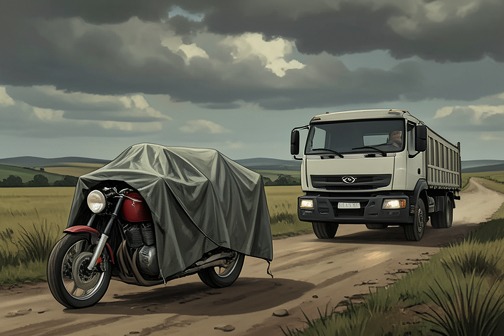
[Koos Kok](entity:character-recall-character-koos-kok-066addcf08aa) helps [Thobela Mpayipheli](entity:character-recall-character-thobela-mpayipheli-bde650756e15) evade the manhunt not with weapons or speed, but with an old [Chevrolet El Camino](entity:object-recall-object-el-camino-8f7db27b66c4), an improvised disguise, and a willingness to take a fugitive into his care. The escape briefly turns the pursuit’s terms upside down: Thobela, exposed on a powerful [BMW R 1150 GS](entity:object-recall-object-bmw-r-1150-gs-806a26725aa3), becomes cargo beneath a tarpaulin, while Koos’s inconspicuous bakkie carries both man and motorcycle past police. The episode also tests Thobela’s self-control, making the chance to get away inseparable from his decision not to kill a stranger at the door.
## From the road to Koos’s door
Before Koos enters the journey, Thobela is still learning how to manage the BMW R 1150 GS he has taken to flee [Cape Town](entity:location-recall-location-cape-town-f6ea4334d11c). Its power nearly throws him as he turns onto Oswald Pirow; at the [N1](entity:location-recall-location-n1-a1425420691b) traffic lights he nearly tips again when the anti-lock brakes engage. He proceeds cautiously, startled by the bike’s size and by reaching 100 kilometres per hour before properly getting into third gear. The open road offers mobility, but it also leaves him visible and vulnerable.
That vulnerability sharpens when two helicopters follow him at low altitude. Thobela pushes the GS beyond 200 kilometres per hour, but speed cannot make him faster than the aircraft. He passes traffic in worsening weather, then enters a dense curtain of rain, slowing because he cannot see clearly. When the helicopter noise fades, the storm has provided an escape the motorcycle alone could not. Elsewhere on the journey, fuel and distance remain pressing calculations: beyond Touws River he plans to refuel at [Laingsburg](entity:location-recall-location-laingsburg-a71091e6a985), considers the long stretch to [Beaufort West](entity:location-recall-location-beaufort-west-9fae3c0c9a72) through the [Great Karoo](entity:location-recall-location-great-karoo-960d979bec6d), and weighs whether he can reach [Bloemfontein](entity:location-recall-location-bloemfontein-91939396c37f) before sunrise. His route is a sequence of practical limits, not a clean line to safety.
## Koos recognizes the fugitive
Koos’s help begins with recognition. He has heard radio coverage of the wanted biker and later listened to John Modise; when he sees the motorcycle near his winter quarters, he understands who has arrived. He interprets the encounter as divine guidance and decides to help rather than stand aside. His choice is striking because he is not introduced as an intelligence operative or armed ally, but as a local entertainer known for songs about the landscape and its people.
The meeting nevertheless carries immediate danger. In a shallow, fitful sleep, Thobela hears a car door slam and rolls off the mattress toward the wall beneath a window. When a man comes inside, Thobela is poised for violence. Koos appears in a tattered suit, a grey shirt, and a bowtie faded from what may once have been red, his hands raised protectively. Thobela later recognizes the encounter as a test of self-control: he had felt an almost irresistible impulse, but suppressed it. The importance of Koos’s arrival therefore lies not only in the shelter he offers, but in the choice Thobela makes at the threshold.
Koos’s account of himself is exuberant and digressive. He calls himself the Troubadour of the [Northern Cape](entity:location-recall-location-northern-cape-90b308b1b32d), a singer who performs for town audiences and writes songs at his winter home. His talk moves between conventional language and the language of his people, requiring Thobela to ask for translation. This distinctive, socially marginal figure becomes an unlikely guide through the pursuit: his local knowledge and his readiness to act matter more than any official authority.
## The El Camino as concealment
Koos’s plan transforms the means of escape. Thobela lies on an old mattress in the back of the Chevrolet El Camino beside the BMW, which has been laid on its side with its baggage cases removed. Around them are rickety furniture, four tatty suitcases filled with clothes and documents, and a carton of stolen mutton. A dirty, paint-flecked canvas covers the load. The vehicle’s worn shock absorbers make the dirt road rough, but the mattress makes the cramped space bearable; rain taps and drips through holes in the tarp.
The arrangement is both practical concealment and a reversal of Thobela’s earlier exposure on the road. The motorcycle that had announced his presence through speed and engine noise is hidden among the ordinary disorder of a working vehicle. Koos’s joke about the mutton as redistribution of wealth gives the cargo a comic cover, but the stakes underneath it remain severe: Thobela is carrying [the hard disk](entity:object-recall-object-94f8ccdf6fc6) toward [Lusaka](entity:location-recall-location-lusaka-2dc45c5fc46b), and every delay reduces the time available for a journey involving several borders. His passport is in his bag, but the GS has no papers. He considers bribery and the possibility of finding or making a gap in a border fence; the [Zambezi River](entity:location-recall-location-zambezi-river-69f6bcda64ca) presents a further obstacle. Koos’s ride buys movement, not certainty.
## The police stop and the handoff
The disguise is tested when the El Camino stops and Thobela wakes to voices. A sergeant orders Koos to show what is under the canvas and asks how many sheep are in the back. Koos denies being in the sheep-stealing business any longer, but the officer accuses him of remaining a sheep thief. Thobela, concealed nearby, wonders how many men are present and whether he could act if discovered. The exchange makes the danger concrete: a single inspection could expose both fugitive and motorcycle.
The police do not find Thobela. When one man asks about the short figure with the motorbike, another tells Koos to leave before he gets into trouble, saying they have more important things to do. Koos answers that he is going to drop off the motorcycle, climbs back into the bakkie, and drives away with spinning tyres. The escape does not defeat the manhunt outright; it passes through a moment of official scrutiny because the officers turn their attention elsewhere and Koos keeps the encounter moving.
After hours beneath the tarp, Thobela is cramped, hot, dusty, and increasingly impatient. Koos finally stops and theatrically lifts the canvas, revealing a different landscape: grass veld, hills, and a town in the distance. He identifies it as Philipstown. Thobela thanks him, then puts his bag in the BMW’s side case, pulls on his gloves, and starts the engine. After a brief hesitation, the GS catches. Thobela rides away through the gears, now comfortable in the machine and back in control, while Koos and the El Camino recede behind him.
## Significance within the escape
The episode makes evasion a matter of changing forms of movement. The GS gives Thobela speed but leaves him exposed; the storm interrupts the helicopters’ pursuit; Koos’s bakkie conceals him by making him part of an unremarkable, cluttered load. The sequence recalls the idea of protean behaviour that Thobela learned from [Otto Müller](entity:character-recall-character-otto-m-ller-b384d4f01327): survival depends on not moving in a predictable, straight line. Here, adaptation is literal, from rider to hidden passenger and back to rider.
Koos’s assistance also creates a pause in Thobela’s cycle of violent response. At the door he has the impulse to attack, yet chooses restraint; later he remembers that decision with satisfaction and imagines telling Miriam about it, as well as having stories to tell [Pakamile](entity:character-recall-character-pakamile-db01684d694b). The ride does not resolve the dangers ahead, but it carries Thobela beyond one exposed stretch of the pursuit and gives his self-command a consequence: an ally lives, and the journey continues.
Event 17
Janina Mentz’s counterintelligence operation against Inkululeko
[Janina Mentz’s counterintelligence operation against Inkululeko](entity:event-recall-event-janina-mentz-inkululeko-1e0c16b0c3b9) is a controlled attempt to test a suspected intelligence penetration by feeding the [Central Intelligence Agency](entity:organization-recall-organization-central-intellig-55def823fc61) information and watching how it responds. Its design depends on credible deception, but the operation escapes Mentz’s control: [Johnny Kleintjes](entity:character-recall-character-johnny-kleintjes-bf98fd1e4a42) may have anticipated the danger, and [Thobela Mpayipheli](entity:character-recall-character-thobela-mpayipheli-bde650756e15) may be carrying the real hard disk. What begins as a test of an alleged informant ends with Mentz unable to explain what Johnny knew or to whom he might have disclosed it.
## Allegation and Historical Background
The operation takes shape after police approach the intelligence services about [Ismail Mohammed](entity:character-recall-character-ismail-mohammed-cf4d6ef5ff92), arrested on March 17 on charges of possessing unlicensed firearms. Mohammed repeatedly requests a meeting with an intelligence representative. Mentz sends [Williams](entity:character-recall-character-williams-5367b03b0006) to meet him, and later tells [The Director](entity:character-recall-character-the-director-ac067526026f) that Mohammed’s information concerns [Inkululeko](entity:character-recall-character-inkululeko-9ae708b27ee4). Her account places the new lead against a history of suspicion rather than presenting it as a settled discovery.
The rumors about Inkululeko reach back to the 1980s, when leaders of the [African National Congress](entity:organization-recall-organization-1cd3963560dc) reportedly regarded them as counter-intelligence planted by the Regime to undermine unity between Xhosa and Zulu members of the organization. Yet the suspicions persist after 1992 amid violence in Kwa-Zulu and allegations surrounding the Third Force. Since the 1994 elections, Mentz says, there has also been a feeling that the Central Intelligence Agency is unusually well informed. The old rumors and newer unease make Mohammed’s claim consequential, but they do not make it proof.
Mohammed says Inkululeko is a senior member of the intelligence arm and has worked for the Central Intelligence Agency for years. He claims to have evidence, though Mentz describes it not as one decisive document but as many small indications. His account further alleges that Cape Muslim extremists with connections to Ghadaffi, Arafat, and Bin Laden deliberately fed disinformation into the system and observed events in the Middle East. Mentz acknowledges that the possibility of a rival group trying to remove Inkululeko by supplying information must be considered. The operation therefore tests not only whether the allegation is true, but whether the source itself is manipulating the service.
## The Test and Its Deception
Mentz brings Johnny Kleintjes out of retirement because she needs someone credible who would have had access to the data. She sends him to the American consulate with three names, including The Director’s, and a quantity of harmless information. The proposed test is conditional: if the Americans dismiss the material as nonsense, the service can infer that the person under suspicion is not among the names; if they pay for it, Mentz will take that as evidence that they are on target. The procedure converts an uncertain allegation into an intelligence experiment, but its result can only be interpreted through the assumptions built into the test.
After Johnny’s visit, the Central Intelligence Agency reacts as Mentz expects. It tells him not to make direct contact again because the building is being watched, and says that it will call him. Mentz arranges for Johnny’s phone to be monitored. A week later, the agency calls under cover of arranging a meeting in the Gardens at the Art Museum, then asks Johnny to take the information to [Lusaka](entity:location-recall-location-lusaka-2dc45c5fc46b). The invitation is a response to the bait, but it also draws Johnny into a journey whose danger the operation does not contain.
Mentz later tells The Director that [the hard disk](entity:object-recall-object-94f8ccdf6fc6) Johnny took was empty or filled with pointless data. She suspects that Mpayipheli has the real disk, the one she prepared. Her original plan was to stop him at the airport and send the disk onward with one of her own people. The Director identifies the logic as a demand for greater control, and Mentz agrees. The plan’s central vulnerability is already visible: although she has arranged the test and intended to control the transfer, the disk and its courier are no longer where she expected them to be.
## Exposure and Reassessment
When Mentz later describes the operation again, she claims that she alone planned it on the basis of Mohammed’s testimony, recruited Johnny, and compiled false but credible data with him. She recounts that Johnny contacted the Americans, that they showed interest and invited him to Lusaka, and that a call then came to his home. The account presents a sequence of controlled steps, but the narrative explicitly marks her claim that she knows everything as a lie. Her insistence on sole authorship and complete knowledge therefore cannot be treated as a reliable account of the operation’s boundaries.
The Director challenges her explanation with details from [Monica Kleintjes](entity:character-recall-character-monica-kleintjes-ddb490033632)’s interview. Two weeks before leaving for Lusaka, Johnny visited Monica at work and told her that if anything happened to him, Mpayipheli was the person to contact. The hard disk in Johnny’s safe had a note bearing Mpayipheli’s phone number on top of it. These details make the daughter’s appeal to Mpayipheli look less like a contingency improvised after Johnny disappeared and more like a possibility Johnny had anticipated. Mentz recognizes that Johnny knew something, though the passage does not establish exactly what he knew about her operation or when he learned it.
The hard disk’s status remains uncertain even as the characters try to reconstruct events. Mentz suspects Mpayipheli has the genuine disk; her later account says the data Johnny carried was false but credible. The available evidence does not resolve whether Johnny independently substituted or withheld the real material, nor does it establish what ultimately became of the disk. That uncertainty is operational, not incidental: the object meant to serve as a controlled test has become the point at which Mentz’s account, Johnny’s choices, and Mpayipheli’s movements intersect.
## Public Narrative and Institutional Control
The operation unfolds alongside a public pursuit shaped by competing descriptions of Mpayipheli. An intelligence alert tells police and traffic authorities along the [N1](entity:location-recall-location-n1-a1425420691b) to watch for a Xhosa man on a large BMW motorcycle, described as an armed and dangerous fugitive. [Allison Healy](entity:character-recall-character-allison-healy-35acfe29d17c)’s initial [Cape Times](entity:organization-recall-organization-2236348bd1c9) report repeats the official language, but she revises the framing toward the striking figure of a big, bad biker. The shift shows how quickly an intelligence description becomes a media story with its own tone and momentum.
On a radio program, Healy questions the claim that Mpayipheli stole the motorcycle. She reports that no charges have been laid, that there is no theft investigation, and that the dealership owner told her Mpayipheli left a note saying he had no choice but to borrow the machine and would pay for its use. She also points out that the Cape Times story has been public for hours without the government stepping forward to correct the record. Her scrutiny does not settle the intelligence case, but it exposes a gap between the official characterization and the publicly checkable account of the motorcycle.
The government’s response to the press becomes another question of control. When the Minister considers the media pressure, one proposal is to ignore it on the grounds that coverage will distort covert operations; a second possibility is to use the media to the government’s advantage. The passage records the options being weighed, not a confirmed decision or a completed campaign. In parallel with Mentz’s attempt to manage information through a controlled leak, the public debate shows that information cannot be confined to the channels its handlers choose.
## Unresolved Betrayal and Significance
The operation’s final uncertainty is expressed in Mentz’s question to The Director: if Johnny betrayed them, to whom could he have gone? The Director answers that they must find out. Mentz’s bewilderment at the disappearance of the political affiliations that once gave such a betrayal an apparent destination does not solve the mystery; it sharpens it. No recipient is identified, and the evidence does not confirm that Johnny sold the service out at all. What is confirmed is that his prior warning to Monica and the note in his safe unsettle Mentz’s claim that events simply became unforeseen.
The operation thus turns on the distance between possessing information and controlling what it means. Mentz can plant plausible data, monitor a phone, and predict the Central Intelligence Agency’s initial response, yet she cannot guarantee that Johnny trusts her, that the hard disk is what she believes it to be, or that Mpayipheli can be intercepted where she planned. The same instability appears outside the service: Healy’s reporting reframes the fugitive story, while officials consider how to answer a narrative they no longer control. The counterintelligence test yields a response, but not a clean verdict; its most consequential revelation is how little even its architect can finally claim to know.
Event 18
Lusaka’s ultimatum over Johnny Kleintjes
[Lusaka’s ultimatum over Johnny Kleintjes](entity:event-recall-event-johnny-kleintjes-0ecf0aa03061) is the moment the hard-disk mission’s competing dangers become explicit: Johnny’s life depends on the delivery, while the call reveals that the people holding him know about the intelligence service’s involvement and may be monitoring its response. The threat is not limited to a deadline. It makes the disk’s authenticity, the presence of agents, and the fate of the motorbike courier separate conditions of a bargain, while holding public exposure over the authorities as an additional weapon.
## Background and Stakes
The call takes place against the intelligence service’s growing awareness of what [the hard disk](entity:object-recall-object-94f8ccdf6fc6) contains. [Janina Mentz](entity:character-recall-character-janina-mentz-374453134b98) has told colleagues that it carries highly sensitive information concerning a mole at the highest level, code-named [Inkululeko](entity:character-recall-character-inkululeko-9ae708b27ee4), and has urged them to put institutional protection ahead of sympathy. Her professional framing makes the disk a matter of state security; the ultimatum gives that abstract danger a personal cost by tying the operation to Johnny’s survival.
The wider public-relations crisis deepens those stakes. [The Minister of Intelligence](entity:character-recall-character-the-minister-of-int-a9da4ff04854) warns Janina that constant media coverage is turning the fugitive into a hero and making the government look like the Gestapo. Janina has already outlined how the authorities might present his criminal past, including his work for a drugs network and his use of [MK](entity:organization-recall-organization-mk-e67543d31759) training for intimidation. Against that backdrop, the caller’s threat to tell the press about false disks and the treatment of a pensioner strikes at the government’s ability to control its account of the affair. The intelligence dispute is therefore also a contest over which version of events the public will hear.
## The Monitored Call
[Quinn](entity:character-recall-character-quinn-2af072947d03) first motions for the room to be quiet, then allows [Monica Kleintjes](entity:character-recall-character-monica-kleintjes-ddb490033632) to speak through a headset and microphone. Her introduction is shaky. The response comes from [Lusaka](entity:location-recall-location-lusaka-2dc45c5fc46b), in the same unaccented voice heard in the earlier call, and immediately demands an explanation for her actions. The caller asks whether she gave the disk to the man on the motorbike, placing the courier at the centre of the negotiation before Monica can shape the conversation herself.
When the caller asks how the intelligence people found out, Monica says the phone was tapped. The response confirms the suspicion and says they are listening at that moment. This disclosure changes the room’s position: the authorities are not merely receiving a threat from outside the operation but are being told that their communications have been compromised. The caller even suggests that agents may be standing beside Monica. No independent confirmation of that claim is given, but its purpose is clear within the exchange: to make any response feel exposed and to warn against assuming that the call is private.
## Terms of the Ultimatum
The caller says forty-eight hours remain of the original seventy-two-hour period. Three conditions are attached to Johnny’s life: the disk must arrive before the deadline; no apparent agent may be seen in Lusaka; and the disk must contain genuine information rather than another false submission. Each condition closes off a different route the intelligence service might otherwise take—delay, intervention, or deception—and the caller treats failure on any one as grounds to kill Johnny.
The demand for genuine data is explained through the caller’s account of Johnny’s recent conduct. Johnny has spoken to the people holding him, the caller says, and they know he is working with the intelligence people and tried to pass off false material. They therefore ordered the real information. The call does not independently establish every part of this account, but it reveals what the kidnappers believe and why Monica’s delivery alone is insufficient: the disk must be both physically returned and accepted as authentic. The ultimatum thus exposes a breach of trust within an operation already built around secrecy and controlled information.
A further threat links Johnny’s fate to the motorbike courier. If the man does not make it, the caller says Johnny will be killed; the false disks and the story of intelligence agents abusing a pensioner will then be given to the press. This adds a public consequence to the private hostage demand. The caller is not only seeking the hard disk but threatening to turn the authorities’ failed deception into a damaging public narrative. The threat also places pressure on the courier’s success without establishing what will happen to him or whether the disk will arrive.
## Interruption and Significance
Monica’s body jerks slightly as she pleads, and she begins to cry. Then the connection breaks. The room recognizes that the call has ended, and [The Director](entity:character-recall-character-the-director-ac067526026f) looks at Janina Mentz with a strange expression. The scene supplies no explanation for his look and does not confirm that the ultimatum is fulfilled; its immediate outcome is uncertainty, not resolution. The call leaves the people in the room with a shorter deadline, an apparently compromised line, and a threat whose conditions reach beyond Johnny to the operation’s public standing.
The episode’s decisive turn is the discovery that the opposing side understands more than a simple ransom exchange would require: it knows about the intelligence connection, suspects the phone is monitored, and can threaten to publicize the false disks. Meanwhile, the authorities’ own language of professionalism and state protection sits beside their fear of appearing abusive or incompetent in the media. The ultimatum makes those pressures collide in one interrupted conversation, with Johnny’s life, the hard disk’s credibility, and the state’s control of its public story all held in the balance.
Event 19
Motorcyclists mobilize in support of Mpayipheli
[Motorcyclists mobilize in support of Mpayipheli](entity:event-recall-event-mpayipheli-d3d3f7aa87de) as his flight along [South Africa](entity:location-recall-location-south-africa-49123e8bd978)’s highways becomes a public cause rather than a pursuit watched only by police and intelligence officers. A radio appeal and a rapidly circulating call for BMW riders to gather at [Three Sisters](entity:location-recall-location-three-sisters-a30c277e2b6b) turn the fugitive’s motorcycle into a point of solidarity. The response is not one organization acting under a single command: it spreads across rival marques and informal networks, then confronts military roadblocks whose officers must decide whether to let the riders pass.
## From a reported sighting to a call for help
The mobilization becomes audible in a radio exchange involving the [Pretoria](entity:location-recall-location-pretoria-6b0a39acc851) Chapter of the [Hell’s Angels](entity:organization-recall-organization-1a8402f0fb0c). The presenters ask where Mpayipheli is and hear that he was near Three Sisters at six that morning; his present whereabouts are unknown. Asked why they want to know, a caller answers from the fellowship of riders: Mpayipheli is their brother, and he is in trouble. The exchange makes the first organizing principle personal rather than political. The Angels offer help because they understand the rider as belonging to a wider brotherhood.
That appeal does not establish that Mpayipheli is an Angel. A later radio discussion makes the distinction explicit: a speaker from the Pretoria BMW motorcycle club rejects the drug allegations being used to discredit him and says the BMW fraternity, not the Harley-riding Angels, should help because Mpayipheli rides a BMW. The remarks redirect the appeal from one club’s kinship claim to a broader network of motorcycle owners. They also place competing accounts of the fugitive’s character beside one another: official accusations are challenged on air, while the motorcycle he rides supplies a concrete basis for solidarity.
A message proposes that BMW owners across the country unite at Three Sisters, find Mpayipheli, and help him continue toward his destination. The plan is deliberately collective: riders are asked to assemble at a known point on his route, not simply to express support from afar. The call turns the geography of the manhunt into a possible corridor of assistance, though the evidence does not specify how the riders would guide him or what arrangements they would make once assembled.
## Messages become numbers on the road
The proposed gathering acquires scale through messages monitored on the BMW motorcycle website. One post describes four riders leaving at 13:00 and arranging to meet in [Kimberley](entity:location-recall-location-kimberley-af7b699c7241). The detail gives the appeal a practical rhythm—departure time, group size, and rendezvous—rather than leaving it as a general declaration of sympathy. The posts multiply: an intelligence officer is told that twenty-two messages have appeared and that more than seventy bikers say they are on their way.
Those figures mark a shift from a broadcast exchange to a developing movement whose reach can be tracked by the authorities. They do not prove that every person who posted actually rode, or that all participants shared the same reasons for joining. What they do establish is that the appeal was being repeated and answered across distance, with Kimberley and Three Sisters anchoring the riders’ movement to the fugitive’s northbound route.
The Hell’s Angels form a conspicuous part of this response, but they do not exhaust it. BMW riders answer the call in their own name, while the broader rhetoric of brotherhood allows support to cross club boundaries. The contrast between Harleys and BMWs is not merely a matter of equipment: it becomes an argument over who has standing to help Mpayipheli. The competing claims converge on a practical purpose—getting riders onto the road—without turning the mobilization into a formally unified organization.
## Roadblocks and decisions to let riders pass
The movement meets armed authority at Windsorton Road, north of the N12. Officials are told that thirty-nine Hell’s Angels on motorcycles are waiting at the roadblock and want to pass. The number makes the question immediate: this is not an isolated rider seeking an exception but a sizeable group arriving together. The situation becomes more difficult when a further fifty riders are reported to be on the way, with the warning that stopping them could mean shooting them.
[Tiger Mazibuko](entity:character-recall-character-tiger-mazibuko-c3f21f32c499) decides to let the Angels through. A colonel then gives the order over the radio for the sergeant to allow them passage. The exchange records a consequential choice under pressure: the armed authorities have the power to block the riders, but the prospect of a much larger crowd—and the danger of a violent confrontation—changes the decision. The bikers’ numbers therefore matter not only as evidence of support but as force exerted without a direct attack.
At another military checkpoint, a lieutenant reports that nineteen BMW riders have been stopped. One says he is a lawyer and will seek an urgent interdict if they are not allowed through. The lieutenant passes the decision up the chain of command, a move the narration identifies as a way for a soldier facing a difficult choice to cover himself. The riders wait in two-rider ranks, headlights on and engines idling, while soldiers watch with rifles over their shoulders.
The command asks whether any black riders are among the BMW group; the reply is that there are none. The lieutenant then receives the order to let them through. The sequence places a question about the riders’ racial composition inside the military decision, without explaining the question’s motive. It also shows that passage is not automatic: the riders’ presence prompts scrutiny, escalation through command, and a final authorization. The exchange makes the roadblock a point where the mobilization’s public and racial context enters the mechanics of movement.
## A moving counterweight to the manhunt
The mobilization does not end the pursuit or guarantee Mpayipheli’s safe passage. Rather, it introduces another kind of pressure into a landscape already shaped by surveillance, checkpoints, and the threat of force. Information about his possible location travels by radio; calls to assemble circulate online; riders arrive at roadblocks in groups large enough to make the cost of stopping them a command-level concern. The response operates through mobility and visibility, not through evidence that the bikers possess official power or control over the route.
Its significance lies in the way a lone fugitive acquires a dispersed public constituency. The first claim is intimate—one rider is another’s brother—but the practical response expands beyond the Hell’s Angels to BMW owners and other motorcyclists. At the checkpoints, solidarity becomes something the authorities must physically accommodate. The motorcycles cannot erase the pursuit, yet their growing numbers complicate the assumption that every force on the road belongs to the state or that Mpayipheli travels entirely alone.
Event 20
The government tries to reshape Mpayipheli’s public image
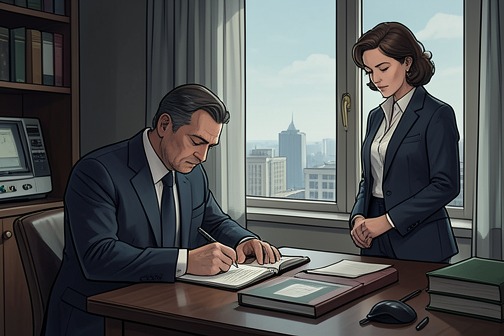
The government’s effort to reshape [Thobela Mpayipheli](entity:character-recall-character-thobela-mpayipheli-bde650756e15)’s public image turns a covert manhunt into a contest over who gets to define him. As the authorities try to cast him as a dangerous criminal rather than a fugitive with a disputed story, [Allison Healy](entity:character-recall-character-allison-healy-35acfe29d17c)’s reporting tests official claims against what can be verified. The campaign’s urgency reveals that the state is not only pursuing Mpayipheli: it is also trying to control the meaning of his pursuit.
## From manhunt alert to media figure
The public framing begins with an intelligence alert to police and traffic authorities along the [N1](entity:location-recall-location-n1-a1425420691b). It describes an armed and dangerous Xhosa man travelling on a large BMW motorcycle, while withholding the identity of the government agency behind the warning. Allison Healy, the [Cape Times](entity:organization-recall-organization-2236348bd1c9) crime reporter, first writes in the formal language of a conventional manhunt report. She then recognizes that the story has a distinctive, lighter element and recasts it around the striking image of a big, bad biker. That editorial shift gives the fugitive a memorable public identity before the authorities have publicly explained their case.
The contrast between the official warning and Healy’s livelier framing matters because the story is already circulating beyond the police channels. On a radio programme, Healy is introduced as the reporter who broke the account of the biker. Rather than simply endorsing or opposing Mpayipheli, she points to two problems in the official version. First, the allegation that he stole the BMW appears unsupported: no theft charge has been laid, no theft investigation is underway, and the dealership owner says Mpayipheli left a note explaining that he had to borrow the motorcycle and would pay for its use. Second, the Cape Times has reported the story for hours without the government stepping forward to correct the record. Healy’s questions make the authorities’ silence part of the story, not just a gap in it.
## The public-relations crisis
The scale of the media attention reaches the Minister of Intelligence. At a meeting attended by the Minister of Water Affairs and Forestry, [Janina Mentz](entity:character-recall-character-janina-mentz-374453134b98) briefs the ministers and [The Director](entity:character-recall-character-the-director-ac067526026f) on the background: the interview with [Ismail Mohammed](entity:character-recall-character-ismail-mohammed-cf4d6ef5ff92), the counter-intelligence operation, and the failures that followed. The Intelligence Minister’s concern is not limited to the operation’s practical setbacks. Radio reports are appearing every half-hour, she says in effect, and their cumulative effect is to make Mpayipheli look heroic while making the state resemble the Gestapo. She describes the situation as a public-relations crisis and anticipates that the President will demand an explanation.
The immediate context sharpens the embarrassment: two agents were sent to the airport, two Rooivalk helicopters and a brigade were deployed at [Three Sisters](entity:location-recall-location-three-sisters-a30c277e2b6b), and the authorities still did not know where Mpayipheli was. The government’s operational reach is therefore set against its inability to locate him and its inability to settle the public account of who he is. The concern that the media is interfering with a covert operation becomes a concern that the state is losing the public interpretation of that operation.
Mentz offers two possible responses. The government could ignore the press, on the grounds that officials cannot control what reporters publish and that another event would soon take attention away. Or it could use the media to its own advantage. The Minister considers the second option, and Mentz explains that the distinction between hero and villain can turn on how facts are interpreted. The decision marks a change in method: instead of relying only on the manhunt, the government will try to make the fugitive’s past and character the central issue.
## Constructing a counter-image
Mentz’s proposed case gathers adverse details into a deliberate portrait. She says Mpayipheli had belonged to a drug network blamed for damage to the social structure and children on the [Cape Flats](entity:location-recall-location-cape-flats-0fdde2ccc692); that he misused his [MK](entity:organization-recall-organization-mk-e67543d31759) training for intimidation and violence; and that unexplained money in his bank account suggests continuing involvement. She also invokes his dependence on a woman and her child, his lack of a home of his own, the serious injury of a young white soldier, and his alleged obstruction of the state after opportunities to surrender. These are presented as allegations and interpretations within the government’s strategy, not as findings established by the evidence in this episode.
The argument is designed to turn the public’s attention from the questionable theft allegation and the failed pursuit to a moral judgment about Mpayipheli. Mentz contrasts him with former MK members who, she says, chose to help build the nation despite unemployment and poverty. Her point is not merely that Mpayipheli has a criminal past; it is that his past should disqualify him from the heroic role the media may be creating. By selecting and arranging claims in this way, the government seeks to make the fugitive appear responsible for the very social damage that gives the chase its political charge.
The campaign also needs a source who can appear to speak from personal knowledge. The Director tells Mentz that a Brigadier in [Pretoria](entity:location-recall-location-pretoria-6b0a39acc851), Lucas Morape, has been found and describes Mpayipheli in strongly discrediting terms. Morape and Mpayipheli trained together in Russia, and Morape is said to have characterized his former comrade as a disruptive embarrassment to both his comrades and the Movement. The Director says Morape will release a short report to the media that afternoon. Mentz welcomes the development as useful from a public-relations perspective and asks The Director to inform Radebe personally, indicating that she anticipates skepticism within the operation as well as scrutiny from outside it.
## Publication and the limits of the campaign
In the editorial office of the Cape Times, Healy reads a report arriving from The Star’s offices in Johannesburg. It identifies Morape as a senior member of the Supply and Transport Unit at [South African National Defence Force](entity:organization-recall-organization-88fc02db1d95) Headquarters in Pretoria and says he served with Mpayipheli in Tanzania and at a Kazakhstan military base in the former USSR, where [Umkhonto we Sizwe](entity:organization-recall-organization-umkhonto-we-sizw-116b53b86e4a) soldiers trained with support from the Eastern Bloc during the 1980s. The report also attributes to Morape an account of Mpayipheli nearly beating a Russian soldier to death in a mess-room fight and says the incident caused weeks of diplomatic repair. A further statement portrays Mpayipheli as a compulsive brawler removed from the training programme and treats the drug-network allegations as consistent with a purported psychopathic profile.
Healy recognizes how neatly Morape’s account fits the Minister’s strategy. She reacts skeptically to the use of a psychiatric label, observing that public commentators now seem ready to diagnose the fugitive. Her response preserves a distinction the campaign tries to blur: Morape’s status as a former comrade makes his account potentially influential, but it does not turn his character judgments into independently verified facts. The newspaper report becomes both the instrument the government hoped to use and a visible part of the effort to discredit Mpayipheli.
The episode’s decisive shift is from a search for a fugitive to a struggle over the story attached to him. The state has the reach to alert police and traffic officials, deploy helicopters and soldiers, and place a former associate’s accusations before the press; yet those measures do not automatically make its account credible. Healy’s earlier report about the motorcycle note and her later scrutiny of Morape’s claims leave the government’s narrative exposed to comparison with specific facts. The campaign’s outcome is not settled here, but its underlying vulnerability is clear: in trying to replace the image of the biker with that of a villain, the authorities reveal how much their public authority depends on controlling the frame.
Event 21
Operation Safeguard
[Operation Safeguard](entity:event-recall-event-operation-safeguard-e6467568fd51) was a disinformation operation designed to protect the identity of [Inkululeko](entity:character-recall-character-inkululeko-9ae708b27ee4), a valuable source inside the South African government, by staging a hunt for that source. [Janina Mentz](entity:character-recall-character-janina-mentz-374453134b98) developed the plan with the [Central Intelligence Agency](entity:organization-recall-organization-central-intellig-55def823fc61), using [Johnny Kleintjes](entity:character-recall-character-johnny-kleintjes-bf98fd1e4a42) and a fabricated hard disk to create a credible trail. What began as a controlled intelligence exercise instead became a chain of deaths, public deception, and competing efforts to seize the disk. Its significance lies in the gap between the operation’s carefully managed appearance and the consequences that its designers could neither contain nor fully explain.
## Origins and the source
The operation grew out of the position of Inkululeko, a source recruited by the Central Intelligence Agency in 1996 after tentative signals at an embassy function. The source’s stated motive was disillusionment with the South African government’s continued support for states the report characterized as rogue. The recruiter regarded that explanation with suspicion, but the source subsequently proved valuable. In the surrounding narrative, Inkululeko is Janina Mentz: an intelligence official who could provide access from inside the new government while maintaining a separate, secret relationship with the American agency.
The code name carried its own disinformation value. Inkululeko is a Zulu word meaning freedom, and earlier decades had seen persistent but unfounded rumors that a Zulu-origin mole inside the [African National Congress](entity:organization-recall-organization-1cd3963560dc) and [SACP](entity:organization-recall-organization-e19a42f6d577) Alliance passed information to both the Central Intelligence Agency and the apartheid government. The report stresses that the Central Intelligence Agency had no reliable source inside the movement at that time, and that intelligence from Eastern Bloc entities had kept acquiring such a source a low priority. In 1996, the source proposed the name precisely because it could revive those suspicions; the report notes that she was of European extraction and had no Zulu ties.
In 2000, the source’s importance increased when she was recruited as Chief of Staff: Operations for the newly created [Presidential Intelligence Agency](entity:organization-recall-organization-presidential-int-f475d6cca9d2). The agency was established amid longstanding rivalry among the [National Intelligence Agency](entity:organization-recall-organization-national-intelli-4ce22c998666), [South Africa's Secret Service](entity:organization-recall-organization-4f6c51036b6a), and [Military Intelligence (South Africa)](entity:organization-recall-organization-military-intelli-5ba6397051f0). Its staff came from outside the intelligence services, with [The Director](entity:character-recall-character-the-director-ac067526026f) the sole exception and a veteran of the African National Congress and [Umkhonto we Sizwe](entity:organization-recall-organization-umkhonto-we-sizw-116b53b86e4a). The source’s new position gave her additional institutional reach, but it also placed the operation inside an intelligence structure already marked by competition and suspicion.
## Design and intended deception
Inkululeko’s immediate problem was a transcript of the Mohammed interview in her sole possession. Suppressing it could become incriminating because both the police, to a lesser extent, and the interviewer knew something about it; that knowledge might surface later. The proposed answer was not simply to conceal evidence but to redirect suspicion away from the source through a disinformation initiative. The plan’s central paradox was that the source would appear to be the target of an investigation she had helped devise.
For that purpose, Inkululeko recruited Johnny Kleintjes, a retired intelligence officer from Umkhonto we Sizwe. He was a plausible intermediary from both South African and American perspectives: he had overseen [MK](entity:organization-recall-organization-mk-e67543d31759) and African National Congress intelligence computer systems before 1992 and later led the integration of systems belonging to the former apartheid government’s intelligence agencies. Persistent rumors held that he had retained sensitive files discovered during that process, including evidence of misconduct by both sides and a list of double agents and traitors. The report says he had apparently deleted the files only after making backups and securing them for possible future use. His history made him credible, while the prospect that he still possessed the missing data made him useful to the source.
Under Inkululeko’s orders, Kleintjes was to prepare a hard disk containing fabricated intelligence about the source’s identity and approach the United States Embassy asking to speak with the Central Intelligence Agency. The agency would respond as expected: it would tell him not to return to the embassy, take his contact details, and arrange a meeting in [Lusaka](entity:location-recall-location-lusaka-2dc45c5fc46b), [Zambia](entity:location-recall-location-zambia-ee8409d63d6a), where the data could be examined. If the material seemed credible, the intended purchase price was $50,000, given in the plan as about R575,000. In parallel, Inkululeko recorded Kleintjes’s embassy visit and began surveillance of him, ensuring that the apparent investigation of the source had a documented trail.
The plan also offered Inkululeko an internal political advantage. She intended to report the operation directly to the Minister of Intelligence, bypassing her immediate superior, whom the report describes as a strong candidate for the identity of Inkululeko. The Minister would then have grounds to suspend him while the matter was investigated. Because Mentz was next in line for his position, the report recognizes that this could elevate her into the National Intelligence Coordinating Committee. The operation thus joined source protection to a contest over institutional authority; its design was directed both outward, at the Central Intelligence Agency’s response, and inward, at the hierarchy that might expose the source.
## Execution and breakdown
The operation appeared to proceed according to plan after Kleintjes visited the United States Embassy and contact was established for a meeting in Lusaka. Because Safeguard was considered controlled, the Central Intelligence Agency assigned only two people to the Zambia leg: Len Fortenso and Peter Blum, agents from its Nairobi office. [Luke Powell](entity:character-recall-character-luke-powell-a4135dbff963) supervised from [Cape Town](entity:location-recall-location-cape-town-f6ea4334d11c) and later accepted responsibility for what followed. Fortenso and Blum confirmed that they had arrived in Lusaka after a chartered flight from Nairobi. That was the last contact the office received from them. Their bodies were found on the outskirts of the city two days later; the report records that they had been killed by gunfire.
The source’s deception had therefore secured the intended channel for the staged sale, but the deaths of the two agents turned a managed exercise into an unresolved loss. The report identifies the operation as not having gone according to plan, while its account of the meeting’s initial execution says that events had proceeded as intended. The contrast marks the moment when apparent control gave way to consequences the operation could not explain. The evidence supplied here does not establish who killed Fortenso and Blum or why; the report instead emphasizes that the office had limited the assignment to two agents because it believed the operation’s controlled nature made a larger deployment unnecessary.
## Exposure and aftermath
Later, after Mpayipheli’s involvement in Operation Safeguard became public knowledge, the Central Intelligence Agency requested records from former [East German Ministry for State Security](entity:organization-recall-organization-136c1af74d99) files to check suspicions dating to 1984. Those records confirmed that [Thobela Mpayipheli](entity:character-recall-character-thobela-mpayipheli-bde650756e15), also known by the code name [Umzingeli](entity:expression-recall-expression-umzingeli-a133400ded02), had assassinated [Marion Dorffling](entity:character-recall-character-marion-dorffling-bf74c89c1f79). The Central Intelligence Agency’s response was to seek to settle the score: two specialized agents from its London office were sent to deal with the matter. This transformed Safeguard’s aftermath into another pursuit, one in which the original hard disk and the identity of the source remained entangled with a separate history of covert violence.
The London agents later went to Northern [Botswana](entity:location-recall-location-botswana-b5b9bf4982b6) after a tip from Inkululeko. They acquired a vehicle and saw a [Presidential Intelligence Unit](entity:organization-recall-organization-presidential-int-02952ccf70a3) [Reaction Unit](entity:organization-recall-organization-4127e5cc1cfa) member waiting in ambush for Mpayipheli. Botswana authorities arrested that member; the agents waited by the road through the night but failed to intercept Mpayipheli or recover [the hard disk](entity:object-recall-object-94f8ccdf6fc6). After returning to Cape Town, they received an urgent contact signal from Inkululeko, who used her car’s indicator in her home driveway to indicate that she wished to communicate. She supplied an address where Mpayipheli was apparently recovering from wounds sustained during his cross-country flight and gave the Central Intelligence Agency three hours before the Reaction Unit was expected to reach the same place. Even with that warning, the agents’ earlier failure to secure the disk remained unresolved.
Safeguard also became a struggle over how the state’s actions would be understood publicly. Mentz argued within the intelligence operation that the disk contained information about a high-level mole and that protecting the state required professionalism rather than sympathy. As news of Mpayipheli’s flight spread, the Minister of Intelligence worried that each broadcast made him seem more heroic while the government appeared authoritarian, and demanded a public-relations solution. The proposed counter-narrative emphasized his former links to organized crime, violence and intimidation, unexplained money, and repeated obstruction of the state. It framed the case as a choice between a dangerous fugitive and responsible former liberation fighters who had chosen to help build the nation.
The Minister later presented the operation as lawful under the [1994 National Strategic Intelligence Act](entity:rule-recall-rule-1994-779379a1f2a1) and said that the planned operation had not required involving civilians. In her account, efforts had been made to avoid civilian involvement, but events had gone wrong; a civilian had died, possibly by her own hand, and the precise circumstances remained unclear. She promised an official inquiry and disciplinary proceedings if officials were found responsible, as well as care for the young dependent. This public explanation sits beside the operation’s documented use of fabricated information, surveillance, and a staged hunt. Safeguard’s central irony is not simply that a deception was exposed: the machinery built to direct suspicion and control risk helped set in motion consequences whose causes and responsibility remained contested.
Event 22
Johnny Kleintjes is found tortured and killed in Lusaka
The discovery of [Johnny Kleintjes](entity:character-recall-character-johnny-kleintjes-bf98fd1e4a42) in [Lusaka](entity:location-recall-location-lusaka-2dc45c5fc46b) transformed a covert search into confirmation that he had been killed. The scene’s controlled approach—an insider bought, a hotel room identified, and agents positioned around the building—ends in a finding that raises more questions than it answers: two disks beside the dead man, and a single word left on his body.
## Locating the Room and Finding Johnny Kleintjes
The operation’s leader took seven minutes and five thousand American dollars to bribe the manager of the [Republican Hotel](entity:location-recall-location-republican-hotel-0fbbda229c17) and learn where Johnny Kleintjes was being held. Although the leader commanded twenty agents, only five went with him to room 227. The rest were assigned to cover entrances, the fire escape, the lifts, windows, and balconies, while some waited in vehicles with their engines running. The arrangements show a team preparing for an uncertain encounter, with the search concentrated on one specific room.
Before using the key, the leader sprayed silicon into the keyhole from a yellow can fitted with a thin red tube. He turned the lubricated key carefully, and the lock opened without sound. After the leader signalled, the first two agents entered; they found Johnny Kleintjes’s body, marked by evidence of severe violence. The quiet, methodical entry gives way to an irreversible discovery: the person the team had come to locate could no longer be rescued.
Two disks lay on Johnny Kleintjes’s lap. The word KAATHIEB had been carved on his chest. The disks and the word make the discovery more than the end of a search: the scene leaves physical evidence connected to the wider intelligence struggle, alongside a message whose purpose is not explained here. The operation has found Johnny Kleintjes, but not an answer to who killed him or why.
## The Inscription and the Intelligence Crisis
The discovery did not explain the message left with Johnny Kleintjes. In a later review of the preceding two days, [Janina Mentz](entity:character-recall-character-janina-mentz-374453134b98) recalled receiving digital photographs from the team leader in Lusaka: one showed the word KAATHIEB, while another showed LIAR. [Rahjev Rajkumar](entity:character-recall-character-rahjev-rajkumar-c42d2052c9b0) identified the latter as Arabic, but the available evidence does not establish who wrote either word, what either meant, or whether the inscriptions were intended as a single message. The clues deepen the uncertainty surrounding Johnny Kleintjes’s death rather than resolving it.
That uncertainty sits within an intelligence emergency. Janina Mentz told her colleagues that [the hard disk](entity:object-recall-object-94f8ccdf6fc6) was believed to contain highly sensitive information about a high-level government source codenamed [Inkululeko](entity:character-recall-character-inkululeko-9ae708b27ee4), and that its disclosure could cause serious damage. The team’s stated responsibility was to protect the state, but the evidence does not establish that this security concern explains Johnny Kleintjes’s killing. His death, the disks found with him, and the unexplained inscriptions remain connected by the investigation, not by a confirmed account of motive or responsibility.
## Death, State Security, and Public Narrative
Johnny Kleintjes’s death unfolded against a struggle over who could define the hard disk’s significance. Janina Mentz told her colleagues that it was believed to contain highly sensitive information about a high-level government source codenamed Inkululeko, and argued that protecting the state required a professional focus on facts rather than sympathy. The security case was presented as urgent, but it did not establish who had killed Johnny or why.
The manhunt also became a public-relations crisis. The Intelligence Minister complained that repeated news coverage was turning the fugitive into a hero while making the government appear repressive; she demanded a response after agents and two Rooivalk helicopters had failed to locate him. Janina’s proposed counter-narrative stressed his former involvement in a drugs network, his use of [MK](entity:organization-recall-organization-mk-e67543d31759) training for intimidation, unexplained money, and his refusal to surrender. These allegations were offered as a way to shape media coverage, not as an explanation for Johnny’s killing.
The official account later described the intelligence operation as necessary, carefully planned, and within the [1994 National Strategic Intelligence Act](entity:rule-recall-rule-1994-779379a1f2a1), while maintaining that it had not required the involvement of civilians and that events had gone wrong. That public defence placed the operation in the name of national interest, yet the discovery in Lusaka left its most immediate questions unresolved: Johnny was dead, the disks were with him, and the messages associated with his body had not yielded a confirmed account of responsibility.
## The Unresolved Source Behind the Intelligence Stakes
The wider intelligence file offers no clear motive for the source codenamed Inkululeko. The CIA had recruited the source from within the South African government in 1996, after tentative signals at an embassy function; the source reportedly objected to the government’s continued support for Iraq, Iran, Cuba, and Libya, but the record explicitly leaves the exact motivation unknown. This uncertainty sharpens the limits of what the discovery in Lusaka can establish: the disks were important to an intelligence struggle involving a sensitive source, but neither that source’s motives nor the source’s connection to Johnny Kleintjes’s death is resolved by the evidence.
Event 23
Miriam Nzululwazi escapes custody and falls to her death
[Miriam Nzululwazi](entity:character-recall-character-miriam-nzululwazi-394be6ca6495)’s escape from custody ends not in freedom but in a fatal fall from an intelligence building. A quiet walk through an empty corridor carries her from the interview room to a sealed exterior fire escape; when [Vincent Radebe](entity:character-recall-character-vincent-radebe-d6a5ba81e5e3) finds her hanging above an alley, she lets go. The event turns a controlled space into a trap and leaves Radebe to accept responsibility for her death.
## Custody and the escape route
Miriam rises suddenly, opens the interview-room door, and slips into the passage, closing it quietly behind her. The corridor is empty, its cold tiled floor stretching in both directions. She walks toward the end of the passage, where faded, peeling red paint marks a fire-escape door. The scene gives her movement a purposeful quality, but it does not explain what she hopes to find beyond it.
The door opens from the inside under a bar marked “Push/Druk.” Outside, Miriam sees the night and hears the city, but the apparent exit is a dead end. Below her is an alley; in front of her, a metal rail and the rusty remains of a sawn-off metal stairway. The door clicks shut behind her, and there is no handle on its exterior. In a few steps, the possibility of escape has narrowed to a precarious ledge with no way back through the door and no intact stairway down.
## The fall
Radebe sees Miriam while returning through the fire door. She is suspended between the building and the ground, her legs swinging out over the drop and back toward the lower platform. Their eyes meet; hers are full of fear. He bends and reaches for her arms, calling her name in despair, and the moment briefly becomes a rescue attempt rather than an escape.
Miriam opens her cramping fingers and lets go. Her swinging body passes the sixth-floor platform and falls without a sound. Radebe watches her turn slowly on the way down and thinks he hears the soft impact on the dirty stone paving far below. The narration does not state why she releases her grip, so the gesture remains devastatingly clear in its consequence but unexplained in its motive: the fall ends her life, while leaving the decisive instant inaccessible to those who witness it.
The scene is set against another thread of the pursuit. Nearby in the narrative, [Thobela Mpayipheli](entity:character-recall-character-thobela-mpayipheli-bde650756e15) waits with a sniper’s scope, becomes conscious of his distaste for what he is doing, and recognizes that this is not the right way to wage war. After Miriam falls, the narrative turns to him riding through the moonlit [Free State](entity:location-recall-location-free-state-609c73cebcdf) plains, experiencing a rare sense of unity with his body and the world around him. That juxtaposition does not make her death part of his actions; instead, it places his fleeting experience of life beside the abrupt end of hers, while the larger pursuit continues beyond the building.
## Responsibility and confirmation
Afterward, Radebe and [Quinn](entity:character-recall-character-quinn-2af072947d03) go to [Janina Mentz](entity:character-recall-character-janina-mentz-374453134b98)’s office. They remain standing, and when they begin speaking at once, Radebe takes responsibility for reporting what happened. He tells Mentz that Miriam escaped from the interview room because of his neglect, reached the exterior fire escape, and fell six floors. He calls it his fault and offers his resignation, saying that he will no longer be an embarrassment to the department. His account turns the death into an acknowledged custodial failure, not merely an accident discovered after the fact.
Mentz goes cold when she hears the news. She eventually states that Miriam is dead; Quinn confirms it and adds that they carried her back up to the interview room. The blunt movement of the body back inside closes the immediate sequence, but not the questions about how she reached the exit or how the escape became fatal. Mentz asks how Miriam got out, leaving the institutional inquiry open even as Radebe has already assigned himself the blame.
## What her death breaks
Miriam’s fall destroys the possibility of the future that she and Thobela had imagined. Earlier, he had insisted that caring for her and [Pakamile](entity:character-recall-character-pakamile-db01684d694b), returning home, and living by lawful, nonviolent work were part of an honourable life, even as he felt bound to repay his debt to [Johnny Kleintjes](entity:character-recall-character-johnny-kleintjes-bf98fd1e4a42). He also entertained the hope that the three of them could take Pakamile to the Cala River and begin again. Her death makes that hoped-for family future impossible; the story’s intimate stakes are not separate from Thobela’s larger attempt to choose a different life, but are among the things that attempt was meant to protect.
The later scene with Pakamile underscores the human cost of that loss without spelling out every consequence. When [Allison Healy](entity:character-recall-character-allison-healy-35acfe29d17c) is about to leave him with the Minister’s secretary, Pakamile clings to her hand and says that he wants to stay with her. His anxious refusal makes his need for a trusted adult immediate and visible. Read alongside the earlier dream of taking him away to a new beginning, the moment gives Miriam’s death an aftermath that extends beyond the building: the escape ends in one fall, but the separation and uncertainty remain with the child she leaves behind.
Event 24
Modder River Bridge shootout and the death of Little Joe Moroka
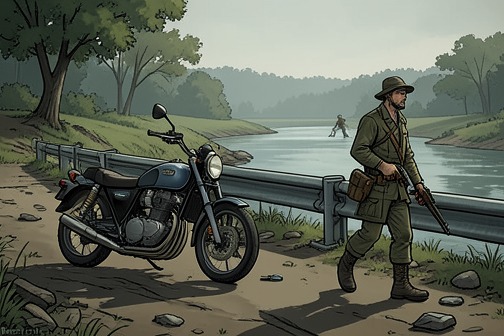
The [Modder River Bridge shootout and the death of Little Joe Moroka](entity:event-recall-event-little-joe-moroka-6c78d940c9b8) turn abruptly from a rare moment of shared amusement into a violent encounter with consequences for both men. The sequence leaves Moroka dead, [Thobela Mpayipheli](entity:character-recall-character-thobela-mpayipheli-bde650756e15) wounded and fleeing, and the people around them confronting the consequences of the gunfire.
## From Celebration to Confrontation
The encounter begins in the wake of singing that has brought the group together. A teasing remark prompts the pilots to sing, and the ensuing response is enough to draw [Little Joe Moroka](entity:character-recall-character-little-joe-moroka-691d62ffb2af) out of the ring of men. The scene’s brief communal warmth matters because it provides the immediate setting for what follows: Moroka walks away from the group to prolong the pleasure of the moment, while Thobela Mpayipheli and the motorcycle remain nearby. At the river, Moroka notices the motorcycle only after looking away and back again. By the time he recognizes it and reaches for his weapon, Mpayipheli is already moving toward him.
## The First Exchange and Thobela’s Restraint
Moroka’s weapon discharges as he falls, and two of its rounds strike Mpayipheli in the hip. Mpayipheli follows him down the bank, takes control of the [Heckler & Koch UMP](entity:object-recall-object-heckler-koch-ump-7b3cbc360f99), and holds Moroka at gunpoint as the others approach. Though wounded and under pressure, he tells Moroka that he does not want to kill him. The struggle is therefore not simply an exchange of fire: Mpayipheli initially tries to stop the confrontation without killing the man who has just shot him.
That effort ends when Moroka breaks free and reaches for the weapons on the ground. As Moroka turns a machine pistol toward him, Mpayipheli fires, then takes the weapon from him and throws his own down. He orders the others to get Moroka to a hospital and have the motorcycle loaded into the helicopter. The command shifts the scene from combat to urgent rescue: despite the fatal outcome, Mpayipheli’s immediate concern is that Moroka receive medical help.
## Flight and Confirmation
After ordering the group to get Moroka to hospital, Mpayipheli has a pressure bandage applied and makes his way toward the Oryx. His steps are unsteady, and the pain in his hip is worsening; he nevertheless tells the pilots that they must leave. The urgency is not only a matter of escaping the scene. Mpayipheli understands that he is running out of time, while the wounded Moroka needs medical care, and he entrusts the immediate response to the men around him.
Once airborne, Mpayipheli points out [Botswana](entity:location-recall-location-botswana-b5b9bf4982b6) on the map and presses the co-pilot to give the coordinates. When the pilot says he cannot cross the border, Mpayipheli argues that they can fly low enough to avoid radar detection. The exchange carries the confrontation beyond the bridge: injured and still pursued, he turns the helicopter into a means of crossing into Botswana, while the pilots must decide whether to follow his direction.
The death confirmation arrives through the radio. In a second Oryx beside the R64, [Captain Tiger Mazibuko](entity:character-recall-character-captain-tiger-mazib-aaad0ca05cc5) hears the emergency signal and believes the search has located Mpayipheli; later, Da Costa reports that Moroka is dead. The confirmation closes the immediate uncertainty left by the shooting, and the radio falls silent. Moroka’s death is the lasting consequence of an encounter that began in fellowship, while Mpayipheli escapes the bridge wounded and continues his flight.
## A Reversal Without a Victory
The episode’s defining contrast is not simply between music and gunfire, but between two kinds of choice under pressure. At first, Mpayipheli tries to keep Moroka alive, even while wounded and holding him at gunpoint; when Moroka reaches for another weapon, Mpayipheli fires to survive. He then gives up his own weapon and directs the others to get Moroka to hospital. These actions resist a clean victor-and-defeated reading: Mpayipheli escapes, but the encounter ends in a death he had initially tried to prevent.
The exchange also turns the group’s shared moment into a fracture. The singing draws Moroka away from the men, and the scene’s temporary fellowship gives way to confusion and urgent decisions. The later report that Moroka has died settles the immediate question of his fate, but not the moral tension of what happened: Mpayipheli’s restraint and his need to survive remain bound together, while his flight continues at the cost of another life.
Event 25
Thobela Mpayipheli’s first assassination in Munich
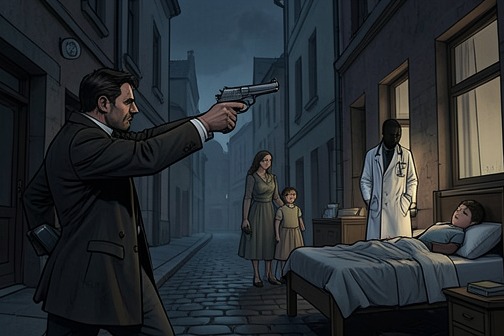
[Thobela Mpayipheli’s first assassination in Munich](entity:event-recall-event-thobela-mpayipheli-8c84b18444a1) is recalled as both a killing carried out under orders and the moment he recognized that the method itself violated his sense of honour. A trained sharpshooter, he takes aim at the West German double agent Klemperer, but the appearance of a woman and child interrupts his shot. When Klemperer later emerges alone, Thobela fires; afterward, he concludes that he cannot wage war from concealment, without giving an enemy the chance to face him. The episode returns years later as a memory he hopes to put behind him, linking his earlier life as a weapon to his attempt at change.
## The memory and its background
The assassination is not introduced as a continuous account of the [Munich](entity:location-recall-location-munich-a2858688fbfd) operation. It rises into Thobela’s consciousness during a later journey: after feeling tense at a petrol station, he rides through the growing dark, his attention divided between the road and the memory of his first killing. The fall he suffered in a [Karoo](entity:location-recall-location-karoo-3c1c4108d0e9) storm still affects him, but the older experience occupies much of his thought. He allows the memories of the preceding day to return, wondering whether reliving them might be part of healing, change, or closure. The remembered event therefore carries two kinds of pressure: the immediate danger of the mission as he experienced it then, and the question of what that past means to him now.
His competence as a marksman had been established before the assassination. In [East Germany](entity:location-recall-location-east-germany-941d93a24532), while studying at the [Stasi](entity:organization-recall-organization-stasi-2fc98e3cd75d) sharpshooters school, he and the other students helped test an experimental SVDS. Evgeniy Fedorovich Dragunov, the Russian weapons developer, took a particular interest in Thobela’s accuracy. In poor light and a crosswind of seventeen kilometres per hour, Thobela achieved a grouping of less than 400 millimetres at 2,000 metres. That record makes the Munich operation an extension of a skill he had already demonstrated under extraordinary conditions; it does not make the first real killing feel like a practice exercise.
## The target and the first hesitation
In Munich, Thobela holds an SVD, described as the latest model, with a synthetic, non-folding stock and a deadly reach of 3,800 metres. Klemperer, a bald, middle-aged West German, is expected to come through a door roughly a kilometre away. He is a double agent feeding both sides, and the [KGB](entity:organization-recall-organization-kgb-7a6cfca0c71a) has marked him for elimination. Thobela, an [African National Congress](entity:organization-recall-organization-1cd3963560dc) exchange student, understands the assignment as a demand to prove his worth. He even wants to dedicate the shot to Dragunov, whose attention had affirmed his ability as a student.
That professional frame breaks down when the door opens and a woman and child appear in the scope. Thobela’s finger is already on the trigger; the sight rests on the woman, but he does not fire. The presence of civilians stops the action at the critical instant. The contrast is explicit in his recollection: competition on a practice range had involved the intensity of sport, while the Munich target is a living person. His skill has carried him to the threshold of the act, but it cannot settle whether he can accept what the act requires.
## The killing and its immediate consequence
Thobela wipes the scope lens, checks his focus and adjustments, and waits for the door again. During the pause, his response changes from concentration to distaste. He recognizes that this is not the way he believes war should be waged, or the way his people should fight. Yet when the door opens and Klemperer appears, he fires. The shot kills the target. The action is presented without turning the killing into a triumph: the significant consequence is Thobela’s judgment of it, not the technical success of the shot.
He dismantles the rifle and packs it away in forty-seven seconds. That brief, practical aftermath closes the operation but not its moral effect. Thobela decides that he cannot continue to wage war in this manner because there is no honour in it. His conclusion is not simply a rejection of marksmanship or of combat altogether. He sets out a standard for combat in which the enemy must be visible and able to fight back. The distant, one-sided shot becomes the example against which he defines that standard.
## Return, change, and significance
When the memory returns on the road, Thobela does not treat it as settled history. He lets it run through his mind, considering the possibility that remembering may help him achieve closure and move beyond the person he was. That later perspective gives the Munich scene a place in a larger change of identity: the event shows the first clear limit he sets on his own use of violence, while the act he completed remains part of the past he must confront.
The episode’s central tension lies between effectiveness and honour. Thobela possesses exceptional technical ability, and the mission’s demand fits the role for which he has been trained. But the woman and child expose the human stakes that precision cannot remove; his initial restraint and subsequent shot leave him with a lasting rejection of assassination at a distance. His rule that an enemy must be able to see and fight back makes the scene a formative memory, not because it erases his participation, but because it gives him a principle by which to judge it. In the later recollection, that principle becomes part of the change he is trying to complete: the first killing returns as evidence of what he did and as the point from which he understands what he can no longer accept.
Event 26
Mpayipheli decides in hospital to end his life of violence
Mpayipheli’s decision to end his life of violence begins not with a plan or a declaration, but with a pause in a hospital doorway. Still recovering from an ordeal shared with [Zatopek van Heerden](entity:character-recall-character-zatopek-van-heerden-5379cb72cb89), he sees a black Xhosa doctor caring for a young white boy and is struck by the distance between that scene and the life he has lived. The encounter revives his childhood wish to make people better; after years shaped by conflict, he recognizes that he might still choose a different purpose, even though he cannot undo what he has done.
## The hospital encounter
Mpayipheli later remembers that he and Van Heerden were in hospital when the change began. One evening, shuffling down a passage while his body remained broken from what they had been through, he stopped in a doorway simply to catch his breath. He looked into a four-bed ward. Beside a young white boy’s bed stood a doctor who was black, Xhosa, about Mpayipheli’s height and roughly forty years old, with grey beginning at his temples. Mpayipheli had not gone looking for a revelation; the moment came upon him during an ordinary pause.
The doctor’s presence returned him to a question his father had once asked about what he would become. At eight, Mpayipheli had answered that he wanted to be a doctor, and when asked why, he had said, “Because I want to make people better.” That aspiration had taken shape after a fever: a white doctor had come from [Alice](entity:location-recall-location-alice-fd6328bbac86), spoken Xhosa to him, and promised that he would be made well. Mpayipheli remembered recovering and understanding himself as someone who wanted to heal, a maker of miracles. The adult doctor in the ward did not merely resemble that remembered future; his care for the boy made the old purpose visible again.
## Recognition and grief
Watching the doctor and child, Mpayipheli relived the conversation with his father and felt the weight of the years he believed had been lost. The scene let him see his life from another angle, including the possibility of choices he had not made. That recognition did not erase his past. Instead, it brought the accumulated consequences of hatred, violence, and death into view, along with his consuming wish to be free of them. His response was physical and emotional: he sank against the wall, went down to his knees, and sobbed as memories opened up before him.
The passage makes the change a reckoning rather than a clean escape. Mpayipheli longs to be born again without the burden of what has happened, but the possibility he reaches is not literal erasure. He cannot blot out who he has been or reverse the harm. What becomes available to him is the narrower, harder power to decide where and how he will go next. The recalled childhood wish gives that choice a direction: away from destruction and toward making and sustaining life.
## Care and the decision
The doctor notices Mpayipheli’s distress, places a hand on his shoulder, and holds him while he calms. He helps Mpayipheli up, supports him, lays him on his bed, and pulls the sheets up to his chin. The doctor’s care echoes the reassurance Mpayipheli remembers from his childhood illness: he is sick, but someone will help make him better. The scene therefore joins two moments across his life—not by promising that the adult’s past can be cured, but by placing care beside his vulnerability and showing that he can accept support.
Mpayipheli sleeps, wakes, and continues an inward struggle against self-justification and rationalization. From the deaths he has witnessed and the violence in which he has participated comes a desire to become a farmer, a nurturer. The choice is explicitly difficult: he understands it as a step-by-step task lasting a lifetime, not as instant absolution. That night he eats a full plate of food and thinks through the night. Before six the next morning, he goes to Van Heerden’s room, wakes him, and says he is finished. When Van Heerden appears to underestimate his ability to change, Mpayipheli asks, “You don’t believe I can change?” His question turns the decision into a commitment he must defend, first to his friend and then through the life ahead.
## Significance and aftermath
Van Heerden already knows what Mpayipheli has discovered, a knowledge connected in the narrative to what happened the previous night under a bridge in the [Free State](entity:location-recall-location-free-state-609c73cebcdf). The hospital episode is thus both a private recognition and the point at which that recognition is spoken aloud to someone who understands its seriousness. The passage does not present Van Heerden as granting Mpayipheli permission to change; rather, the exchange makes clear that Mpayipheli must claim the possibility for himself.
The encounter gives the decision its moral shape. Mpayipheli cannot recover the doctor he once hoped to become, nor cancel the violence that has marked his life. He can, however, refuse to treat that history as the only possible ending. The ward’s doctor and child recall an earlier act of healing; the adult Mpayipheli’s response is to choose, with full awareness of the past, the work of nurturing rather than continuing violence. His hospital decision is therefore a beginning, not a declaration that the struggle is over.
Event 27
Tiger Mazibuko is arrested near the Zambezi River
[Captain Tiger Mazibuko](entity:character-recall-character-captain-tiger-mazib-aaad0ca05cc5)’s arrest near the [Zambezi River](entity:location-recall-location-zambezi-river-69f6bcda64ca) turns a carefully anticipated interception into a reversal: the hunter waits for [Thobela Mpayipheli](entity:character-recall-character-thobela-mpayipheli-bde650756e15), but the day ends with Tiger in handcuffs and his own weapon taken from him. The failure is not explained. Tiger knows someone has betrayed him, yet the identity of that person remains as uncertain as the reason Mpayipheli never appears.
## The Interception That Never Comes
By a quarter past two, sleep is beginning to overcome Tiger in his car. He puts his machine pistol beneath the rubber mat at his feet, climbs out again, and searches the road for the man he expects. His repeated movements—walking around the car, sitting on the bonnet, wiping sweat from his face—make the wait physical as well as tactical. He keeps checking the time and recalculating when events should begin, but every fresh estimate leaves him still waiting.
Tiger tries to account for the delay. Perhaps Thobela Mpayipheli has stopped for lunch; perhaps he has found someone in [Francistown](entity:location-recall-location-francistown-885cf46ad3f5) to tend his wounds. Tiger also wonders whether Mpayipheli will ride with his headlight on, as bikers commonly do, or keep it off. These are guesses, not information: Tiger has no clear view of his target’s whereabouts, only a road, a timetable in his head, and the expectation that the fugitive will come within reach.
The wider journey explains why the waiting matters. Thobela Mpayipheli is riding a powerful [BMW R 1150 GS](entity:object-recall-object-bmw-r-1150-gs-806a26725aa3), a machine whose acceleration and unfamiliar weight initially threaten to unseat him. He learns to manage it cautiously, then travels fast across open roads. Later, two helicopters follow him at speeds exceeding 200 kilometres per hour, but a violent rainstorm reduces visibility and the aircraft’s noise eventually fades. The journey is not a direct, predictable run to Tiger: Thobela Mpayipheli adjusts his route and exploits conditions that make pursuit difficult.
By the time Tiger is waiting, the journey has also become a contest against time and distance. Thobela Mpayipheli has calculated fuel stops at [Laingsburg](entity:location-recall-location-laingsburg-a71091e6a985) and the long stretch to [Beaufort West](entity:location-recall-location-beaufort-west-9fae3c0c9a72), considered whether he can reach [Bloemfontein](entity:location-recall-location-bloemfontein-91939396c37f) before sunrise, and anticipated the difficulties of crossing borders without papers for the motorcycle. He knows he needs every available hour and that the Zambezi River presents a particular obstacle. Tiger’s plan depends on predicting the route; the journey’s many constraints and possible changes frustrate that certainty.
## A Stranger at the Roadside
The waiting takes place in tourist country. Tiger dismisses the parade of luxury four-wheel-drive vehicles as part of the local traffic, mentally grouping them with visitors headed for [Chobe](entity:location-recall-location-chobe-e05205a6593e) and other regional attractions. His contemptuous observations give the setting a routine surface: vehicles pass, the day continues, and he keeps his attention on the road. That ordinary traffic also gives an approaching vehicle room to go unnoticed at first.
A green Land Rover Discovery comes from the direction of Kazangula. Tiger tries to look past it, still watching for Thobela Mpayipheli, and only turns his attention to the vehicle when it pulls off opposite him. Two white men are in front; the passenger rests a thick arm through the open window and fixes his gaze on Tiger. Distracted and irritated, Tiger tells them to go away. The passenger’s expression gives him no explanation, and Tiger cannot see the driver. The encounter interrupts the vigil, but the passage does not establish who the men are or what they know.
## The Plan Fails
As late afternoon approaches, Tiger’s frustration deepens. His eyes ache from staring down the road, his body is stiff from sitting and standing, and repeated calculations have become guesswork. Anger is itself exhausting: he finally gets out of the Golf, throws a stone at the thorn trees where finches are chattering, kicks the car’s wheel, and hurls more stones until he is out of breath. Once the outburst has spent itself, calm returns, and so does the fact he has been resisting: Thobela Mpayipheli is not coming.
Tiger considers that his target may have taken another road or that his wounds have stopped him. He refuses to begin another round of speculation. The plan has failed, and he accepts that he has taken a chance and lost. He decides to stay until sunset, then wait for twilight to darken before leaving. This is a limited concession, not a recovery of control: Tiger can choose how long to remain, but he cannot make the expected interception happen.
## Arrest and Reversal
When Tiger climbs back into the car, three police vehicles arrive, carrying uniformed officials. He sees them approach but does not register the significance until they stop and their occupants pour out. Ordered to get out with his hands behind his head, he obeys slowly and methodically, trying to prevent a misunderstanding. The deliberate compliance contrasts with the physical agitation of his earlier wait; now he controls each movement because the officials control the encounter.
Two officials search the Golf. One emerges with Tiger’s [Heckler & Koch UMP](entity:object-recall-object-heckler-koch-ump-7b3cbc360f99), which had been hidden under the rubber mat, while another searches him and clamps handcuffs around his wrists. The weapon’s recovery makes the arrest concrete: the man who had been waiting to intercept a fugitive is now disarmed and detained. Tiger understands the event as betrayal. He knows he has been sold out, but cannot tell how or by whom.
The arrest changes the balance of the pursuit without resolving its larger uncertainties. Tiger’s intended meeting with Thobela Mpayipheli never takes place, and the available account does not identify the source of the leak or describe what happens to Tiger after his capture. The reversal rests on that sharp contrast: hours of watching, calculating, and waiting leave Tiger exposed, while the fugitive’s route has remained beyond his grasp.
Event 28
South African arms-deal scandal exposed by the media
The media exposure of the South African arms-deal scandal makes the contents attributed to [Thobela Mpayipheli](entity:character-recall-character-thobela-mpayipheli-bde650756e15)’s hard drive a public issue and changes the meaning of his flight: the fugitive may be carrying evidence of alleged corruption, not merely classified material. The disclosures bring the government’s pursuit of him into collision with the press, the unresolved disappearance of [Miriam Nzululwazi](entity:character-recall-character-miriam-nzululwazi-394be6ca6495) and her son, and a fragile political effort to present [South Africa](entity:location-recall-location-south-africa-49123e8bd978) as a responsible partner abroad.
## From classified files to public allegations
The scandal’s immediate public form is a newspaper report asserting that the computer disk in Mpayipheli’s possession contains full particulars of the weapons transaction: names, sums, and Swiss bank-account numbers belonging to government officials. The report attributes the claim to advocate Pieter Steenkamp, formerly of the Directorate for the Investigation of Serious Economic Crimes, and connects it to evidence heard about alleged irregularities in a weapons transaction worth R43.8 billion. The alleged contents include account details and amounts said to have been paid as bribes and kickbacks. These are reported allegations, not findings independently established in the scene; the distinction matters because the same coverage that raises the scandal also records an immediate government denial.
Steenkamp says that electronic data held by an intelligence agency had been mentioned repeatedly during the hearing, and argues that public interest requires Mpayipheli not to be apprehended. He compares the significance of the fugitive’s journey to Dick King’s 1842 ride from Durban to [Grahamstown](entity:location-recall-location-grahamstown-7a69d250b89f) to warn the English of the Boer siege. The comparison recasts a motorcycle escape as a journey with national consequences. The newspaper’s headline, presenting the motorcyclist as holding the key to the scandal, likewise makes the hard drive a pivot between a manhunt and a wider question about what the state may be trying to suppress.
## Why the records are vulnerable
The disclosure gains force from the intelligence system’s troubled relationship with its own records. After the elections, the integration of intelligence services required the consolidation of multiple databases, including material from state and liberation-movement systems in South Africa and abroad. The work involved hundreds of gigabytes of information, from personal records and informants to weapons systems. Mpayipheli’s father was placed in charge of combining the computer records, deciding what to erase and what useful material to preserve. The scale of that task gives the hard drive’s alleged contents a history: the information was produced and managed inside institutions already struggling over access, preservation, and control.
Those struggles had a practical consequence. Some team members could not break with the inherited secrecy and the habit of treating outsiders as enemies; operational records disappeared. When [Johnny Kleintjes](entity:character-recall-character-johnny-kleintjes-bf98fd1e4a42) realized that records were being deleted, he began making backup copies, and after a backup tape went missing he took work home. Meanwhile, [Janina Mentz](entity:character-recall-character-janina-mentz-374453134b98)’s unit treated electronic information as easy to copy and distribute, and therefore vulnerable to intrusion. Its response was to make a single paper copy of transcribed information, keep it under controlled access, and delete the digital tapes. Across these different procedures, the novel presents an archive that is never simply a neutral store of facts: material can be erased, copied, concealed, or made available as evidence.
## Denial, pursuit, and competing accounts
The Defence spokesperson strongly denies the allegations, calling them a malicious attempt by opposition journalists to damage the government through deliberate fabrication. The spokesperson also denies military involvement in the disappearance of Miriam Nzululwazi and her six-year-old son. The same news coverage reports that Miriam was arrested at her workplace, a commercial bank, and that a man identifying himself as a Department of Defence employee took [Pakamile](entity:character-recall-character-pakamile-db01684d694b) into custody. The juxtaposition does not itself resolve who ordered the detention or what happened to Miriam; it places official denials beside reported events that make those denials politically consequential.
The arms-deal story also alters the context of the pursuit. Earlier reporting describes an unknown government intelligence agency alerting police and traffic authorities to seek an armed, dangerous Xhosa fugitive on a BMW motorcycle. [Allison Healy](entity:character-recall-character-allison-healy-35acfe29d17c), the [Cape Times](entity:organization-recall-organization-2236348bd1c9) crime reporter covering the case, challenges another part of that official picture: the authorities’ claim that Mpayipheli stole the motorcycle. She reports that no theft charge or investigation exists and that the dealership owner says Mpayipheli left a note promising to pay for borrowing it. Her reporting does not establish what the hard drive contains, but it exposes a gap between the fugitive label and the available account of his conduct. Once the disk is linked to the weapons scandal, that gap becomes part of a broader struggle over which version of the chase the public will believe.
## Political costs and narrative significance
The revelations reach beyond the newspaper page. At a meeting attended by intelligence, defence, and police leaders, the Minister relays the President’s anger at the combined spectacle of alleged abductions, a missing woman and child, and war veterans being pursued across the veld on a motorcycle. She connects the crisis to the government’s effort to advance its African Renaissance plan while the United States, the European Union, the Commonwealth, and the World Bank consider their positions. The scandal therefore places the hard drive within a larger political crisis: the state’s handling of Mpayipheli and his family threatens its credibility at a moment when it seeks international support.
The Minister’s response is not simply to ignore the press. When asked how to answer its coverage, she considers using the media to the government’s advantage. That possibility underscores the contest over framing: the same communications channels can expose alleged corruption or be used to manage its public meaning. Later, a newspaper’s inquiry reaches the Minister directly, asking whether Miriam is dead; the Minister learns that the boy has been found. The call shows how reporting has become entangled with the immediate consequences of state action, while leaving Miriam’s fate and the disk’s precise contents unresolved.
The event’s significance lies in that unresolved contest. The hard drive is at once a container of potentially compromising information, a product of a fractured intelligence archive, and the object around which a public manhunt is being narrated. The press does not settle every allegation, but its disclosures make silence harder to maintain and make the government answer for both the weapons scandal and the treatment of people caught in its pursuit.
Event 29
Johnny Kleintjes is executed in Lusaka
[Johnny Kleintjes](entity:character-recall-character-johnny-kleintjes-bf98fd1e4a42)’s execution in [Lusaka](entity:location-recall-location-lusaka-2dc45c5fc46b) is the fatal culmination of a struggle over intelligence records he had secretly preserved. The report of his death links a personal act of record-keeping to a possible leak within the [Presidential Intelligence Unit](entity:organization-recall-organization-presidential-int-02952ccf70a3) and leaves [the hard disk](entity:object-recall-object-94f8ccdf6fc6)—and the information it may contain—unaccounted for.
## Background: records in upheaval
After the elections, the intelligence services faced the difficult task of integrating agencies that had operated separately and often against one another. Johnny Kleintjes was brought back to help combine their computer records into a central, uniform database. The project encompassed material held in [Pretoria](entity:location-recall-location-pretoria-6b0a39acc851), as well as records connected to Denel, the Security Police, the Secret Service, [Military Intelligence](entity:organization-recall-organization-724601e0c2de), and systems belonging to [Umkhonto we Sizwe](entity:organization-recall-organization-umkhonto-we-sizw-116b53b86e4a) in Lusaka and London. The estimated volume was 400 to 500 gigabytes, ranging from personal information to weapons systems, informants, and double agents. Kleintjes was expected to remove material that could cause trouble while preserving useful information.
The integration was compromised by institutional mistrust. Some team members could not set aside habits of secrecy and suspicion; operational records disappeared when individuals sought to avoid accountability. When Kleintjes noticed records being deleted, he began making backups with a colleague. After one backup tape went missing, he started taking work home. The scale and sensitivity of the project made his retained material consequential: it might preserve information absent from the official record, though the evidence does not establish precisely what was on the disk later sought in Lusaka.
## From concealed archive to target
The intelligence unit’s own handling practices underscored the fragility of digital records. [Rahjev Rajkumar](entity:character-recall-character-rahjev-rajkumar-c42d2052c9b0) warned [Janina Mentz](entity:character-recall-character-janina-mentz-374453134b98) that electronic information could be copied, distributed, or accessed through linked systems. The unit therefore relied on a controlled paper copy: typists transcribed information from signed-out tapes in a monitored room, and the paper records were filed with access restrictions while digital tapes were deleted. Against this system of controlled retention and deletion, Kleintjes’s private backups represented an alternative archive—one outside the routine chain of custody.
A later assessment distinguished the suspected target from fabricated data associated with Kleintjes. Its author believed the operatives were after information he had secretly retained during the 1994 integration, rather than the fabricated data. The distinction remains an inference, not a confirmed identification of the disk’s contents. The report reasoned that the original records might help expose a high-level mole in the South African intelligence community, known by the code name [Inkululeko](entity:character-recall-character-inkululeko-9ae708b27ee4).
## The execution and the search for the disk
After two [American Central Intelligence Agency](entity:organization-recall-organization-f8fce2cfb9d5) agents, Fortenso and Blum, were killed, unknown operatives blackmailed Kleintjes’s daughter, Monica, in [Cape Town](entity:location-recall-location-cape-town-f6ea4334d11c) and demanded that she bring a specific hard disk to Lusaka. Monica, who had a physical disability, asked [Thobela Mpayipheli](entity:character-recall-character-thobela-mpayipheli-bde650756e15)—a former friend and colleague of her father—to deliver it on her behalf. The report places Kleintjes’s death within this chain of killings, blackmail, and attempted transfer, although it does not establish who killed him or how the operatives learned about the operation.
Kleintjes was found executed in a room at the [Republican Hotel](entity:location-recall-location-republican-hotel-0fbbda229c17) in Lusaka. The account records that his body bore a pointed inscription, interpreted as an accusation of lying. The report assumes extremist involvement but acknowledges that neither Inkululeko nor the office could explain how local or foreign groups had learned of the operation. It raises a leak from within the Presidential Intelligence Unit as one possibility, not as a proven source of the breach.
## Aftermath: an archive still missing
The attempted interception near the Zambian border deepened the suspicion that the hard disk mattered to more than the fabricated Kleintjes data. A member of the Presidential Intelligence Unit arrested by [Botswana](entity:location-recall-location-botswana-b5b9bf4982b6) police had been lying in wait to intercept Mpayipheli and the disk; investigators believed the interceptors may have wanted to prevent it from reaching the unit. That interpretation, like the theory about the disk’s contents, remains qualified in the report.
The disk is still missing in the account’s final assessment. Kleintjes’s death therefore does not resolve the fate of the material he preserved; it makes that uncertainty central. Records created to consolidate a divided intelligence system may have been selectively erased, secretly copied, and pursued by competing actors, while the official investigation cannot establish who exposed the operation. His execution marks the cost of that unresolved contest and leaves open whether the hidden archive could identify Inkululeko.
Event 30
Marion Dorffling is assassinated in Paris
[Marion Dorffling](entity:character-recall-character-marion-dorffling-bf74c89c1f79)’s assassination in [Paris](entity:location-recall-location-paris-c02b439ce220) in 1984 becomes a decisive part of the record assembled around [Thobela Mpayipheli](entity:character-recall-character-thobela-mpayipheli-bde650756e15): first an intelligence suspicion, then a claim confirmed through recovered files, and finally a past act bound up with the question of whether he can become someone other than an assassin. The book presents the event retrospectively, through an account of what the [Central Intelligence Agency](entity:organization-recall-organization-central-intellig-55def823fc61) knew and how it acted when new information surfaced. It does not provide a detailed scene of the killing; its emphasis is on attribution, documentary proof, and the continuing consequences of a violence that Mpayipheli later struggles to reject.
## The Paris killing and the initial suspicion
In 1984, Dorffling was a senior CIA field agent, described in the later account as a decorated and highly valued veteran. She was assassinated in Paris. The account places the killing among a pattern: the assassin’s method was said to resemble that of at least eleven other executions of American assets and operatives. That comparison gives the event a wider intelligence context, presenting it not as an isolated attack but as part of a suspected campaign against US personnel.
The CIA had information from Russian and Eastern European sources that led it to conclude, or at least strongly suspect, that Mpayipheli was responsible. The report identifies him by the code name [Umzingeli](entity:expression-recall-expression-umzingeli-a133400ded02), glossed as a Xhosa word meaning Hunter. It describes him, according to the information then available, as an [MK](entity:organization-recall-organization-mk-e67543d31759) soldier loaned by the ANC and [SACP](entity:organization-recall-organization-e19a42f6d577) alliance to the [Soviet KGB](entity:organization-recall-organization-80c01782124e) and [East German Ministry for State Security](entity:organization-recall-organization-136c1af74d99) as a specialist in targeted killings. These are the report’s account of his role and affiliations; the passage presents the early attribution as a strong suspicion, not yet as a finding established by the files later retrieved.
## Records turn suspicion into confirmation
The narrator of the retrospective account says that he was a rookie member of the CIA team in Paris at the time of Dorffling’s assassination. Years later, when Mpayipheli’s involvement in [Operation Safeguard](entity:event-recall-event-operation-safeguard-e6467568fd51) became public, he requested possible documentation from former East German Ministry for State Security files held by the Berlin field office. Colleagues in Germany responded within hours. The records confirmed that Mpayipheli, under the name Umzingeli, had assassinated Dorffling.
That sequence matters: intelligence gathered from Russian and Eastern European sources had already pointed toward Mpayipheli, but the later archival search supplied documentary confirmation. The episode also sits within a broader story in which intelligence records are incomplete, contested, or deliberately altered. During the post-election integration of [South Africa](entity:location-recall-location-south-africa-49123e8bd978)’s intelligence services, officials faced hundreds of gigabytes of material from multiple institutions and systems, and were tasked with removing information considered dangerous while preserving what could be useful. An investigator later reports finding no record of Mpayipheli in MK files, while a separate account describes operational records disappearing during the transition and [Johnny Kleintjes](entity:character-recall-character-johnny-kleintjes-bf98fd1e4a42) making backups to preserve material others were deleting. These circumstances do not disprove the [Stasi](entity:organization-recall-organization-stasi-2fc98e3cd75d)-file confirmation; they show why the existence, absence, and recovery of records carry such weight in the novel’s intelligence world.
## Retaliation and the expanded public record
After notifying Langley of the confirmation, the former Paris team member received a response from the deputy-director level indicating that the CIA remained interested in settling the score. Two specialized field agents from the London office were sent to deal with the matter. The account establishes that the agency moved from renewed interest to an operational response, but does not describe the agents’ actions or specify the outcome of their assignment. The killing’s aftermath therefore extends beyond the 1984 event without resolving every part of that later operation.
The assassination also enters a different kind of record when [Allison Healy](entity:character-recall-character-allison-healy-35acfe29d17c) writes about Mpayipheli as a fugitive motorcyclist and identifies him as a [Cold War](entity:time-recall-time-cold-war-8b037806e152) assassin for the Soviet KGB. Her text says he was responsible for at least fifteen deaths. This public-facing claim is broader than the earlier account’s comparison with at least eleven similar executions of US assets and operatives: the two figures refer to different descriptions, and the book does not equate them. Dorffling’s killing becomes one element in a larger indictment of Mpayipheli, while the recovery of the files gives a specific name and episode to that otherwise sweeping portrait.
## The event’s place in Mpayipheli’s reckoning
The novel does not present the Paris assassination as an isolated historical fact detached from Mpayipheli’s later life. His memories of violence return during his flight, when he recognizes how quickly he can revert to the readiness to kill that he is trying to leave behind. In one moment of self-reproach, he recognizes that blaming another person for his actions displaces responsibility: the source of the violence he fears is within himself. Elsewhere, he identifies the hatred in [Captain Tiger Mazibuko](entity:character-recall-character-captain-tiger-mazib-aaad0ca05cc5)’s voice as a feeling that had been his closest companion for nearly forty years. These passages do not state that Dorffling’s death alone produces his crisis; they place the assassination within the accumulated history he must face.
At the end of his reckoning, Mpayipheli remembers that as a sick boy he had wanted to become a healer. He grieves the years lost to hatred and violence, acknowledges that he cannot undo what happened, and decides that he can still determine how to live from that point onward. His intended future is farming and nurturing rather than killing. In this arc, the confirmation of Dorffling’s assassination sharpens the distance between the identity recorded by intelligence agencies and the identity Mpayipheli hopes to choose. The past remains factual and consequential; the possibility of change does not erase it, but begins with accepting responsibility for it.
Event 31
Mpayipheli crosses southern Africa carrying the hard disk
[Thobela Mpayipheli](entity:character-recall-character-thobela-mpayipheli-bde650756e15) crosses southern Africa carrying [the hard disk](entity:object-recall-object-94f8ccdf6fc6) in a journey that binds a private debt of honour to a widening intelligence struggle. [Monica Kleintjes](entity:character-recall-character-monica-kleintjes-ddb490033632) asks him to deliver it after her father, [Johnny Kleintjes](entity:character-recall-character-johnny-kleintjes-bf98fd1e4a42), is blackmailed; as the pursuit closes in, the disk’s original contents become more consequential than the fabricated information its pursuers were thought to seek. Mpayipheli reaches Northern [Botswana](entity:location-recall-location-botswana-b5b9bf4982b6), but an ambush fails to intercept him. He is later found badly injured and taken to Kasane, and the hard disk remains missing.
## The commission and its moral stakes
The journey begins as a personal obligation. Monica, Johnny Kleintjes’s daughter, asks Mpayipheli to carry a specific hard disk to [Lusaka](entity:location-recall-location-lusaka-2dc45c5fc46b) after unknown operatives blackmail her in [Cape Town](entity:location-recall-location-cape-town-f6ea4334d11c). The inquiry later explains that she turned to Mpayipheli, her father’s former friend and colleague, because she is physically challenged. Her choice makes a dangerous intelligence operation depend on an old relationship of trust: the courier is not an anonymous agent, but someone with a personal connection to the man being held under pressure.
Mpayipheli has already told [Miriam Nzululwazi](entity:character-recall-character-miriam-nzululwazi-394be6ca6495) that he can refuse. He acknowledges that his earlier decision to leave his violent life behind still stands, and insists that accepting the commission is a choice for which he is responsible. He frames the delivery as a debt of honour to Johnny Kleintjes, one that he must repay alongside his responsibilities to Miriam and [Pakamile Nzululwazi](entity:character-recall-character-pakamile-nzululwazi-b4d294751d47). The conflict is not simply between obedience and escape. It is between his attempt to live lawfully and peacefully and his belief that loyalty requires him to act when a friend is in danger.
## Pursuit and the contested disk
The hard disk acquires a significance beyond the delivery itself. The later intelligence account argues that the unknown operatives were not primarily after fabricated Kleintjes data. It points instead to information Johnny Kleintjes may have secretly retained during the 1994 integration process. The distinction changes the apparent purpose of the journey: Mpayipheli may be carrying material that could expose a mole within the South African intelligence community, rather than merely a false file designed to mislead its recipients.
Near the Zambian border, a member of the PIU [Reaction Unit](entity:organization-recall-organization-4127e5cc1cfa) waits in ambush for Mpayipheli and the hard disk. The report believes the operatives had been tipped off and intended to prevent the disk from reaching the PIU. Botswana authorities arrest the waiting operative. Two specialized agents sent from the London office also reach Northern Botswana after a tip from [Inkululeko](entity:character-recall-character-inkululeko-9ae708b27ee4); they see the arrest, but cannot intercept Mpayipheli or recover the disk. The pursuit thus produces an arrest without resolving its central question: where the information is, or whose hands it will ultimately reach.
## Injury, rescue, and unfinished pursuit
Mpayipheli is found beside the road near the Mpandamatenga turn-off after falling from his motorcycle. A doctor in Kasane discovers a telephone number in his pocket and calls [Zatopek van Heerden](entity:character-recall-character-zatopek-van-heerden-5379cb72cb89), whose number it is. Locals take the injured man to Kasane in a vehicle rather than contacting the authorities. Van Heerden later tells [Allison Healy](entity:character-recall-character-allison-healy-35acfe29d17c) that Mpayipheli is in serious but stable condition, has lost a great deal of blood, and needs further transfusions at a time when blood is scarce. The reported account does not establish precisely what happened before he was found.
The London agents return to Cape Town, then learn from Inkululeko that Mpayipheli is apparently recovering at an address she provides. She gives them three hours before the PIU Reaction Unit is expected to arrive there. The agents’ pursuit has therefore not ended with the failed border interception: they must choose whether to use a narrow opportunity to reach him, while another unit is closing on the same location. Allison’s later recollection of the scene centres on the killing that follows, making this discovery part of a further violent turn in the wider struggle over the disk.
## Consequences and the unresolved ending
The intelligence account concludes that the hard disk is still missing. Its possible contents might shed light on a Muslim mole within the South African intelligence community, but the account presents this as a conclusion conditional on its theory, not as a confirmed revelation. The failed interception and the absence of the disk leave both its destination and the suspected leak unsettled. Mpayipheli’s physical survival in Northern Botswana does not bring the mission to a clear resolution; the pursuit continues to shape the lives of those connected to him.
The journey also sits within Mpayipheli’s effort to imagine a life beyond violence. He has reflected on the possibility that someone who once lived as a predator might reject that vocation, and on the hope of making a new beginning with Miriam and [Pakamile](entity:character-recall-character-pakamile-db01684d694b). Elsewhere along the route, he hears [Little Joe Moroka](entity:character-recall-character-little-joe-moroka-691d62ffb2af) sing Shosholoza with other men. That brief encounter offers a human moment within a journey defined by pursuit, though it does not remove its danger. Near the novel’s close, Reverend [Lawrence Mpayipheli](entity:character-recall-character-lawrence-mpayipheli-596c1330b028) hears a motorcycle outside his home in [Alice](entity:location-recall-location-alice-fd6328bbac86) and sees a large man and a small boy arrive. He waits for them to remove their helmets before deciding whether he can be certain who they are. The scene places a possible return against the unresolved fate of the disk: the journey may bring a family back within reach, while its political cargo remains unaccounted for.
Event 32
Miriam Nzululwazi falls to her death from the intelligence building
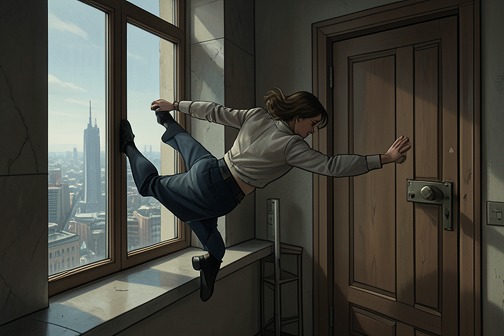
[Miriam Nzululwazi falls to her death from the intelligence building](entity:event-recall-event-miriam-nzululwazi-947dfa74779f) after leaving a [Presidential Intelligence Unit](entity:organization-recall-organization-presidential-int-02952ccf70a3) interview room without an escort. Her death turns a procedural failure into an irreversible human consequence: [Vincent Radebe](entity:character-recall-character-vincent-radebe-d6a5ba81e5e3) later admits that he left the door unlocked and that her fatal fall followed directly from her departure while in a disturbed state of mind. The account also places the tragedy within a longer history of state custody and fear, and makes Radebe’s inquiry testimony a record of both responsibility and institutional harm.
## Circumstances and Earlier Fear
The death is first disclosed in a conversation between [Allison Healy](entity:character-recall-character-allison-healy-35acfe29d17c) and [Zatopek van Heerden](entity:character-recall-character-zatopek-van-heerden-5379cb72cb89). Allison insists that the news concerns Miriam, not their relationship, and tells him that Miriam died the previous night. The authorities, she says, will describe the fall only as an accident: Miriam fell five storeys. The news leaves Van Heerden silent and shaken. At this point, the conversation gives the outcome but not the full chain of events that produced it; the later inquiry supplies that account.
The interview room gives the episode a significant institutional setting. During its design, [Janina Mentz](entity:character-recall-character-janina-mentz-374453134b98) questioned the assumption that interrogation required a table, hard chairs, bare walls, and an uncomfortable atmosphere. She insisted that the Presidential Intelligence Unit was not a police station and had three easy, brown, stain-resistant chairs installed instead. They were bolted to the floor in an intimate triangle, while a concealed microphone and a camera behind one-way glass preserved the room’s surveillance function. That more humane design does not make the interview safe: the door is not locked, and Miriam is ultimately left to leave without an escort. The contrast is between considered surroundings and a failure of care at the threshold.
Miriam’s fear in that room has a history. Fifteen years earlier, at seventeen, she had been caught in a demonstration and taken to the cells at Caledon Plain. The protest, which had blocked the road, broke apart in a police charge; she was pushed into a crowded cell where a woman screamed for her sick child as a policeman raised and repeatedly brought down his truncheon. Miriam remembered gripping the arms of her chair in the interview room, while her eyes seemed unable to register the wall before her. The narrative links the present interrogation to that remembered terror without claiming that the earlier event alone explains her later fall. It establishes that detention is not a neutral setting for her: the room brings an old fear into the present.
## The Fall and Its Immediate Meaning
The clearest account of how Miriam died comes from the inquiry transcript dated 7 November. Vincent Radebe admits that he neglected to lock the interview-room door. As a direct result, Miriam left the room without an escort and in a disturbed state of mind; she then fell to her death from the building’s fire escape. The statement identifies a specific breach, a specific consequence, and the fatal outcome. It does not present the fall as an intentional act, nor does it establish an alternative account to the official description of an accident.
That procedural detail changes the meaning of the brief news Allison gives Van Heerden. The five-storey fall is not merely an unexplained mishap occurring during an intelligence operation. Radebe’s admission connects it to a preventable lapse while Miriam was in the unit’s care. His words make the unlocked door consequential: once she could leave without supervision, her disturbed condition became part of the circumstances leading to the fatal fall. The inquiry records his responsibility in the language of negligence rather than claiming that he intended her death.
## Inquiry and Wider Breaches
The [Commission of Inquiry into the death of Mrs Miriam Nzululwazi](entity:organization-recall-organization-miriam-nzululwaz-8ff5bf0d97e8), held on 7 November, was chaired by Advocate B. O. Ndlovu, with Advocate P. du T. Mostert and K. J. Mapoyane as assessors. Janina Mentz appeared for the Presidential Intelligence Unit. No witnesses were called. The account of the death therefore enters this record through Radebe’s written admission, rather than through a succession of witness testimonies.
Radebe accepts responsibility not only for the unlocked door and Miriam’s death, but also for abducting her six-year-old son, [Pakamile](entity:character-recall-character-pakamile-db01684d694b), without official sanction. He admits keeping the boy at his home overnight and handing him to personnel of the [Cape Times](entity:organization-recall-organization-2236348bd1c9) the following day, thereby undermining the unit’s operation. He declares that he acted alone in both matters and does not seek to implicate anyone else. These admissions widen the inquiry’s significance: the episode involves a fatal failure in custody, the unlawful removal of a child, and an unauthorized handover to the press. They are distinct actions, but together they show how far the operation had departed from lawful and accountable conduct.
In his statement, Radebe acknowledges that protecting the state and democracy can involve difficult decisions that negatively affect innocent civilians. He then says that he is unsuited to intelligence work and was never suited to it. The events of 26, 27, and 28 October, he explains, were traumatic, particularly because he believed the basic human rights of [Thobela Mpayipheli](entity:character-recall-character-thobela-mpayipheli-bde650756e15) and then Miriam had been infringed. He cannot understand how the operation’s importance to national security justified its means. His regret is specific: he says that dismay clouded his judgment, that he was negligent when he should have been diligent, and that he failed to protest more forcefully through official channels. He identifies his greatest weakness as doubting his own judgment of right and wrong.
## Consequence and Narrative Significance
Miriam’s death makes the consequences of intelligence work visible in a record usually organized around state protection and operational necessity. Radebe’s testimony does not erase his part in the events; it formally acknowledges that his omission directly preceded her fatal fall. Nor does the statement turn his remorse into a substitute for accountability. Instead, the inquiry preserves the sequence of negligence, unescorted departure, and death alongside his admissions about Pakamile and the rights violations he believed had occurred.
The narrative also places Miriam’s earlier experience of police custody beside her final time in an intelligence building. The former returns through memory: a crowded cell, a child’s desperate cry, and the threat of a truncheon. In the later room, her hands grip the chair as the past intrudes on the present. The text does not collapse the two episodes into one, but their juxtaposition gives her final detention a history that the formal account of an accident cannot contain. Her death is therefore both a specific consequence of Radebe’s admitted negligence and the culmination of a story in which official custody has already been associated with fear and the violation of ordinary protections.
Event 33
Attack on Van Heerden’s home
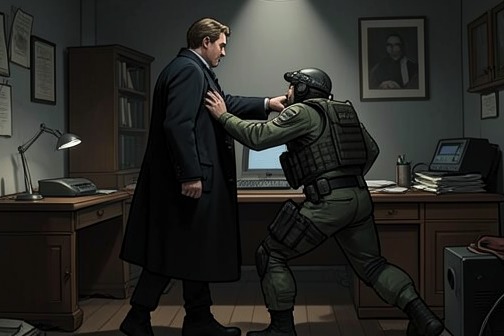
The attack on [Zatopek van Heerden](entity:character-recall-character-zatopek-van-heerden-5379cb72cb89)’s home interrupts a rare evening of warmth in which [Thobela Mpayipheli](entity:character-recall-character-thobela-mpayipheli-bde650756e15), [Allison Healy](entity:character-recall-character-allison-healy-35acfe29d17c), and Van Heerden seem to be moving toward a shared future. It is also the violent culmination of an intelligence pursuit: two London agents trace Thobela to the house while he recovers from his cross-country flight, but their mission ends in a struggle whose aftermath the agency cannot establish. The scene’s decisive reversal is from domestic intimacy to a fight for survival, followed by an official silence that leaves the fate of the agents unknown.
## Background and Convergence
The pursuit follows the public exposure of Thobela’s involvement in [Operation Safeguard](entity:event-recall-event-operation-safeguard-e6467568fd51). Records from the [Stasi](entity:organization-recall-organization-stasi-2fc98e3cd75d) confirmed suspicions dating to 1984 that Thobela, also known as [Umzingeli](entity:expression-recall-expression-umzingeli-a133400ded02), had assassinated [Marion Dorffling](entity:character-recall-character-marion-dorffling-bf74c89c1f79). After receiving that confirmation, a senior response from Langley made clear that the agency remained interested in settling the score. Two specialized agents from its London office were sent to deal with the matter; a subsequent account describes their assignment as helping to secure the hard drive.
The agents’ trail first leads them to Northern [Botswana](entity:location-recall-location-botswana-b5b9bf4982b6) after a tip from [Inkululeko](entity:character-recall-character-inkululeko-9ae708b27ee4). They acquire a vehicle and locate a PIU [Reaction Unit](entity:organization-recall-organization-4127e5cc1cfa) member lying in wait for Thobela. Botswana authorities arrest that member while the agents watch, but the agents spend the night at the roadside without intercepting either Thobela or the hard drive. They return to [Cape Town](entity:location-recall-location-cape-town-f6ea4334d11c), apparently on the point of leaving for London, when Inkululeko signals them by leaving her car’s indicator on in her driveway. Once they establish contact, she gives them the address where Thobela is apparently recovering from wounds suffered during his journey and allows them three hours before the PIU Reaction Unit is expected to arrive there.
That information makes Van Heerden’s home the convergence point of competing operations. The agents have a location and a limited window; the account does not establish what they know about the household or how they intend to secure the hard drive. For Allison, by contrast, the evening is framed not as a rendezvous in the manhunt but as a moment of personal possibility.
## The Gathering and the Assault
Before the attack, Allison sees the gathering as a pleasant occasion to remember. Don Giovanni plays in the sitting room; Van Heerden’s cooking and his devotion to Mozart are part of the domestic ease she is beginning to associate with him. Thobela is present as a friend, carrying his grief for [Miriam Nzululwazi](entity:character-recall-character-miriam-nzululwazi-394be6ca6495) with a composure that has changed Allison’s view of him. Conversations on the veranda have replaced some of her earlier fear with tenderness. The next day, Thobela intends to claim [Pakamile](entity:character-recall-character-pakamile-db01684d694b), and the future seems briefly open to all of them.
The violence arrives without a clear warning. Allison cannot be sure she heard anything beforehand, and, even if she did, she doubts her untrained ear could have distinguished a threat. Thobela moves from the chair beside her toward the sitting room with sudden purpose. What follows happens so quickly that Allison can arrange it chronologically only afterward: bodies collide with a dull thud, a silenced firearm reports in a short series of shots, the coffee table breaks, and men shout. From the doorway, with light behind her, she sees rolling shadows and fragments of the struggle rather than a clear field of action.
Thobela and one man writhe on the floor, a steel blade flashing between them. Across the room, a tall, athletic man holds a gun fitted with a silencer, calmly searching for a target amid their frantic movement. Van Heerden has left the kitchen by another door and reached the passage without Allison noticing. Only when the gunman puts his weapon on the floor does Allison realize that Van Heerden has him covered with a double-barrelled shotgun. Van Heerden orders, “Allison, go into the kitchen, close the door.” She freezes instead. Her inability to move becomes part of the event’s aftermath: in the weeks that follow, she repeatedly asks herself and Van Heerden why she could not react.
## Recognition, Memory, and the Assegai
The struggle shifts from a confused ambush into a confrontation marked by recognition. Thobela and the knife-wielding man stand facing each other; the attacker has close-set eyes, a thick neck, and massive shoulders. Van Heerden calls, “Tiny,” and throws an object across the room, which Thobela catches deftly. The attacker lowers his head and moves his broad-bladed knife, addressing Thobela as “Amsingelly.” Thobela answers, “Umzingeli,” then says, more softly, “[Mayibuye](entity:expression-recall-expression-mayibuye-6491524a7fe5)”.
The object Van Heerden has thrown is [the assegai Allison bought for Thobela](entity:object-recall-object-allison-thobela-assega-e0a6eabd5cd2) in a curio shop on Long Street. Seeing it in his hand, and the strange illumination on his face in the kitchen light, Allison recognizes that this is not simply a fugitive defending himself in a home invasion. The weapon ties the present fight to Thobela’s earlier life and to the identity the attacker invokes. The scene does not explain every movement or disclose the fight’s final outcome; Allison’s broken perception and the later report both preserve that uncertainty rather than supplying a complete account.
## Aftermath and Significance
An intelligence report says that contact with the two agents cannot be re-established. The office can only assume that the mission was unsuccessful, while Inkululeko is unable to provide information about what happened at the house, which belongs to a member of a local university’s psychology department. The agency says it will continue pursuing the matter but must presume the worst. It does not confirm whether either agent survived, whether the hard drive was secured, or precisely how the encounter ended.
That gap between the physical immediacy of Allison’s memory and the institution’s incomplete report gives the attack its unresolved force. In the room, the decisive details are a silenced gun, a broken table, a shotgun held at an attacker’s head, and the assegai crossing the space into Thobela’s hand. In the report, those particulars collapse into missing contact and presumed failure. The assault therefore disrupts more than one quiet evening: it exposes how the competing intelligence operations have reached into a home, places Allison’s new understanding of Thobela beside the violence of his past, and leaves both the agents’ fate and the hard drive’s security unsettled.
Event 34
Pakamile is returned at the Waterfront parking lot
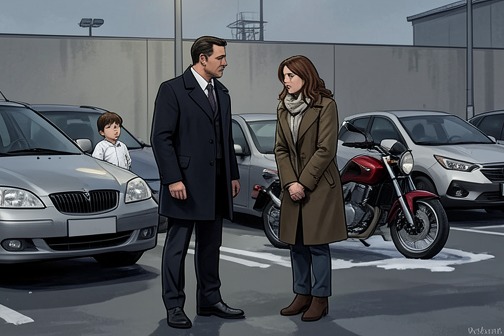
[Pakamile is returned at the Waterfront parking lot](entity:event-recall-event-waterfront-pakamile-c1c07e470f19) when [Thobela Mpayipheli](entity:character-recall-character-thobela-mpayipheli-bde650756e15) turns a coercive exchange into a test of leverage: he refuses to surrender [the hard disk](entity:object-recall-object-94f8ccdf6fc6) for the child and threatens to expose the matter to the press. [Janina Mentz](entity:character-recall-character-janina-mentz-374453134b98) agrees to get [Pakamile](entity:character-recall-character-pakamile-db01684d694b), and the scene reaches its emotional turning point when Thobela sees the boy. The hard disk remains outside the parties’ possession, but a later report says it is secure.
## Background and Terms
Before the meeting, Thobela enters Janina Mentz’s home in the early morning and identifies himself. He makes clear that he wants two things from her and that the children are not to be woken. The scene establishes that she is frightened and under pressure, but the exchange at the [Waterfront](entity:location-recall-location-waterfront-2cf88404b8b0) is the point at which the demands become explicit: Pakamile must be brought to the underground parking lot at eleven, or Thobela will send a copy of the hard disk to every newspaper in the country. He warns her not to be late.
The arrangement makes the child and the disk competing forms of leverage. Thobela’s demand is for Pakamile; Mentz later insists that the boy is in a car behind her and that Thobela must give the disk to [Tiger Mazibuko](entity:character-recall-character-tiger-mazibuko-c3f21f32c499) to get him. The terms do not produce an immediate exchange. Thobela declares the child-for-disk bargain unacceptable and keeps the disk’s location from Mentz, saying only that it is safe.
## The Parking-Lot Confrontation
The meeting takes place in a parking garage at the Waterfront. Van Heerden waits in his car with the CIA agent’s silenced machine pistol, while [Allison Healy](entity:character-recall-character-allison-healy-35acfe29d17c) has chosen not to attend. A minute before eleven, Mazibuko approaches from the shopping-centre entrance. Thobela recognizes him by his confident stride and connects the man before him with the voice and anger he already knows.
Mentz’s voice comes from among the parked cars as she asks where the hard disk is. Thobela answers that it is safe and asks where Pakamile is. When Mentz identifies the car behind her and says that the disk must go to Mazibuko, Thobela refuses her terms. Instead, he takes out a cellphone and announces that he is going to call a reporter from the [Cape Times](entity:organization-recall-organization-2236348bd1c9). The threat changes the immediate balance: Mentz cries for him to wait, while Thobela makes clear that he has waited long enough.
## Pakamile and the Unresolved Exchange
Mentz says she will get the boy. Thobela keeps the phone line open and tells her that he is waiting. As Mazibuko turns away and heads for the exit, Thobela tells him to stay and quietly presents him with a choice between being a victim and refusing that role. The narration marks a change in Mazibuko’s expression: the earlier wildness has gone, and he is silent. He nevertheless continues toward the exit; the scene does not establish what he decides beyond that movement.
Thobela then sees Pakamile, and the boy sees him. The moment threatens to overwhelm Thobela, marking the emotional result of the confrontation after the threats and bargaining. The account does not describe a handover of the hard disk at the parking lot. In a subsequent report, a driver in a white Mercedes-Benz says that the disk is safe and absolutely secure, while also clarifying that it is not in their possession. The child’s return and the disk’s continued separation from the people reporting on it therefore resolve different parts of the standoff, rather than completing a simple exchange.
## Significance
The scene turns on Thobela’s refusal to let the opposing party dictate the price of Pakamile’s return. The hard disk remains a powerful threat because he can use its disclosure to bring the matter before the newspapers; the cellphone makes that threat immediate rather than hypothetical. At the same time, the boy’s appearance gives the confrontation a personal stake that the hard disk alone cannot represent. The reunion is the scene’s emotional release, while the unresolved custody of the disk preserves the larger uncertainty around the information it contains.
Event 35
Thobela and Pakamile return to Alice

[Thobela Mpayipheli](entity:character-recall-character-thobela-mpayipheli-bde650756e15) and [Pakamile](entity:character-recall-character-pakamile-db01684d694b) return to [Alice](entity:location-recall-location-alice-fd6328bbac86) on a motorcycle in the novel’s closing scene. Their arrival brings the journey back to family and home, but the reunion with Thobela’s father, Reverend [Lawrence Mpayipheli](entity:character-recall-character-lawrence-mpayipheli-596c1330b028), remains poised at the edge of recognition: Lawrence sees the riders approach, yet waits for them to remove their helmets before he is certain who they are.
## Arrival in Alice
The return is framed first through the motorbike’s driver. As the radio introduces David Kramer singing with [Koos Kok](entity:character-recall-character-koos-kok-066addcf08aa) on [The Ballad of the Lonely Motorbike Rider](entity:expression-recall-expression-the-ballad-of-the-14a64e4669ba), the driver smiles and slips a finger beneath the collar of his snow-white shirt, easing the pressure against a small hump. The song turns the solitary rider into a figure named in public song; the private journey, meanwhile, has brought Thobela and Pakamile back together to Alice.
## Lawrence in the Garden
The scene shifts to Reverend Lawrence Mpayipheli, searching among his vegetable plants for ripe tomatoes and cutting them loose with pruning shears. He hears the motorcycle before it reaches the door and straightens behind the tall green bushes. Two riders are approaching: a large man and a small boy. The ordinary work of tending the garden is interrupted by a possibility Lawrence can scarcely believe.
## Recognition at the Threshold
Lawrence thinks that it cannot be, then says a brief prayer aloud. He does not call to his wife yet; he waits for the riders to take off their helmets so he can be sure. Only then, he imagines, can he call her in the clear voice that carries across the back yards of Alice like a church bell. The scene ends before that confirmation is shown, holding the return between hope and certainty. Its final emphasis is not on pursuit or escape but on the suspended instant before a family recognizes who has come home.