El Planeta
MayaEl Planeta, born Antonio, is a Cádiz-born flamenco singer whose family association with the Triana style gives him a place in Ana María Maya’s lineage and whose life becomes the starting point for a chain of interwoven legends. The account treats him both as a historical artist and as a figure reshaped by oral tradition: dates and places offer points of verification, while the jester’s appearances and the mysterious portrait remain stories with multiple versions and scant documentary support.
Identity and Background
El Planeta was born in Cádiz around 1785. According to Ana María Maya’s family tradition, he was her great-great-great-grandfather and the founder of what would become the distinctive Triana school of cante jondo. The family’s account places his descendants in Triana, where Ana’s parents and two grandparents still live, but the narrator says he has found no confirmation of the claimed kinship beyond the family’s esoteric tradition. He allows that the singer could have had many descendants over seven generations, without presenting that possibility as proof of Ana’s descent.
The account gives his nickname a pair of possible associations. It may reflect a belief in the influence of stars and planets, to which his songs supposedly allude, or it may suggest a wandering star. In the early nineteenth century he came to Seville and worked in the forges of Triana, an occupation described as common among Roma people of that period. His later reputation belongs to the family’s remembered past as much as to the history of flamenco.
The Singer and the Family Line
The novel presents El Planeta as a respected cantaor whose supposed descendants carried his name and stories forward. His identity links Ana María Maya’s family to Triana’s musical culture, but the narrative keeps the distinction between a family genealogy and a verified one in view. José’s account does not resolve the ancestry claim; instead, it shows how the family’s sense of inheritance is built through repeated stories and remembered associations.
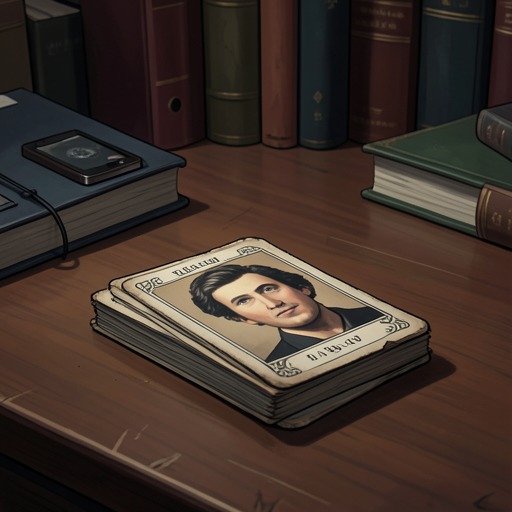
A copper engraving by Francisco Lameyer is described as the only surviving portrait of El Planeta. Some observers think it depicts a Comodín, or a dwarf, connecting the singer’s image to the jester figure at the center of the family legend. The resemblance is suggestive rather than conclusive: it offers a visual echo through which later tellers can attach El Planeta to the jester’s story, without independently establishing that the events happened as told.
The Marseille Tale
One strand of the oral tradition sends El Planeta from Cádiz in the spring of 1842 on a long journey to the shrine of Les-Saintes-Maries-de-la-Mer in the Camargue. The story places him in Marseille on May 26, working for a time as a dockworker to earn money for his return. A few weeks later, while he is on the quay preparing to unload a schooner apparently damaged by a storm, a small man climbs over its side, leaps ashore, and runs off among the harbor sheds. The vessel is said to be Norwegian.
The story has no written record identified by José, even in more recent sources, and its versions vary within the Maya family. He also mentions a supposedly independent Swiss tradition said to be as old as the Andalusian one. In some versions, El Planeta and the dwarf spend several days together among the Marseille port sheds. One night, the dwarf tries to explain his story through gestures and drawings: he sketches a French deck of cards, with hearts, diamonds, clubs, and spades, and recites a short verse for each of its 52 cards in German. El Planeta remembers some of the verses, though he cannot understand the language.
The 1842 episode is presented as legend, not established biography. Its importance lies in the repeated pattern it creates: the itinerant singer encounters a stranger whose identity is conveyed through riddling signs, while the tale itself travels back to Seville and enters the family’s store of stories.
The Card Deck and the Cádiz Wharf
A related legend reaches back to 1790, when a ship from Sanlúcar de Barrameda briefly stops at the Cádiz wharf before putting out to sea. Roma sellers there offer sailors oranges, olives, cigars, lighters, and playing cards. The child Antonio, about six years old, is said to sell the sailor a strange deck. The proposed age fits the independently checkable outline of El Planeta’s birth around 1785, though that fit corroborates only the possibility of the detail, not the supernatural tale built around it.
The same tradition places a dwarf at the wharf, wearing bells beneath ordinary clothes like a jester. It also says he showed those present a portrait of a woman rendered so naturally and in such detail that the onlookers fell silent in astonishment. One of them was the young Antonio. José’s pointed chronological claim is that the portrait was already in Seville in 1790, years before Goya painted his gitana or maja desnuda. He regards that early presence as enough to make the story significant, but the account does not establish the portrait’s identity or prove the legend’s explanation of it.
Oral History and Narrative Significance
José explicitly describes the stories about El Planeta as oral tradition, even a circuit of myths, and says that the same account changes from one family telling to another. He combines versions by retaining only the points on which they agree. That method makes uncertainty part of the subject: the narrative preserves the family’s transmission of the past while marking where documentation ends and legend begins.
The distinction matters to Ana María Maya’s own relation to the stories. She knows the accounts of El Planeta, Manuel el Solitario, and an older relative, but is not said to accept every element; she is sometimes irritated by the family stories because of the association of Roma people with deception. Yet she is certain that the bell-wearing dwarf she chased through the Alcázar gardens was the same figure in the family legend: she heard the bells and followed him. Her experience, as reported by José, gives the inherited story a new claim to credibility without verifying every earlier episode. El Planeta thus stands at the junction of a plausible historical lineage and a deliberately unstable legend, where family memory survives through repetition, variation, and a handful of details that seem to fit the record.