Vera
MayaVera is Frank Andersen’s wife, a paleontologist whose intimate postcard and Frank’s later letter make her more than a figure in his past: she is the person with whom he must confront the brevity of life, and the reader to whom he entrusts the story of Ana and José. Her presence is mediated largely through written messages and Frank’s recollections, so the relationship emerges through the words they exchange and the history he chooses to recount.
Identity and Background
Vera is Norwegian and works as a paleontologist. Frank says that they met in Spain in the late 1980s; within a couple of months they were living together in Oslo. Their shared life began while he was in Spain to present his doctoral thesis on human migrations out of Africa. The pairing of his evolutionary biology with her paleontology places both within the study of life’s deep history, a professional affinity that sits beside the personal question of how to accept an individual life’s shortness.
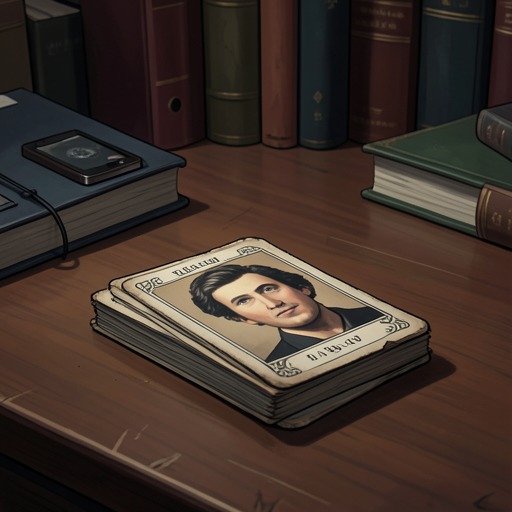
The surviving account offers little direct description of Vera’s appearance or daily life. Instead, her character is established through her direct, intimate writing and through the pivotal place she occupies in Frank’s recollections. The Barcelona postcard is dated 26 May 1992 and shows the unfinished Sagrada Familia; its physical image and personal message become a compact record of their intimacy and of the anxiety that shadows it.
The Barcelona Postcard
In the postcard, Vera tells Frank that she will arrive in Oslo on Tuesday, but not alone, and warns him that everything will be different from then on. She asks him not to call: she wants to feel his body before more words come between them. The message makes physical closeness immediate and urgent, while its reference to an unexpected companion signals a change in their shared circumstances without explaining it further.
Vera also invokes the magic drink, saying that Frank will soon drink a few drops. Alongside this promise, she admits that she is sometimes afraid and asks what the two of them can do to accept that life is so brief. The postcard therefore holds several registers together: desire, a coming change, an enigmatic promise, fear, and a question about mortality. Its recurring importance lies not in resolving those elements, but in giving Frank a question he later takes up as his own.
Marriage and Separation
Frank confirms that he and Vera were married. When asked whether the relationship had broken apart, he shakes his head, yet his answer does not simply establish that the marriage continued unchanged. The passage leaves a tension between their formal bond and the separation or distance Frank later describes in his letter. Their history is presented in fragments, and that incomplete account keeps the relationship from being reduced to a single break or reconciliation.
Frank’s description of their early life together is brief but concrete: they met in Spain, moved in together after only a couple of months, and made their home in Oslo. The postcard’s request for bodily closeness gives that shared history an intimate counterpoint to the later distance. The narrative does not supply a full explanation of what changed between them at the time of the postcard, so its announcement that Vera will not arrive alone remains significant without supporting a more specific account of her circumstances.
Frank’s Letter and the Shared Question
After seeing Vera again, Frank writes to her from Madrid. He explains that he stayed in Salamanca because he believed he had seen Ana and José beneath the bridge over the Tormes, later encountered them again, and then met José in the Prado and Retiro Park. José gave him photographs bearing the manifesto, and Frank says he cannot leave Madrid without sending Vera the whole story. He plans to travel to Seville on Friday morning, but first wants to set down what he has learned and deliver it to her as a complete account.
Frank explicitly connects that task to Vera’s earlier question. He recalls her asking what the two of them could do to accept that life is so brief, and says that he is now asking the same question. To answer it, he believes he must first tell her about Ana and José and trace the story further back, as far as the Devonian, when the first amphibians appeared. The shift from a private exchange between spouses to an expansive account of evolution makes Vera the intended listener for Frank’s attempt to think through mortality on a cosmic scale.
Narrative Role and Significance
Vera’s role is shaped by correspondence: the postcard supplies an intimate question from the past, while Frank’s letter turns that question into the reason for narrating the events surrounding Ana and José. She is not merely receiving information. Frank acknowledges that she had once doubted his account of seeing the pair in Fiji, laughing at what she took to be an invented performance meant to keep her beside him by the river. He now addresses that earlier skepticism directly, promises to lay out events in chronological order, and asks her to read the whole account.
This framing makes the relationship itself one of the stakes of Frank’s narration. He says the history of Ana and José matters to him and Vera, and raises the question of what they can do together in the face of life’s brevity. At the same time, he leaves open what will happen between them, saying that his request for a favor will come later. Vera thus stands at the receiving end of a story that is both an explanation and an appeal: the narrative of deep time is directed toward a particular person, in the hope that the question they once shared can be faced again.