Laura
MayaLaura is an Australian-based environmental journalist whose work and presence on Taveuni sharpen the novel’s attention to ecological loss and the limits of a mechanistic view of life. At Maravu she moves from a solitary airport arrival, intent on reading about the island, to a forceful participant in debates about environmental responsibility; her attraction to Frank is bound up with the naturalist perspective that he finds difficult to dismiss.
Identity and Arrival
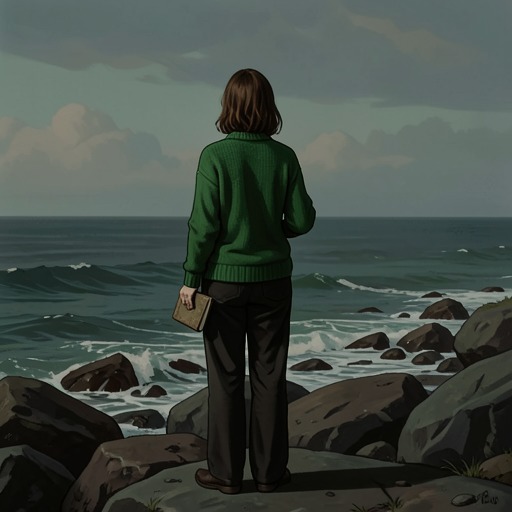
Laura comes from Adelaide and is described as a woman nearing thirty, with long black braids, golden skin, and one green eye and one brown eye. A World Wide Fund for Nature pin on her cloth backpack quietly signals an environmental concern before she explains her work. Frank finds her attractive and eccentric, but his attempt to imagine a connection at the airport meets no encouragement: she is absorbed in a Lonely Planet guide to the island and shows no interest in a superficial airport encounter.
She shares the four-wheel-drive transfer from the airport to Maravu with Frank and Bill. Their introduction places her among visitors who have come to Taveuni for very different reasons: Bill seeks new experiences, while Frank arrives preoccupied with questions about life and evolution. Laura’s attentive reading of an island guide gives her first appearance a strong sense of place; she is not simply a visitor to a tropical setting but someone already orienting herself to the particular environment she has reached.
Work and Environmental Commitments
In conversation at Maravu, Laura explains that she is actually from San Francisco, studied art history, and has recently worked as a journalist in Adelaide. She has received a kind of work fellowship from an American environmental foundation. Her assignment is to keep an annual record of individuals, institutions, and major companies that, for economic reasons, publicly minimize threats to the environment and oppose peoples’ efforts to defend it.
Laura presents this record-keeping as a response to a planetary crisis rather than as detached clerical work. She warns that cultivable resources will diminish over time, tropical forests will burn, and the variety of species on Earth is close to shrinking. She describes these as irreversible processes. When Mario questions the point of collecting names of scapegoats, his challenge reveals a tension in her method: she sees documentation as a way to make organized opposition visible, while he doubts the value of compiling a list. The conversation gives Laura a defined public purpose and makes environmental accountability a subject of dispute among the guests.
Her perspective also unsettles Frank. After he describes his own work, Laura no longer conceals her respect for him, and he feels that he has finally earned it. He had supposed that she was the only person on the island, perhaps even the only person in the world, to have taken a position on environmental problems. The exchange revises that impression: she is not merely an isolated campaigner, and the guests’ conversations reveal a broader shared concern, even where they disagree about what effective action means.
Conflict with Bill
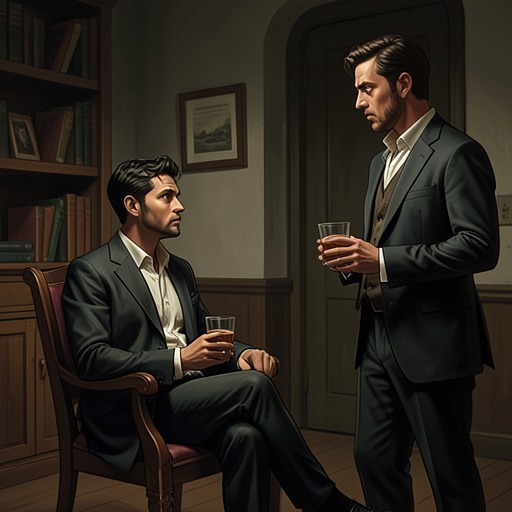
The environmental discussion takes a more personal turn when the guests ask Bill to tell stories about his past. Bill had worked for a major oil company and later became an expert in advanced technology used to contain uncontrolled oil-well blowouts; he also recounts work with Red Adair and assignments for NASA. While he is describing a dramatic well explosion, Laura suddenly rushes at him and strikes him, denouncing him as an oil-industry figure and calling the moment a real explosion.
Frank regards her intervention as ill-timed and unfair. Bill had been recounting how he risked his life to prevent a major environmental catastrophe, so his story complicates the simple opposition between an oil-company career and environmental protection. Laura’s outburst makes the conflict vivid but does not resolve that complication: her fury answers the industry’s wider environmental record, whereas the immediate story Bill has told concerns preventing harm. The scene exposes the strain between judging a person by institutional association and attending to the particular consequences of his actions.
Frank, the Island, and Later Traces
At first, Frank encounters Laura mainly through her reserve and then through her arguments. In a later recollection, José says that Frank’s account of his reason for being in that part of the world aroused Ana and José’s curiosity: as they were developing new maxims for their manifesto, they wanted perspectives on existence from an evolutionary biologist. José adds that Frank had chosen to speak to them in English despite apparently understanding Spanish, and frames this as part of taking on a role. Laura belongs to the same Taveuni setting in which Frank’s scientific account meets Ana and José’s philosophical and theatrical interests, though the evidence does not make her a participant in their manifesto-making.
The novel later links Laura to Frank’s unsettled thinking. José’s retrospective account suggests that Frank was struggling to shed an overly mechanized picture of the world, and that Laura’s naturalist outlook may have become a welcome temptation. The account is qualified: José presents this as his impression, not as a certainty, and acknowledges that he does not know what happened during the rest of Frank’s final night on the island. The distinction matters. Laura’s narrative importance lies in the perspective she offers Frank, while the extent of their private relationship is not fully established in this evidence.
Laura’s environmental attention also persists after she leaves Taveuni. When Frank and José later walk in Seville, Frank tells José that Laura sent him a photograph she had taken on Taveuni of a rare pigeon with an orange breast. The image carries a specific observation from the island into a later meeting in Spain: Laura is absent from the scene, but her photograph preserves a record of its wildlife and recalls her interest in the natural world. Its return also connects the visitor’s travel experience to the novel’s wider concern with species and the human habit of noticing, documenting, and sometimes threatening them.
Narrative Role
Laura brings environmental advocacy into a novel preoccupied with evolution, consciousness, and existence. Her work gives those large questions a concrete political counterpart: ecological threats are not only abstractions but subjects of annual documentation, public minimization, and contested responsibility. The contrast between her conservation mission and Bill’s technical work on oil-well emergencies prevents the environmental debate from settling into an easy moral division, while her naturalist perspective offers Frank an alternative to mechanistic certainty.
Her appearances also form a compact arc of changing visibility. At the airport Frank sees an attractive stranger who does not return his interest; at Maravu he hears a journalist set out a specific environmental mission, then witnesses her anger collide with Bill’s account; later her photograph returns as evidence of attention to a particular species. Laura’s importance is not that she resolves the novel’s philosophical questions, but that she makes the natural world a subject of argument, work, and sustained observation rather than mere scenery.