Ana María Maya
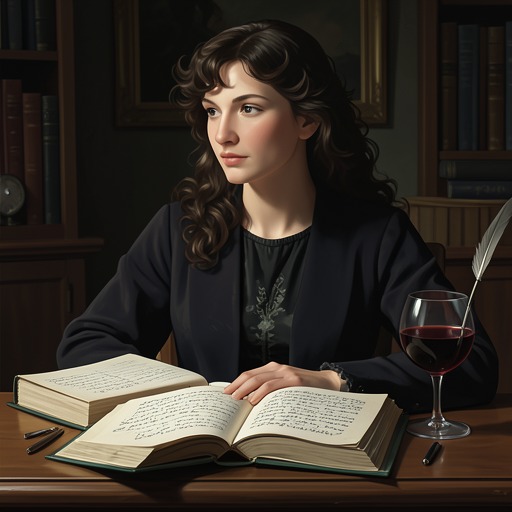
MayaAna María Maya is a celebrated Roma flamenco dancer whose presence binds the novel’s Fijian and Spanish narratives. First encountered by Frank on Taveuni as a striking, self-possessed young woman beside José, she later emerges as the woman whose face resembles Goya’s Maja and whose full name sharpens that resemblance into a mystery. Her artistry, intimate partnership, heart condition, and unexplained declaration of divinity make her at once vividly embodied and difficult to place within ordinary limits of identity and time.
Identity and Introduction
The novel’s framing description casts Ana María Maya as the mysterious thread leading to its surprising conclusion. The first part centers on Fiji’s ecological refuge; the second turns to Spain, where Goya and the face of his Maja become essential to the plot. Ana is the point of connection between those settings, while the novel’s account of vertebrate and cosmic evolution, time, purpose, and the Hindu concept of maya gives her story a larger field of questions about what can be known and what may only appear to be real.
Frank first sees her through the mangroves on Taveuni, walking barefoot at the water’s edge with José. She has long, curly black hair falling over a red dress, black eyes, white teeth, and a tall, golden, graceful bearing; José, by contrast, is shorter, fair-haired, blue-eyed, and reserved in manner. Frank feels that he has seen her before, though he cannot place her in any recent encounter. The impression is not an ordinary recognition: he thinks of a previous life or an entirely different existence, a premonition that gives their meeting an uncanny charge before he knows her name.
When the three introduce themselves, Ana and José say that they are staying at Maravu, the only accommodation for many miles. Frank gives his own name and says he has been conducting field studies in the South Pacific. His remarks about threats to the region’s ancient flora and fauna catch their attention. They exchange a knowing look and seem so attuned to one another that their closeness unsettles him; he reflects on the advantage of facing a situation as a pair. Ana’s first appearance thus joins two elements that remain central to her character: an immediate, physical presence and the sense that the people around her are encountering more than they can yet explain.
Life and Plot Trajectory
On Taveuni, Ana and José repeatedly speak in a grave, enigmatic manner. In one exchange, Frank struggles to listen to José while concealing that he understands the language, and Ana keeps her eyes fixed on him, apparently watching for a reaction. Afterward, she picks up a camera from the ground and places it on the front seat of the car. She leans against the vehicle as if dizzy and looks pale; the moment lasts only seconds. She then straightens, runs the eight steps to José, and takes his hand. Together they stand in the tropical dusk like a living statue of Amor and Psyche. The brief pallor gives physical form to the unease and vulnerability that accompany Ana even in scenes marked by mythic imagery.
The novel later returns to Ana through José’s account of their life in Spain. She loved a Madrid garden and insisted on visiting it at least once a day whenever they were in the capital, whatever the season. While José attended meetings, Ana might spend half a day there alone; if he left for a meeting at ten, he would come back at lunchtime to find her. The search itself became a game: José wondered among the trees where she would be and what new thing she would have discovered. Sometimes Ana saw him first, hid from him, or secretly followed him while he searched. She gradually learned the names of the trees and shrubs and eventually knew which bird belonged to which tree. This account presents her curiosity as active and sustained: the garden is not merely a refuge but a place she continually reads, explores, and turns into play with José.
Art, Name, and the Maja Mystery
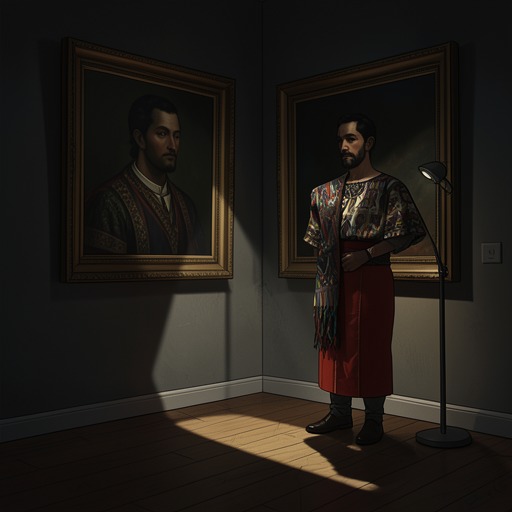
Ana’s appearance acquires a second identity through its resemblance to Goya’s Maja. José tells Frank that the likeness was, in his view, not simply strong but exact. Ana became increasingly aware of what he calls her strange disadvantage from adolescence onward; in Seville, during her later years, people called her La Niña del Prado. José’s account makes the resemblance a developing feature of her life, one she came to recognize over time, rather than a comparison imposed only at the moment Frank discovers it.
The name completes the convergence. When José says that her full name was Ana María Maya, Frank is struck silent: she not only looks like Goya’s Maja but is called Maya. The name recalls an earlier encounter on Taveuni, when John Spooke touched Ana’s forehead to show that he had learned her surname, an action José had disliked. The connection among Ana, Maya, and Goya’s painted figure does not settle her identity; it makes the distinction between a person and an image increasingly difficult to hold. The novel’s wider interest in maya as an illusion that can falsify perception gives this resemblance a thematic resonance, while leaving the reader to contend with the unsettling possibility that likeness, name, and identity may be entangled across time.
Ana also unsettles ordinary categories through what she says about herself. When asked to speak for herself, she answers, “I am a divine being.” José is the only person besides Frank who seems to notice the comment’s accompaniment: an unreadable smile. Mario, by contrast, simply opens his brown eyes wide and asks whether she is God. The scene preserves the gap between Ana’s startling assertion and the reactions of those around her. The text supplies no explanation that would reduce her words to a settled claim; the smile leaves their meaning open, sustaining the mystery attached to her throughout the novel.
Relationship with José
Ana and José appear together from their first meeting, and their mutual attentiveness is immediately visible. They speak English well, listen closely when Frank discusses ecological threats, and exchange looks that suggest a shared understanding. Frank experiences their companionship as a practical as well as emotional force: they seem so in tune that he feels conspicuously alone beside them. The later image of Ana running to take José’s hand turns that impression into a clear gesture of attachment.
José’s memories of the Madrid garden show a relationship built from repeated acts of searching, discovery, and play. He looks for Ana among the trees; she sometimes hides or follows him unseen; each reunion makes room for something new she has noticed. His account preserves their everyday intimacy alongside the larger mystery of Ana’s resemblance to Goya’s Maja. He speaks of her as a person with habits, preferences, and a particular knowledge of the natural world, not only as the figure around whom the novel’s riddles gather.
Illness, Performance, and Ending
José recounts that a few years after they met, Ana was diagnosed with a mild heart lesion that was difficult to operate on without considerable risk. Doctors expected her to live with it without special precautions in daily life, but episodes of poor circulation sometimes drained the color from her face for a minute or two. The doctors considered these episodes not particularly alarming, yet they frightened both Ana and José. Her fleeting pallor on Taveuni acquires added significance in retrospect: it resembles the recurring symptom José describes, although the initial scene itself does not explain it.
Her first serious setback came roughly a year before José tells the story. Ana collapsed onstage and was taken to hospital by ambulance. The doctors continued to offer reassurance but told her she had to stop performing. José stresses how passionate flamenco dancing is, linking the medical restriction directly to the form of life and work through which Ana had expressed herself. The advice was compounded by another prohibition: doctors did not recommend that she have children. These instructions place bodily vulnerability against the force of her public identity as a dancer and the life she shared with José, without making her illness the whole of her character.
At a flamenco performance in Seville, Ana returns to the stage in a vivid, controlled entrance. Three men descend from a gallery to provide guitar, clapping, and voice; then Ana comes down a spiral staircase, greeted by the enthusiastic applause of Japanese spectators who have traveled from Tokyo, Kyoto, and Osaka partly to see her. She wears a red dress, a pink silk shawl, and bright red shoes, with her long black hair gathered into a ponytail and marked by a rose. Frank whispers her name as she descends. The scene sets the force of her performance against the doctors’ instruction that she stop dancing: the stage presents the passionate artist in full command of her appearance, even as the account of her heart condition makes that command precarious.
Narrative Role and Significance
Ana’s role is to make the novel’s separate scales of attention meet. Her life connects Taveuni’s threatened natural world to Spain’s gardens, flamenco, and Goya; her body is at once the dancer’s instrument and the site of a serious heart condition; her face makes an artistic image seem to return in a living woman. Her name and resemblance accumulate rather than resolve the mystery, while the novel’s interest in illusion and the purpose of the universe gives that uncertainty philosophical reach.
The contrast between Ana’s ordinary details and her uncanny associations is central to her effect. She knows the birds and plants in a Madrid garden, plays hide-and-seek with José, and appears in a red dress beside a car on Taveuni; she is also remembered as a woman Frank feels he knew in another existence, recognized as the living likeness of Goya’s Maja, and heard declare herself divine. The novel does not require one register to cancel the other. Ana remains both an individual with a particular shared life and the figure through whom the story tests whether identity can be contained by a single time, image, or explanation.