Sheila
MayaSheila is John Spooke’s wife and the enduring presence at the center of his account of bereavement. She dies at fifty-nine, before the turn of the millennium, after a final year marked by chemotherapy; in the years that follow, John’s life is reorganized around the small objects, phrases, and habits through which he still experiences their intimacy. Her absence does not end their relationship in his telling: it changes its form, leaving him to live with memories that console and wound him at once.
Identity and shared life
Sheila and John had known each other for more than forty years when she died. Their familiarity was so deep that John believed he could anticipate not only her opinions but the exact words she would use. He notices how particular expressions associated with her recur in the speech of other people, making ordinary conversation unexpectedly feel like a trace of her presence. In his account, shared language becomes one of the everyday forms through which a long marriage persists after death.
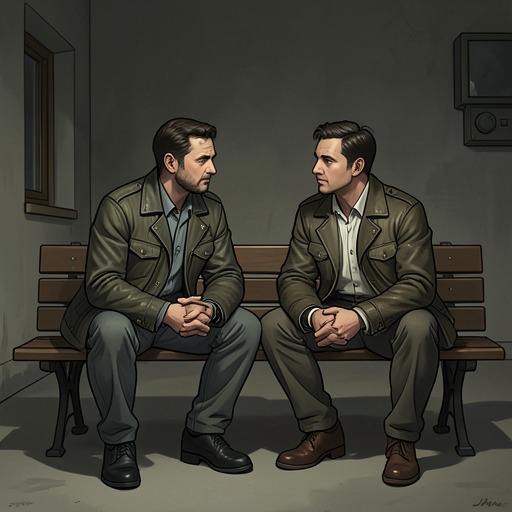
A particularly intimate part of their routine involved playing solitaire. Sheila could spend whole afternoons at it while John worked in the attic. When he came downstairs to the sitting room, she sometimes made him wait until she had finished her game; when she was feeling playful, she asked him to shuffle the cards so she could begin another. The ritual was affectionate precisely because it was familiar and slightly teasing: the cards gave Sheila her own occupation, while John’s return from work became part of its rhythm.
John recalls that solitaire was one of the eccentricities that first helped him fall passionately in love with Sheila. Later, the same habit could irritate him. He disliked losing whole afternoons to the games, objected when he caught her cheating to make a game come out in her favor, and once told her that solitaire was considered a game of death. She was deeply offended. After her death, he misses even the very traits he used to resent. The reversal does not erase their ordinary frictions; it makes those frictions part of what he loved and can no longer recover.
Death and its immediate aftermath
Sheila died at fifty-nine, three years before John’s epilogue. John describes the loss as difficult to comprehend: even after that interval, it still seems impossible that he will never see her again. He remembers that she had been able to cross a room and place a comforting hand on the back of his neck only months before her death. That bodily memory sharpens the contrast between their recent closeness and the finality of her absence.
In the earlier account, John says he had to say goodbye to Sheila in the same century in which he lived. The approaching millennium had fascinated and frightened him since childhood, when he imagined reaching sixty-seven if he lived to see it; Sheila did not live even to sixty. The calendar’s immense historical threshold therefore meets a private limit: the future he had pictured arriving with her in his life arrives instead after her death.
The practical work of bereavement comes later. After rereading the letter to Vera, John finally feels able to sort Sheila’s clothes. People from the Salvation Army are due the next morning to collect them, including old dresses that he doubts they will be able to sell. He compares the task to removing a swallow’s nest that has been empty for years. The image registers both the time that has passed and the force of the act: the home has contained the shape of Sheila’s absence, and now even the clothes that preserve her physical presence are to be taken away.
John says that he is beginning to get used to life as a widower, recognizing it as another way of existing. He can look at Sheila’s large color photograph with less of his earlier physical recoil. Yet this change is only partial. In the epilogue he still shudders when he looks at the photograph, which hangs in a black frame above the desk where he works. He had taken it years earlier in front of Croydon’s old town hall; because Sheila appears to look directly at the camera, he sometimes feels that she had meant the picture to keep watch over him if she died first.
A continuing relationship in memory
John describes speaking with Sheila after her death, sometimes unsure whether he is talking aloud or only thinking. He knows that at least sometimes he answers aloud, while her replies occur in his thoughts. The conversations do not mean he has forgotten she died: he explicitly locates them in the aftermath of her death and recognizes that his neighbor thinks he talks to himself. Instead, they show how their long familiarity supplies a continuing internal dialogue. John already knew how Sheila would answer him while she was alive; memory now gives that expectation a voice without restoring her body.
Her phrases and remembered remarks circulate through his mind as a distinctive personal vocabulary. He reflects that people have their own characteristic words and expressions, and he continues to notice Sheila’s among those used by others. He sometimes answers aloud when something she says in his mind upsets him, even though he knows in advance what she is going to say. He describes this as one respect in which his life has undergone no dramatic change. What has changed is that the exchange now takes place across an absence that he cannot undo.
John says that he misses Sheila’s body, even though many other forms of their shared life remain in some sense intact. Their conversations continue internally, and their shared memories still give her a principal place. He particularly misses her asking him to shuffle the cards for another solitaire game. The recollection gathers the larger pattern of his mourning into an unceremonious request: the habits he once took for granted have survived as memories, but the person who made them reciprocal is gone.
He also fears that the voices may eventually become harder to keep private. A neighbor has remarked that he talks to himself, and John supposes that one day he may no longer be able to keep Sheila’s words to himself. He is conscious of growing old and calls what he is experiencing a kind of verbal incontinence that might worsen. The concern gives his private conversations a vulnerable social edge: they sustain intimacy, but they may also become visible to people who cannot hear the remembered half of the exchange.
Bereavement, uncertainty, and narrative role
John’s memories of Sheila resist a simple progression from attachment to detachment. Sorting her clothes and becoming less startled by her photograph suggest some accommodation to widowhood; the picture’s gaze, the conversations in his thoughts, and his longing for her physical presence show how much remains unresolved. The same memories can be comforting and painful, and the ordinary details that preserve their closeness also make the irreversibility of death palpable.
The epilogue extends that uncertainty into a question about reunion after death. John admits that he is almost, but not entirely, sure he will never see Sheila again. He reasons that the mere existence of the world has already exceeded the limits of what would seem probable, and asks why another world after this one should therefore be impossible. The hope is not presented as certainty or proof. It grows from the same tension that shapes his mourning: Sheila is irretrievably absent from his present life, yet his attachment to her makes absolute confidence in permanent separation difficult.
Sheila’s narrative role is thus not limited to the past that John recounts. Her remembered gestures, speech, and habits structure the present tense of the epilogue, while the black-framed photograph gives that presence a concrete image that is at once visible and unreachable. John’s account neither resolves grief nor treats continued conversation as a cure. It records a changed bond: one made from recollection and internal reply, sustained by the particulars of a shared life, and shadowed throughout by the fact that the woman John still addresses has died.