José
MayaJosé is Ana’s partner, a teasing and persistent conversationalist whose questions unsettle Frank’s confidence in a purely mechanistic account of evolution. Through their encounters in Fiji and his later recollections in Madrid, José joins a speculative argument about purpose in nature to the concrete history of Ana’s family, illness, and life with him. His story culminates in the revelation that he and Ana have a young son, Manuel.
Identity and First Encounters
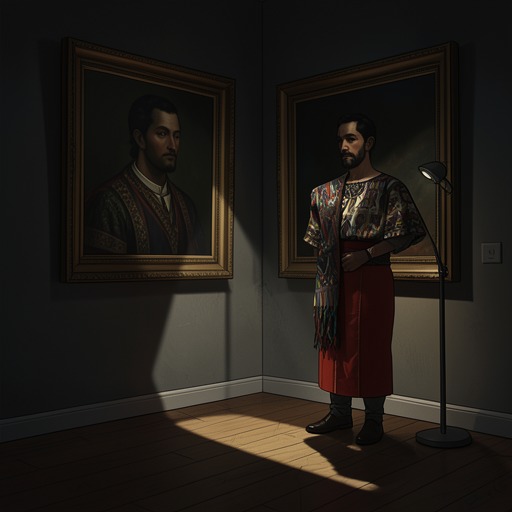
José first appears with Ana on Taveuni, walking closely beside her through the palm grove near Frank’s cabin. He wears a black linen suit; Ana, whom he holds affectionately by the shoulders, wears a poppy-red dress. Their Spanish conversation initially seems private to Frank, who overhears José reflect on the wonder of creation and Adam’s lack of astonishment. When Frank approaches, the couple introduce themselves in English as Ana and José, and Frank gives his own name. All three are staying at Maravu Plantation Resort, the only accommodation for many miles.
José is shorter than Ana and initially seems reserved, even guarded, but his narrow face brightens into an almost mischievous smile as Frank comes near. The first meeting also establishes the couple’s conspicuous closeness: they exchange knowing looks, listen intently when Frank speaks about threats to the South Pacific’s ancient flora and fauna, and give him the uneasy impression of two people deeply attuned to one another. Frank’s response to their intimacy is mixed with curiosity and self-consciousness, sharpened by his sense that he has encountered Ana before.
José’s philosophical reflections continue at the water’s edge. Standing with his back to Frank and Ana, he speaks in Spanish in a tone that makes his words sound rehearsed or repeatedly considered. He argues that the existence of a world approaches the limit of the improbable: if nothing had existed, nobody would have been there to ask why. Ana watches Frank as José speaks, testing whether he understands a language the couple assume he does not know. Their conversation thus combines an abstract claim about existence with a small social game about what Frank can hear and whether he will reveal it.
Evolution, Purpose, and Frank’s Challenge
At a card game, José redirects a discussion of probability and the distribution of cards toward Frank’s field of evolutionary biology. He asks whether life on Earth has been propelled solely by chance mutations or whether natural science might have overlooked another mechanism. In particular, he challenges Frank to consider whether intention or purpose could have a place in evolution. Frank sighs at the return of a subject that has troubled him throughout the day, then gives what he regards as standard textbook answers.
José’s broader claim is that life is not merely a real process but a meaningful one. He argues that human consciousness cannot be just another arbitrary quality in the struggle for existence; it may instead be the process’s end or direction. He treats the repeated emergence of sensory and physical capacities as evidence that nature tends toward increasingly comprehensive ways of perceiving: eyes and vision have evolved independently on multiple occasions, as have flight and upright walking. In his interpretation, intellectual vision belongs to that same pattern, as though life were developing an ever more specialized means of apprehending the whole.
Frank recognizes that José’s argument touches ideas he entertained as a child, when he was influenced for a time by the theologian Pierre Teilhard de Chardin. His subsequent biological training led him to reject evolution with a predetermined purpose, and he feels professionally obliged to resist José. Yet he acknowledges the repeated development of eyes, flight, swimming, and upright posture in life’s history. His scientific examples sharpen rather than settle the disagreement: eyes arose roughly forty or fifty times, while insects developed wings more than a hundred million years before reptiles did. The pterosaurs, the earliest vertebrates capable of flight, appeared about two hundred million years ago and became extinct with the dinosaurs; they were not ancestors of modern birds. The much later Archaeopteryx, about 150 million years old, was a small dinosaur, and the development of feathers and wings in birds took place independently of pterosaurs.
José uses that distinction to press the question of how a structure could begin before it became useful. Wings and feathers do not appear overnight, he observes, but their gradual emergence raises the problem of whether nature somehow “knows” where it is going. Frank answers that natural selection operates through mutations across many thousands of generations: an individual with a small advantage has a greater chance of passing on its genes. José’s challenge is more specific than a general appeal to design. He asks what advantage could accrue to an animal with awkward, rudimentary wings many generations before those wings could help it, when the structures might instead hinder attack and defence.
Retrospective Purpose and the Future
José’s argument broadens from biological adaptations to the history of the planet. John Spooke gives voice to the possibility that what looks purposeless at an early stage may be judged differently once its later development is visible. Three hundred million years ago, John suggests, it would have been premature to declare life absurd or without purpose: its apparent end might simply not yet have had time to flower. Asked whether humanity has reached that end, he answers that people belong to the vanguard but have not arrived at the goal. The destination might become legible only in a hundred years, a thousand, or a billion years.
This account reverses the ordinary direction of causation. John proposes that what happens in the future can become, in a sense, the cause of what happens now, because later outcomes allow earlier stages to acquire a meaning they could not yet display. He extends the reasoning to the formation of the solar system: an observer witnessing immense forces at work might have called the spectacle blind, stupid, and absurd, but that judgment, too, could be premature. The claim does not describe a known biological mechanism; it treats purpose as something disclosed retrospectively through the long course of development.
Frank directly objects that causes point backward in time and cannot belong to the future. John replies that this may be where the usual perspective fails. Without the evolution of life from the first amphibians, he argues, one might have called earthly life absurd and purposeless; but in that counterfactual world there would have been nobody to make the judgment. Across these exchanges, José’s side of the debate presses Frank to distinguish an account of how traits spread through natural selection from a claim about what the entire history of life means. Frank supplies the mechanism; José and John ask whether mechanism alone exhausts the question.
Ana, Family, and Illness
In Madrid, José recalls the everyday life he shared with Ana. She loved the oasis of Retiro Park and insisted on visiting whenever they came to the capital, at least once a day and in every season. While José attended meetings, she could spend half a day alone among its trees. If he left for a meeting at ten, he would return at lunchtime to look for her. Finding her became a game: he wondered where she would be and what new thing she would have discovered, while she sometimes hid or secretly followed him as he searched. Over time she learned the names of the trees and shrubs and came to know which birds belonged to which trees. José’s recollection presents her attentiveness to place as a habitual, self-directed pleasure, not merely as an accompaniment to his work.
José also explains Ana’s family history. She was the youngest daughter in a longstanding Roma family living in Triana, Seville, since the beginning of the previous century; her poor parents and two grandparents still lived there. Family tradition traced one branch to El Planeta, the legendary flamenco singer associated with the development of the Triana school. Born in Cádiz and said to have lived from about 1785 to 1860, El Planeta was thought to have taken his name from his belief in the influence of stars and planets, or from the sense of being a wandering star. He came to Seville in the early nineteenth century and worked in the forges of Triana, an occupation common among Roma people of that period.
The family called El Planeta Ana’s great-great-great-grandfather, but José is careful to qualify the claim: he had found no confirmation beyond the family’s own esoteric tradition. After seven generations, he allows, El Planeta might have hundreds or even thousands of descendants, so Ana’s place in that line remains possible rather than established. José’s account thus carries family inheritance as both a living tradition and an uncertain genealogy. When Frank asks about a different explanation held by Ana and her family, José describes it as an old story, more likely a fabrication in his view, beginning with an episode attributed to El Planeta in France.
A couple of years after José and Ana met, doctors discovered that Ana had a mild heart defect that was difficult to operate on without considerable risk. She could live with it without special restrictions in ordinary life, but occasional circulatory episodes made her lose colour for a minute or two. Although doctors did not consider those episodes alarming in themselves, they frightened both Ana and José. About a year before José recounts the history, Ana suffered a more serious setback: she collapsed onstage, was taken by ambulance to hospital, and was told to stop performing. The doctors also advised against her having children. For a flamenco dancer whose work was intensely physical, the instruction to leave the stage and the warning about pregnancy placed limits on two central parts of the life she and José shared.
Manuel and the Story’s Personal Stakes
The later revelation of José’s fatherhood gives those earlier medical warnings a concrete consequence. After a performance, Ana accompanies the group to the gallery, and José comes to Frank’s table carrying a baby. Frank stares first at the child, who appears to be no more than two months old, and then at José, asking haltingly whether the baby is his. José nods with unmistakable pride and names him Manuel. Ana joins them at the table moments later. The scene establishes that José and Ana have a son despite the earlier medical advice against pregnancy, but it does not explain how the pregnancy unfolded or resolve the medical risks that had accompanied it.
José’s character is defined by the conjunction of these registers. In conversation, he persistently tests explanations that treat evolution as a sequence of adaptations without an overarching purpose; in recollection, he preserves the detailed habits, family stories, and bodily vulnerabilities that made Ana’s life particular. His arguments do not cancel Frank’s scientific account, and Frank does not report being converted to José’s position. Instead, the debate makes the limits of their disagreement visible: natural selection explains how advantageous traits can be inherited, while José insists that a retrospective account of life may still ask what consciousness and the long process of evolution signify. The child named Manuel closes that inquiry on an intimate image of a future made present, without proving the cosmic purpose José argues for.