Mario
MayaMario is an Italian sailor who has made a life in the South Pacific without managing to return to Naples. At Maravu on Taveuni, he turns a bridge game into an inquiry about how much partners can know of one another: Ana and José’s repeated wins look to him like clairvoyance, while their play becomes the occasion for wider questions about probability and the meaning of evolution. The eventual disclosure that the couple sometimes signalled their cards gives his suspicion a practical basis, though not the supernatural one he had proposed.
Identity and circumstances
The narrator first notices Mario at dinner as a dark-haired, bearded man with white strands, roughly ten years older than himself. Mario is seated separately from Ana and José, while the narrator sits nearby and exchanges greetings with the other travellers. The brief arrangement of tables establishes the social setting in which Mario will approach: a group of strangers gathered at the resort after the afternoon excursion, with the Spanish couple already absorbed in one another.
Mario introduces himself after the tables are cleared, approaching the narrator directly and offering his hand. In recent years he has run charter trips from Suva on a yacht he built himself. He had not originally planned to make this his occupation. Fifteen or twenty years earlier, he had sailed through the Suez Canal to India, Indonesia, and Oceania; the journey became a prolonged displacement, since he still had not saved enough money to return to his native Naples. His life in the islands is thus both a chosen seafaring venture and an unfinished passage home.
The bridge game
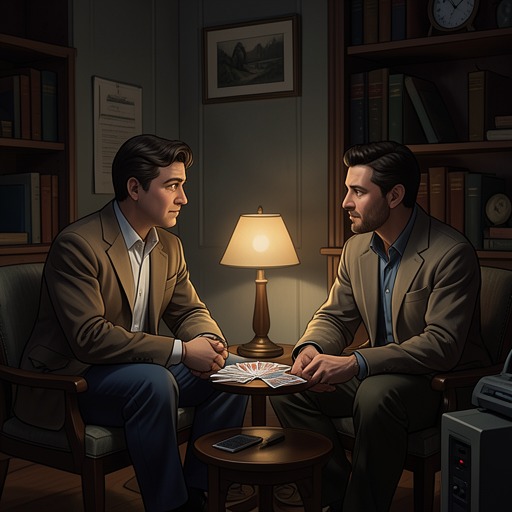
Mario’s immediate purpose in approaching the narrator is practical: he asks whether he plays bridge. The narrator is a capable player, but is not especially eager to spend a tropical night at cards. He agrees when Mario explains that they will play against the Spanish couple. On previous evenings Mario and Ana and José had played with a Dutchman, who has since continued on to Vanua Levu by the regular boat.
The four play a couple of hands. Ana and José repeatedly make their contract or beat Mario and the narrator on the decisive final trick. Their precision is striking, but so is the effortlessness with which they play: they can rest between bids and tricks while continuing their strange Spanish wordplay. The narrator catches phrases including “the ancient drumbeat,” “the chic primate,” and “the bored half-brother of the Neanderthal.” When he is dummy, he can leave the table long enough to jot down the expressions he has heard. He suspects that the couple’s murmured language may even distract their opponents from the play, though he cannot establish whether that is intentional.
Mario’s frustration breaks through during one hand. After the bidding reaches five clubs, he complains that the sequence might as well have been called by Frank holding the ace; Ana and José seem to know what is in the other players’ hands at every moment. Ana looks at him with mischievous satisfaction. The narrator, carried along by the tropical night, briefly entertains the possibility that the pair’s unusually close rapport allows them to read each other’s thoughts. He places Mario’s suspicion within a cosmic scale, imagining the four players as observant primates on a small planet in the Milky Way, while acknowledging that the night has weakened his own critical judgment.
From luck to evolution
Mario broadens the dispute from their particular game to the odds of winning. If all four players are equally skilled, he asks, what is the probability that one partnership will win eight hands in a row? The narrator answers that the deal matters, but that receiving the better cards eight times consecutively would be so unlikely that it is simpler to suppose Ana and José are the stronger players. Ana is delighted rather than embarrassed by the run of victories; she even lays a consoling hand on Mario’s shoulder, and he recoils with an ill-tempered expression.
José then turns the question of probability and distribution toward the narrator’s professional field. He asks whether life on Earth has been propelled only by the unpredictable operation of random mutations, or whether natural science might have overlooked some other mechanism, including intention or purpose. Ana and José, and gradually Mario as well, question the narrator about science. The narrator enjoys being the focus of attention and gives short talks on paleontology and evolutionary biology, but José’s humorous questions put him in professional difficulty. He comes away not with new information, but with a sharper awareness of uncertainties in natural science that he had never previously questioned.
José argues that life is not merely a real process but one filled with meaning, and that human consciousness may be the process’s end rather than an arbitrary quality useful in the struggle for existence. His examples include the repeated development of eyes and vision, flight, and upright walking, which he treats as evidence of a broader tendency toward intellectual vision. The argument touches an idea the narrator remembers entertaining as a child under the influence of Pierre Teilhard de Chardin; studying biology had led him to reject purposeful evolution, and he now feels obliged to resist José in the name of science. Mario’s presence in the discussion marks a shift from his initial role as an aggrieved bridge opponent: he joins the group’s scientific questions, and the game’s contest over chance becomes a debate about whether life’s history can be understood as purposeless.
The secret language and the limits of clairvoyance
A later conversation supplies a partial explanation for the couple’s apparent insight at the card table. José says that each verse of the old texts corresponded to a card. He and Ana had often played as partners and had both memorized the texts, giving them a private language linked to the suits and numbers. Sometimes they whispered isolated words to tell one another which cards they held. When asked whether they cheated, José admits that they sometimes did.
The disclosure gives Mario’s suspicion a concrete, limited truth: Ana and José were able to communicate information unavailable to their opponents. But José distinguishes this from Mario’s esoteric interpretation. Mario had said that the pair were clairvoyant; José says that explanation was not entirely right. The distinction leaves room for what the scene does not settle. The couple’s skill, the signals, and the narrator’s earlier speculation all coexist, while the supernatural claim remains unconfirmed.
Narrative role
Mario’s bridge complaint supplies a comic and intelligible entry into the novel’s larger questions. The cards make hidden information visible as a problem: partners may seem to read minds because of extraordinary coordination, superior play, or covert signals. The later account of the private code revises the impression without making the game’s earlier mystery meaningless. Mario is neither proved clairvoyant nor simply dismissed as mistaken; his language identifies the uncanny effect, while José’s explanation exposes one mechanism behind it.
The bridge table also gives the book a miniature model of its argument about knowledge. A run of wins invites competing explanations—chance, ability, communication, or something beyond established science—and the players move from those alternatives to questions about purpose in evolution. Mario’s movement from suspicion to participation links the social scene to the philosophical debate: he begins by asking how the couple knows the cards, and becomes part of a conversation about what the history of life may mean.