Gordon’s London Dry Gin bottle
MayaGordon’s London Dry Gin bottle is the recurring object through which Frank’s attempt to manage distress becomes visible and contested. He treats the gin as medicine and a possession to be protected; the bottle’s repeated handling, near-loss, and concealment reveal how fragile that sense of control is, while the gecko Gordon repeatedly challenges the human claim to it.
Introduction and Function
The bottle belongs to Frank’s life at Maravu Plantation Resort on Taveuni, where his conversations with Gordon, a gecko, turn an ordinary drink into a recurring point of conflict. Frank refers to the gin as vital medicine and explicitly connects drinking to the wish to quiet or anesthetize his thoughts. Its function is therefore practical as well as symbolic: it offers immediate relief, but every effort to secure it also exposes the anxiety that makes it seem necessary.
The bottle’s label and its association with Gordon give the object a double identity. It is Gordon’s London Dry Gin, yet Gordon the gecko acts as though the bottle is also his concern, guarding it and contesting Frank’s efforts to drink or store it. The shared name makes the repeated struggle feel almost like a dispute between two Gordons, though one is a bottle and the other a living animal.
The Bottle Lost and Recovered
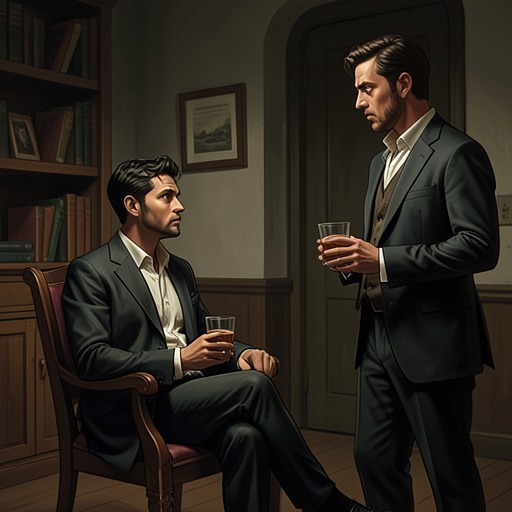
In one confrontation, Frank tells Gordon to be quiet because he is becoming very nervous. Gordon replies that Frank may lie down while he himself will look after the bottle. Frank refuses and lunges at both the gecko and the gin, announcing that the moment has come to anesthetize his synapses. His declaration makes the bottle’s role unusually explicit: drinking is presented not as a casual pleasure but as a way of blunting mental activity.
The struggle immediately makes the bottle’s physical presence consequential. Gordon walks angrily across Frank’s hand, leaps to the wall, and begins climbing as the bottle falls, rolls across the floor, and spills gin through the wide gaps between the floorboards. Frank retrieves it and holds it to the light. Only about a decilitre, or at best a decilitre and a half, remains; he drinks what is left in one gulp. The episode turns a supposedly dependable remedy into a precarious object governed by gravity, leaking liquid, and the resistance of a small animal. Gordon calls Frank a scoundrel and promises they will meet again, leaving the contest unresolved rather than granting Frank secure possession.
Replacement, Display, and Concealment
After deciding to travel to Tavoro National Park, Frank asks the resort’s German owner, Jochen Kiess, to help him hire a car and also tries to obtain a full bottle of alcohol. The bar is licensed to serve alcoholic drinks, but national law forbids it to sell an entire bottle. Frank argues that the purchase should count as compensation for damage caused by one of the resort’s geckos, offering to pay either for the bottle or for its contents at the bar’s per-glass price. Kiess’s good humour, rather than any demonstrated success of Frank’s reasoning, appears to help him leave with an unopened bottle of Gordon’s Dry Gin.
Frank carries a sprig of hibiscus that Laura had pointed out, and places it in an empty gin bottle filled with water. He sets this improvised arrangement on a table by the window overlooking the palm grove. The empty bottle thus becomes a container for a plant, while the newly acquired gin is marked as Frank’s own: he opens it, takes a sip to establish that it belongs to him and is not to be left at the bar, then seals it in his locked briefcase. The contrast between the visible, repurposed bottle and the fresh bottle shut away under lock gives the object a strikingly divided presence—one bottle displayed, the other guarded.
Repeated Use and Narrative Significance
Gordon later appears on top of a curtain, where Frank thinks he is hibernating, though the gecko’s open eye makes it difficult to tell whether he is asleep. Frank wonders whether Gordon saw him come in with the new gin. The uncertainty preserves the bottle’s place in their silent contest: even when Frank has obtained a replacement and locked it away, Gordon remains a possible witness and rival.
The bottle continues to come out of the briefcase. While reflecting on people, places, books, and music he cannot bear to lose, Frank takes it out and drinks a small amount. Gordon asks whether he is starting so early; Frank rejects the implication that this is the beginning of a drinking bout, explaining instead that he is thirsty and wants to extinguish something. The exchange links the physical act of drinking to the language of concealment: the small sip is framed as quenching thirst, but Frank’s own explanation also makes it a response to an inner need. Later, as he prepares to sleep, Frank opens the briefcase, removes the bottle, and takes a large drink for the stated purpose of ensuring that he will sleep. Gordon answers that he does not believe him.
Across these scenes, the bottle’s changing condition and location—spilled across the floor, nearly emptied, replenished, displayed in an altered form, and locked away—make Frank’s dependence concrete without resolving it. Its apparent promise of control is repeatedly unsettled: the gin can disappear into floorboard cracks, Gordon can intervene, and Frank’s explanations for drinking shift between medicine, thirst, and sleep. The bottle is both a guarded possession and an object that keeps exposing the vulnerability behind the guarding.