Millennium Monument
MayaThe Millennium Monument is a planned memorial on Taveuni’s 180th meridian whose time capsules are to remain sealed until 1 January 3000. Introduced amid a dispute over which Pacific islands would enter the year 2000 first, it transforms the novel’s fascination with dates, mortality, and long stretches of time into a concrete proposal: preserve a trace of the present for people a thousand years away.
Setting and Proposal
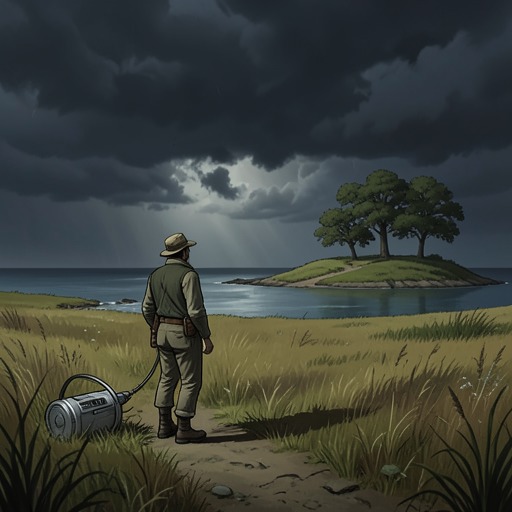
The monument is proposed for the 180th meridian, where Ana and José had interviewed Frank about endangered species in Oceania. Its setting connects the project to the argument over the International Date Line and the coming millennium. Fiji had advanced its clocks by an hour, hoping that Taveuni and other Fijian islands would enter 2000 before Tonga and Little Pitt Island. The monument therefore stands within a contest over how time is marked, not merely at a picturesque location.
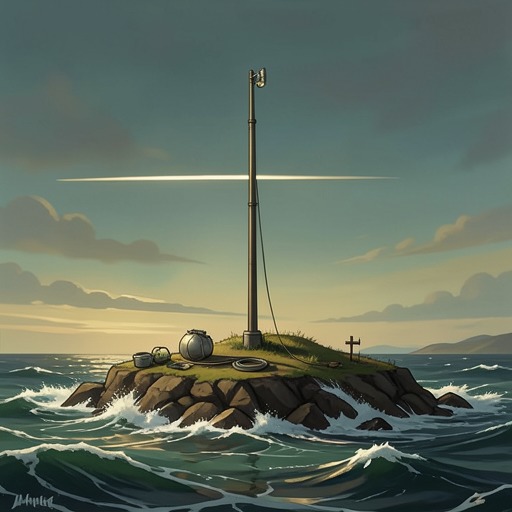
The plan allows anyone to place a time capsule inside the monument. A greeting to the fourth millennium is written down, sealed in a glass capsule, and inserted into a hollow brick; the brick is then sealed, covered with cement, and incorporated into the structure. Each capsule costs five hundred dollars. A foundation is charged with preserving and maintaining the monument for the ensuing thousand years, and the capsules are to be opened at a solemn ceremony on 1 January 3000.
Frank’s Proposed Contribution
When Frank explains the project to José and Ana, José observes that the opening lies far in the future and wonders whether he has anything to say to it. Frank answers that he has been considering placing a twentieth-century manifesto in a capsule. He clarifies that it is not a political manifesto, but a kind of report on the Tropical Summit held at Maravu Plantation Resort. His proposal makes the monument a possible repository not only for personal greetings but also for a record of the island gathering and its participants.
Ana and José laugh at Frank’s idea. The exchange keeps the proposal from becoming a solemn abstraction: the future-facing project is discussed among people who have met on Taveuni, while the very real distance to its opening remains part of the conversation. The capsule would preserve a written account of their encounter for readers who could not know the people directly.
Time, Memory, and Survival
The monument’s thousand-year interval echoes the book’s repeated effort to set brief human lives against immense spans of time. Frank is preoccupied with mortality and has tried to place his individual life within the larger history of life and the universe, without finding that this perspective reliably brings peace. Against that uneasy background, a sealed message offers a modest form of persistence: not the survival of its writer, but the possible survival of words after the writer is gone.
The proposed capsule also makes preservation a deliberate act. At Salamanca, Frank and Vera consider how shared memories can keep their dead daughter Sonia present in a living sphere of influence that only they can create. The monument extends a related question beyond a family: whether people in the present can leave something that will give their meeting meaning to people in a remote future. It cannot promise that the message will be understood or that its authors will be remembered; its carefully specified opening date instead makes the gap between human lives and historical time visible.
Narrative Significance
The monument links the novel’s Taveuni plot to its larger concern with how the future is imagined and the past given meaning. The approaching year 2000 first appears as a disagreement about clocks and precedence; the time capsule turns that disagreement into a structure intended to outlast the millennium itself. Frank’s proposed summit report shifts the project from an impersonal marker of time toward an account of particular people and a particular meeting.
Its design depends on both material care and trust in institutions: a glass capsule, a brick sealed into the monument, a foundation responsible for a thousand years of maintenance, and a ceremony scheduled for the first day of 3000. The plan’s scale is deliberately larger than any participant’s lifetime, but its contents begin as a small human gesture—the wish to leave a greeting, or a record of having met.