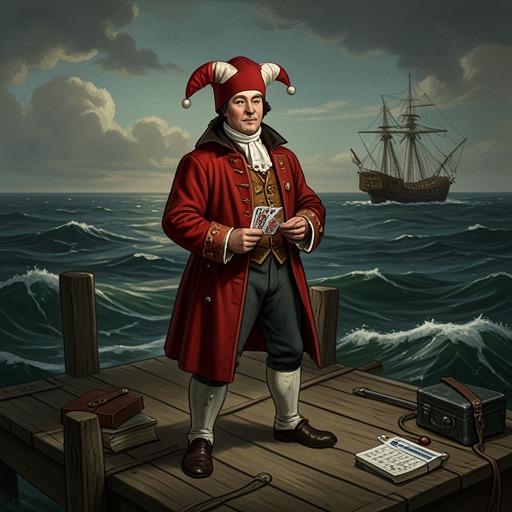
Magical Playing Cards
MayaThe Magical Playing Cards are at once a survival object, the source of an embedded creation story, and a practical code shared by Ana and José. In José’s account, a sailor stranded alone on an island carries only the deck, plays solitaire for decades, and dreams its figures into apparent life. The story’s central ambiguity is whether the cards merely give form to the sailor’s imagination or open a passage from consciousness into the world; their later use at the bridge table gives that ambiguity a sharply ordinary counterpart in secret signals and apparent clairvoyance.
The Deck and the Shipwreck
The deck enters the tale through a sailor whose vessel is wrecked in 1790. The man reaches a deserted island with nothing in his shirt pocket but the cards, an elaborate pack in which every card bears a full-length human figure. The figures resemble characters from fairy tales: they are short, elf-like, and, unlike the naked human figures in Bosch’s The Garden of Earthly Delights, dressed in finely made clothes of the Enlightenment era.
The shipwreck story is connected to a specific historical loss. José says the sailor left Cádiz aboard a Spanish brig named Ana, sailed first to Veracruz, and was lost on the return voyage to Cádiz with a great cargo of silver. He says that he checked old annals and ship records, although those records report that everyone aboard perished and offer no evidence of survivors. That gap between the documented wreck and the sailor’s survival is where the legend takes hold: the cards arrive in a story whose records both anchor and contradict it.
Solitaire and the Figures’ Arrival
Alone for 52 years, the sailor fills his long days by playing solitaire, as Napoleon did during his exile on Saint Helena. After years with no other company, he begins to dream intensely about the card figures and seems to see them in the daytime, floating around him like weightless spirits. He speaks with them at length, though the account acknowledges that, at first, he is plainly speaking to himself.
The tale then makes a consequential distinction between imagining the figures and their supposed arrival in the external world. One morning, the elves emerge from the sailor’s creative consciousness into the created space beneath the sky. They appear one after another, as if leaping from his forehead; after several months the full deck has become 52 living elves in a village, and the sailor is no longer alone. The last to emerge is Comodín, arriving like a child born long after the rest of a family. The cards’ figures have thus become more than images within the pack: they are the inhabitants of a world that the story presents as both miraculous and open to doubt.
Comodín and the Question of Reality
A later shipwreck brings a young sailor to the island in 1842. He, too, sees all 52 elves, which complicates the possibility that they are only the first sailor’s hallucinations. The elves themselves take their existence and surroundings for granted; Comodín is the exception. He can see through the veil of illusion, recognize that he has entered a world, and wonder at the sky and land that the others accept without reflection.
This difference makes Comodín an outsider among the card-born figures, but also the one most capable of perceiving the conditions of their existence. As José recounts it, Comodín understands that he is inside an inconceivable fairy tale; what is ordinary to the other elves appears to him as a miracle. The deck’s story therefore turns on a reversal: the figures originate in one mind, yet the account gives them a shared world and a witness who can question it. The cards become a model for the book’s recurring concern with how consciousness distinguishes the imagined from the real.
The Magical Image and the Painting
The legend associated with the deck also includes a miniature portrait of a young woman. Its surface is said to be as smooth as silk, and its image so lifelike that the dwarf who carries it is credited with supernatural artistic powers. The tale interprets the portrait as an image from a distant future, when people know how to make pictures of what they see; to observers who lack that knowledge, it appears magical or diabolical. José stresses the historical strangeness of the old tale: it predates photography, even though its miniature seems to anticipate a photographic image.
That image connects the cards’ legend to Ana María Maya and Goya. In José’s account, Goya encounters Comodín at Sanlúcar de Barrameda in the spring of 1797 and tries to take him to his studio to paint him. Goya does not hear the protesting dwarf, but releases him when Comodín produces the mysterious portrait of Ana María Maya. Goya is then completing La maja desnuda; he uses Ana’s face on the nude figure, concealing the model’s identity. The portrait thus joins the card legend to the paintings and to the novel’s later recognition of Ana’s resemblance to the woman in Goya’s work.
Bridge, Signals, and the Deck’s Second Use
The deck’s function is not confined to the embedded legend. During a tropical-night bridge game, Ana and José play as partners against Frank and Mario, and their precise, effortless wins make Mario suspect that they can see the opponents’ cards. He cries out that they must be clairvoyant after a five-club bid appears to anticipate Frank’s hand. The narrator entertains the possibility, linking the couple’s exceptional accord to the idea that they might exchange simple signals about the colors and numbers of the 52 cards.
José later supplies a more practical explanation. Each verse of the couple’s old texts corresponds to a card, and because both partners have memorized the texts, they share a private language of card colors and numbers. While playing with friends, they sometimes whisper words to communicate what they hold; José concedes that they sometimes cheat. This account does not settle whether their earlier bridge success involved only signals, exceptional partnership, or something more. Mario’s supernatural explanation remains part of the episode, while the code demonstrates how the cards can mediate information between partners without being visible to their opponents.
The game makes the deck’s motif concrete. During the match, the narrator overhears phrases from Ana and José’s peculiar verbal exchanges and even steps away during dummy play to write some down. Later, as he secretly listens to the couple, their talk falls silent at a pause, and the only question he hears is whether the next card should be a club or a diamond. The cards move between a legendary world of figures born from imagination and an ordinary game in which a coded word can alter what a partner knows. That shift preserves the story’s central uncertainty: whether apparent magic is an extraordinary breach of the ordinary or an effect produced by hidden knowledge and shared language.