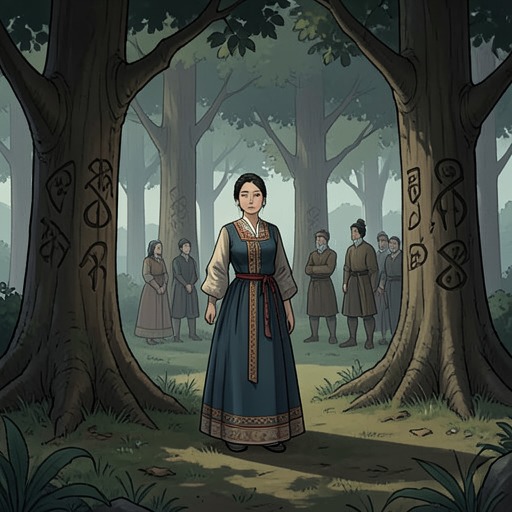
Magical Portrait
MayaThe Magical Portrait is a miniature carried by Comodín whose uncanny likeness to Ana María Maya links a modern woman to a legend from the late eighteenth century and to Goya’s La maja desnuda. Its decisive significance lies in its impossible timing: the image appears to show Ana before the photographic moment that produced it, so that an old story about a jester and a perfect portrait becomes evidence of time crossing itself rather than a mere tale of supernatural skill.
The Miniature and Its Legend
As José recounts the story, Comodín is at the Cádiz wharf watching the Spanish brig Ana sail away. In his jacket pocket he carries a small portrait of a young woman, an object he is said to have used when escaping drunks who mocked him for being a dwarf. The scene makes the miniature both a possession and a means of escape, attached to the vulnerable body of the man whose unusual stature draws ridicule.
The portrait is described as a miniature made by a technique no one recognizes: it is neither a copper engraving nor an oil painting, and its smooth surface is compared to silk. Its likeness is said to be so lifelike that people call Comodín a genius with supernatural powers. The image seems to reproduce what human beings can see, but its realism does not explain its making. Instead, the more faithful it appears, the more it invites the conclusion that it must be magic.
The story is known as the legend of the dwarf and the magical portrait. José says it has survived as an invented tale, a piece of Romani imagination that people did not necessarily believe, yet whose brightness has endured. He stresses the historical difficulty concealed by that legend: the story of a perfect portrait is older than photography. The anachronism is not simply that an image looks convincing; it is that the culture telling the story has no photographic technology that could account for such a likeness.
A Photograph Out of Time
Frank recognizes the portrait as connected to an image made only days earlier, recalling a woman who had sat on a bench in the Alcázar gardens shortly before she died and a dwarf who came there and took her picture. José answers by distinguishing the characters’ present from the earlier historical moment: what is only days old to them would have seemed even newer to the people at the Cádiz wharf. The portrait belongs to a distant future in relation to those witnesses, so they experienced it as magic and supposed it must be the devil’s work.
This exchange makes the object a temporal hinge as well as an image. The portrait does not merely resemble Ana; its place in the story’s chronology reverses the ordinary relation between an image and its subject. A photograph usually records someone who is already present before the camera. Here, the old legend seems to preserve a likeness that belongs to a future encounter, making the later photograph and the earlier miniature versions of the same unresolved event.
Frank’s visit to the Prado is prepared as a search for something specific. He realizes that advice to go there was a clue, not simply an echo of his earlier talk about the museum’s treasures. At the Prado, the image of the woman in Goya’s paintings becomes part of the mystery he is trying to solve. The portrait therefore belongs to a chain of visual evidence: the miniature, the later photograph, and the painted face that leads Frank to recognize Ana’s connection with La maja desnuda.
Comodín, Goya, and the Painted Face
José’s account connects the portrait to Goya through Comodín. In the spring of 1797, in Sanlúcar de Barrameda, Goya tries to take the small jester to his studio so he can paint him. Comodín shouts and resists, but Goya, deaf and unable to hear his protests, continues until the miniature of Ana María Maya is brought out. Goya releases him only after seeing the strange portrait, which he has never encountered before.
At the time, Goya is finishing La maja desnuda. He paints Ana’s face onto the naked figure, concealing the model’s true identity. In this account, the portrait does not simply inspire a painting: it supplies the likeness that allows a face from another time to enter Goya’s work. The painting consequently becomes another medium through which the same image travels, carrying the mystery forward while hiding the identity that produced it.
That hidden identity has a human cost. José observes that it was never easy for Ana to be identified with the woman in the old painting and that the association could become a burden. He also points to the danger a living Romani woman would have faced in Goya’s time if she had allowed herself to be painted nude. The concealment in the painting is thus not only an artistic device within the legend; it is connected to the perilous circumstances attached to the model’s identity.
The Portrait and the Alcázar Encounter
The novel makes the miniature’s connection to a photograph concrete through a later encounter in Seville. After a funeral for a young woman, Frank sees the dwarf from the Alcázar gardens. Comodín winks at him, gestures with his left index finger to draw him away from the departing group, and takes a bundle of photographs from his inner jacket pocket. He gives Frank a photograph of Frank himself, seated in the little square before the Puerta de Marchena in the Alcázar gardens.
Frank searches his pockets for coins, but Comodín firmly refuses payment and says, “¡De nada, de nada!” Before Frank can look at him closely, both the dwarf and the rest of the people have disappeared. The photograph is therefore not presented as a simple keepsake or commercial portrait. Like the miniature in José’s tale, it arrives through Comodín, exceeds an ordinary transaction, and leaves its recipient confronting an image that has appeared under circumstances he cannot settle.
The funeral photograph is not the same depicted likeness as the miniature of Ana, but it echoes the portrait’s operation: Comodín’s camera seems to connect people and moments across a temporal puzzle. On its reverse is a statement that human beings may be the only living creatures in the universe with universal consciousness, followed by an argument that protecting Earth’s habitats is a cosmic responsibility. The image of Frank in mourning is thus paired with a warning about the possible return of darkness and the disappearance of the spirit of God over the waters. The portrait motif moves from a face that appears to come from the future to a photograph that turns a living observer into the subject of reflection.
Image, Recognition, and Meaning
The novel’s images do not settle identity through straightforward proof. Frank’s search at the Prado is prompted by clues from Ana and José, and the sequence of portrait, photograph, and painting gives those clues material form. Yet each medium also carries a different historical condition: an uncanny miniature predating photography, a likeness associated with a contemporary photograph, and Goya’s painted figure concealing its model. Their correspondences sharpen the mystery rather than dissolve it into a single explanation.
The portrait’s most consequential effect is to collapse the distance between legend and evidence. A story dismissed as a fanciful tale of Romani life contains an image that can be recognized in the later history of Ana and Goya. Its apparent impossibility makes the old story newly legible, while the novel’s recurring photographs show that even modern images can acquire an equally unsettling relation to time. The Magical Portrait is therefore not just a supernatural object within José’s account: it is the central visual link through which the novel makes identity, historical memory, and the apparent direction of time overlap.