Taveuni Photo Collection
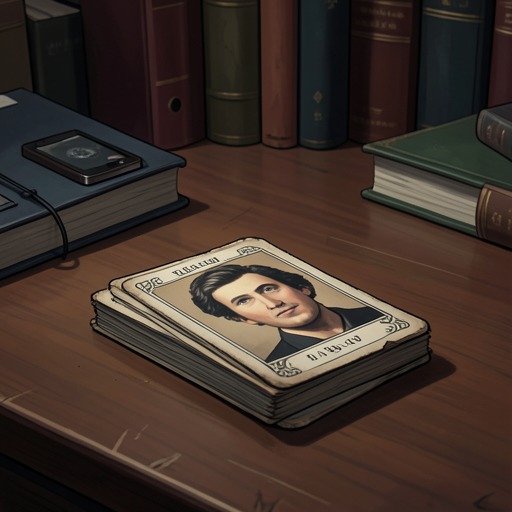
MayaThe Taveuni Photo Collection is a set of photographs taken by Ana on Taveuni, with the manifesto written on the back of each picture. Sent alongside Frank’s letter to Vera, the images turn a record of the island into a means of transmitting the couple’s shared text—and, for the narrator, into a possible message to posterity.
The Photographs and the Manifesto
The collection enters the correspondence as more than an enclosure. In the letter’s closing account, Frank describes opening an envelope on his walk back to the hotel and finding a bundle of photographs Ana had taken on Taveuni. In his room, he turned them over and discovered writing on every reverse: the manifesto. The final maxim given in the letter is that logic is too poor in ambivalence, making the collection’s paired form especially apt: each image carries words on its other side.
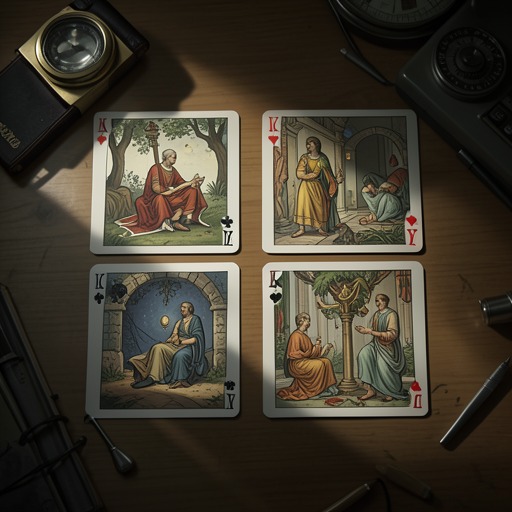
The narrator later identifies the photographs as a set of fifty-two, corresponding to the manifesto’s fifty-two maxims. Ana had inscribed the text on their backs, and the narrator recalls its sequence while walking across Plaza de España in Seville, mentally assigning one maxim to each Spanish province. The pictures therefore preserve not only scenes from Taveuni but also the complete text as a series distributed across physical objects.
A Message Meant to Be Shared
Frank’s letter presents the manifesto as something that should be shared by two people. The narrator likewise reflects that its outlook is difficult to bear without someone to hold on to; the photographs’ arrangement makes that principle tangible, joining a visual record to words intended for a pair. Their significance lies not simply in what they show, but in the relation their inscriptions preserve and communicate.
The collection also connects the separated stages of the narrative. Ana’s photographs and writing travel with Frank’s account to Vera, while the narrator later recalls the same objects in Seville, where Frank and Vera have reunited with Ana and José. By then, the narrator imagines Frank as less overwhelmed by the lost prospect of eternity because he is no longer alone in facing cosmic night. The photographs’ paired message resonates with that change: the burden is not removed, but can be shared.
Preservation, Privacy, and Posterity
The photographs are included with Frank’s long letter, which the narrator says he obtained after unexpectedly meeting Frank at the Hotel Palace in Madrid in November 1998. He presents the letter in full rather than interrupting it with commentary, and explains that it was emailed on the night of Thursday, 7 May 1998; a year passed before he secured a copy. His interest in the enclosed manifesto is one reason he values the document, while he insists that he did not take a personal letter—an assertion whose propriety he postpones to the epilogue.
The narrator considers preserving the letter and its materials in a time capsule near the International Date Line, to be opened on Taveuni on 1 January 3000. He wonders whether future readers should inherit Frank’s detailed account of the island’s natural life as well as the manifesto, and whether the message ought instead to circulate among people of the narrator’s own time. The photographs thus sit at the intersection of private correspondence and public preservation: their inscriptions make the manifesto portable, but the decision to keep, publish, or seal the material remains the narrator’s to make.