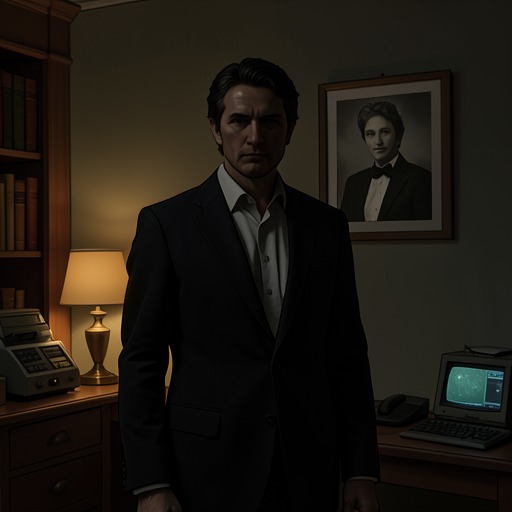
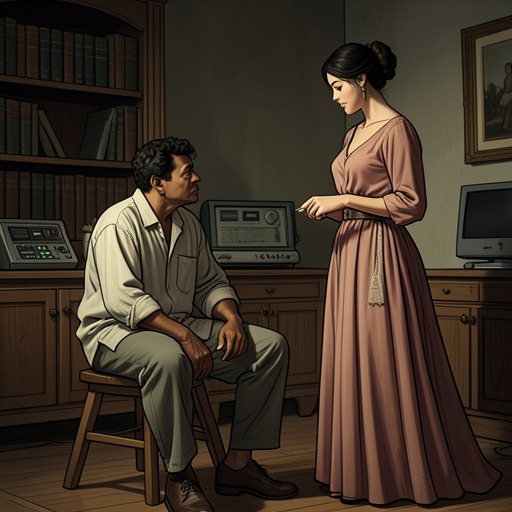
Narrator photo in the Alcazar garden
MayaThe photograph of the narrator in the gardens of the Alcázar is both a mysterious keepsake and the instrument of a final recognition. Returned to him by the garden jester after a funeral, it makes him see himself as a grieving primate and redirects the meaning of the novel he has been writing: away from Frank Andersen and Vera, and Ana and José, toward Sheila, her solitaire letters, and the narrator himself.
The Photograph at the Funeral
At the end of the service in the square before the ochre-colored church, the narrator discovers the little jester associated with the Alcázar gardens among the departing people. The jester winks, separates him from the procession with a gesture of his left index finger, and draws a stack of photographs from the inside pocket of his jacket. One shows the narrator sitting in the small square before the Puerta de Marchena, in the Alcázar gardens.
The narrator searches his pockets for coins, but the jester firmly refuses payment, saying, «¡De nada, de nada!» Before the narrator can get a closer look at him, the jester and the rest of the crowd have disappeared. The exchange leaves the photograph as an unexplained gift: it is a physical image of the narrator, delivered by a figure whose sudden presence and disappearance connect the funeral to the uncanny recurrences of the gardens.
An Image and a Change of Subject
The narrator remains for a long time in the square before the Church of Santa Ana, studying the photograph. Rather than discovering something new in it, he sees only what he already knows. The image shows him as a primate in mourning; the face looking back offers no reconciliation with his grief.
That recognition changes how he understands the work he has been writing. The novel, he realizes, is not essentially about Frank Andersen and Vera, or Ana and José. Its deeper subject is Sheila and her solitaire letters, and the narrator himself. The photograph does not resolve loss; by returning his gaze to his own bereaved face, it reveals where the book’s emotional center has been all along.
The Inscription and Its Cosmic Claim
Turning the photograph over almost instinctively, the narrator finds a statement about humanity as perhaps the only living being in the universe with universal consciousness. The inscription draws a consequence from that claim: preserving the habitats of the planet is not only a global responsibility but a cosmic one. It warns that darkness may one day cover everything again, ending with the image of the spirit of God no longer flying over the waters.
The reverse side therefore shifts the photograph from personal memorial to ethical proposition. Its two sides hold the narrator’s particular grief and a vision of life on a planetary scale together: a mourning individual is also a conscious being implicated in the fate of other habitats and, ultimately, in the persistence of life’s capacity to perceive the universe.