British Cabinet
MunichThe British Cabinet is presented as a working council at the centre of Britain’s response to the Sudeten crisis: a place where military danger, diplomatic choices and the domestic consequences of policy are brought into the same room. Its importance lies not in acting as a single, seamless voice, but in the collision of information and judgment that culminates in a consequential refusal to pressure the Czechoslovak Government into immediate surrender.
Identity and place in government
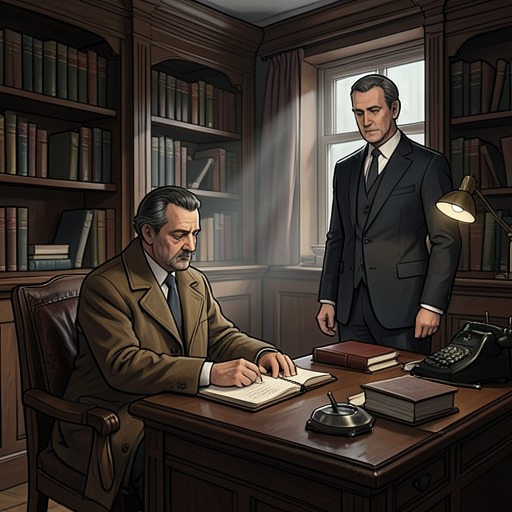
The Cabinet’s deliberations unfold in the Cabinet Room at 10 Downing Street, where the long table serves as both a setting for debate and a surface on which information is delivered, read and recorded. The room is not reserved to one kind of meeting. Neville Chamberlain confers there with senior ministers, receives the Chiefs of Staff, and later gathers a full Cabinet. In that shared space, political deliberation and military advice meet without becoming the same thing.
The boundaries of the Cabinet’s work are visible in the people who surround it. Its ministers debate and decide; Sir Horace Wilson attends as a special adviser to report on his meeting with Adolf Hitler; Cabinet Secretary Edward Bridges is present to support the official business; and officials such as Hugh Legat carry documents and take notes. That distinction matters. Legat’s place near the table gives him a view of the discussion, but his access to it is still shaped by his administrative role and by what the Prime Minister wants recorded.
Crisis, deadlines and competing advice
The Cabinet’s deliberations take place against the threat of German invasion and the approaching ultimatum. Neville Chamberlain reports that Adolf Hitler has rejected a longer wait before action over the Sudetenland, and the prospect of war gives each discussion an immediate deadline. Military readiness is therefore not an abstract concern: partial mobilisation could demonstrate that Britain was prepared to fight, but it could also provoke the very conflict it was intended to deter.
The debate over mobilisation shows how the Cabinet weighs signals as well as capabilities. Chamberlain recognises that mobilising before Germany might make Britain’s resolve unmistakable, yet fears that Hitler, unwilling to lose face, could respond by escalating. The argument turns on how an adversary might interpret British action: restraint might be mistaken for weakness, while a show of strength might close off the remaining space for negotiation. The Cabinet’s predicament is not simply whether Britain can act, but whether a particular act will prevent war or hasten it.
The decision not to send the telegram
The sharpest test comes when the Cabinet considers a proposed telegram to the Czechoslovak Government. The proposal would tell the Czechs to hand over their territory at once under threat of force. Lord Halifax, Foreign Secretary, objects that this would amount to capitulation. He also argues that Britain cannot urge the Czechs to take a course it believes wrong, that the House of Commons may not accept such a demand, and that Britain cannot guarantee the German Army would stop at the Sudetenland rather than occupy the whole country.
Halifax’s intervention changes the room. Ministers listen closely as he sets the danger of war against the moral and political costs of coercing Czechoslovakia. Neville Chamberlain acknowledges the force of the argument, while making clear that he had regarded the telegram as a last real chance. He pauses for colleagues to express a different view; none does. He then agrees that the telegram will not be sent. The decision is both a collective outcome and a moment of constraint: the Prime Minister’s proposal does not prevail once his ministers decline to support it.
The scene also shows how a decision becomes an official act. A telegram from Berlin, numbered 545 and identified as a letter from Hitler to Chamberlain, is brought to the Cabinet meeting a little after ten at night. Legat lays it before the Prime Minister while the Foreign Secretary is speaking, then takes his place with the officials along the wall. Documents arrive through designated hands; ministers interpret them in the meeting; and the resulting choice is followed by the shifting of chairs and papers as those present absorb its consequences. Procedure does not soften the danger, but it gives disagreement a form in which policy can change.
Access, records and incomplete knowledge
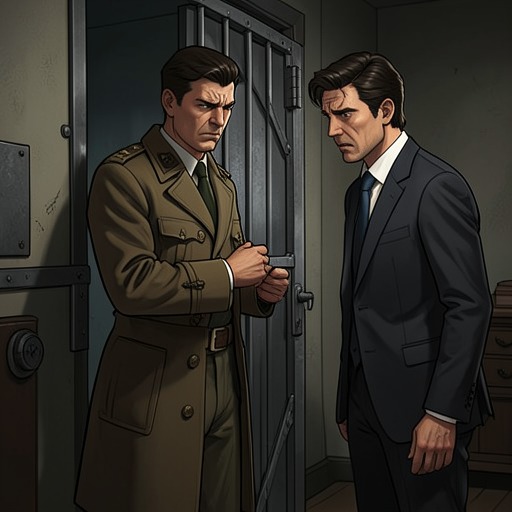
The Cabinet’s work depends on what information reaches it, who can enter its discussions and what survives as a record. Before the full ministerial debate, Neville Chamberlain meets with senior ministers, and the Chiefs of Staff are separately brought into the Cabinet Room to give their military assessment. Legat makes a minute of that meeting, but later reports that the Prime Minister decided he did not want it recorded. Principal Private Secretary Osmund Somers Cleverly challenges Legat about the missing minute and asks what he is carrying instead. The exchange makes record-keeping part of the political machinery: an account may exist in an official form, or a decision may leave the participants without that particular record.
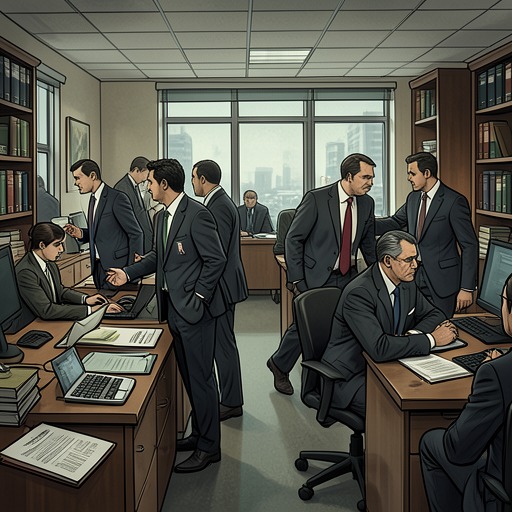
At the later Cabinet meeting, the contrast is explicit. Cabinet minutes identify the Berlin telegram and the meeting’s attendance, including the twenty ministers present, Wilson in his advisory capacity, and Bridges as Cabinet Secretary. The account situates debate within a crowded room, its papers spread over the table and carpet and its open window letting in the night air. These details place the Cabinet’s decision within a documented proceeding, while the earlier missing minute warns that not every consequential exchange is preserved in the same way.
Munich and the Cabinet beyond the room
The Cabinet’s information problem continues during the Munich negotiations. After Chamberlain returns from a private meeting with Hitler, Wilson briefs officials that Hitler has imposed a Saturday deadline and is watching the clock against a temporary postponement of mobilisation. Wilson also reports that Benito Mussolini has produced a draft agreement. These are urgent accounts of negotiations conducted elsewhere, conveyed through an adviser rather than witnessed by the Cabinet as a body.
A further uncertainty surfaces when Legat tells Wilson that Hitler agreed the previous night to another assurance. Wilson immediately asks whether the Foreign Secretary or the Cabinet knows; Legat cannot say and thinks they do not. The exchange does not establish that the Cabinet was definitively kept uninformed, but it makes the possibility of uneven knowledge impossible to ignore. In a crisis shaped by promises and private understandings, the Cabinet’s ability to judge policy depends not only on what has happened but on whether the relevant information has reached the ministers.
As the party flies back to London, Wilson says a Cabinet meeting will take place as soon as they return. William Strang warns Chamberlain to treat Hitler’s undertaking cautiously. Chamberlain replies that he believes Hitler may keep his word, while explaining that a breach would expose him, unite Britain and rally the Dominions; he intends to publicise the joint declaration on landing. The Cabinet is thus positioned as the next forum for testing and responding to the settlement, even before it reconvenes. Across these scenes, it is neither merely a backdrop to Chamberlain’s diplomacy nor an all-knowing collective: it is the place where competing judgments can block a proposed course, while gaps between private negotiation, official records and ministerial knowledge remain consequential.