Secret Intelligence Service
MunichThe Secret Intelligence Service enters the story not through a formal account of its organization but through a Whitehall encounter with Colonel Menzies. In a crisis shaped by deadlines, invasion threats and uncertain promises, its role is to assess the credibility of information from Germany and manage access to it. The service’s methods are cautious and indirect: test the document, judge the people behind it, and arrange for a trusted intermediary to obtain further evidence without adding to Neville Chamberlain’s already immense strain.
Identification and Role
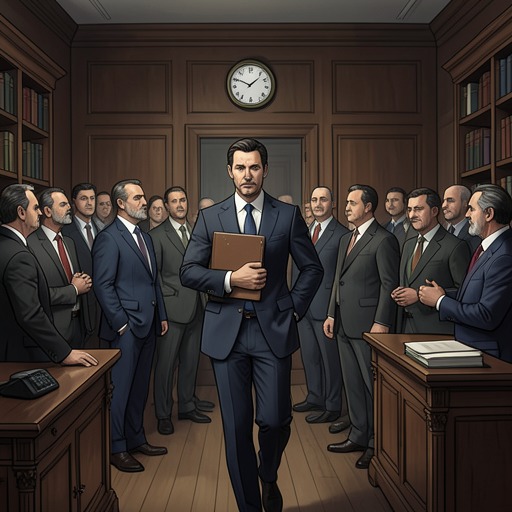
The service is first signalled by the setting and appearance of Menzies. He is a colonel in a Savile Row suit, meeting Hugh Legat in Whitehall; Legat recognizes that this combination can mean only the Secret Intelligence Service. The identification is filtered through Legat’s inference rather than supplied as an institutional introduction, matching an organization whose presence is conveyed through discreet personnel and confidential work.
Menzies has been asked by Alexander Cadogan to examine the directive that was delivered through Legat’s letterbox. His assessment gives the document a significance beyond its alarming contents: it is genuine as far as the service can tell, and it is the first written evidence produced by German opposition figures whom Britain has been hearing from since the beginning of the summer. The service thus appears as an evaluator of sources as well as texts. It does not treat a secret document as self-authenticating; Menzies places it alongside prior reports and distinguishes the new documentary proof from the less certain claims that preceded it.
Assessing the German Opposition
Menzies describes the German opposition as disparate: diplomats, landowners and an industrialist, many apparently unaware of one another. Their shared expectation that the British Empire would fight to restore the Kaiser or his family strikes him as politically naive, particularly given the enormous British losses in the war that removed the Kaiser less than twenty years earlier. The service has also heard claims of support within the Army, but Menzies says it is not convinced, apart from the possibility of a few disaffected Prussians at the top. His account makes clear that contact with opposition figures does not amount to confidence in their political judgment, unity or capacity.
Against this uncertain background, Menzies singles out Hartmann as more promising. Hartmann’s position inside the German Foreign Ministry has given him access to secret material, and he is willing to share it with Britain—more specifically, with Legat. Menzies presents this channel as distinct from the other opposition contacts: the service is not merely collecting a general collection of rumors, but assessing a source whose official position may give him access to consequential evidence. The distinction remains provisional, however; the service wants to learn what Hartmann possesses and why he has chosen Legat as the recipient.
The Munich Operation
A contact from the German opposition reaches the service that evening through a secret channel. The contact asks Britain to arrange for Legat to travel to Munich as part of the Prime Minister’s party; in return, the opposition will try to ensure that Hartmann is included in the German delegation. The reciprocal arrangement offers a route to a meeting, but it depends on access on both sides and on cooperation the service cannot simply assume. Hartmann, Menzies explains, holds another document, more important than the one delivered to Legat in London.
The service’s plan also controls who will receive that evidence. Hartmann intends to hand the document personally to Chamberlain, an idea Menzies says cannot be allowed. Instead, Hartmann will give it to Legat, who can find out what it contains. The operation therefore uses Legat as an intermediary between a German source and the British government, separating the acquisition of intelligence from the Prime Minister’s direct involvement. Menzies and Cadogan tell Legat plainly that the meeting would technically constitute espionage on foreign soil and that it carries risk; they do not disguise the danger as routine diplomatic business.
Legat tries to withdraw, including by pointing out that Osmund Somers Cleverly has already told Cecil Syers he will travel to Munich. Cadogan dismisses this as no obstacle and tells Legat to leave Cleverly to them; Menzies also says that he knows Cleverly. The exchange shows the service and its Whitehall interlocutors managing a practical complication around the proposed journey, although the precise arrangements are not described. Their silence as Legat considers the request leaves the decision with him, even as the operation’s design has made refusal harder to separate from the consequences of losing access to Hartmann.
Information, Pressure and Consequence
The operation takes shape amid a rapidly worsening crisis. Chamberlain tells the Chiefs of Staff that Hitler intends to invade Czechoslovakia on Saturday, after rejecting a proposed orderly transfer of the Sudeten territory, and reports Hitler’s warning that Britain and France may soon be at war. British officials also debate partial mobilization: it might show that Britain is prepared to fight, but could instead push Hitler into war. Later, a telephone report from Sir Nevile Henderson records that Benito Mussolini has asked Hitler to postpone mobilization for twenty-four hours, and that Hitler has agreed. These events establish the unstable setting in which the service’s intelligence work has to operate: threats and pauses alter the available time without resolving the underlying danger.
The service’s caution is therefore not simply a preference for secrecy. Its officers are trying to establish whether the German source is credible, obtain evidence through a controlled channel, and avoid placing additional demands on a Prime Minister already under immense strain. The decision to route Hartmann’s document through Legat reflects a tension between the urgency of warning the government and the need to protect the process by which the warning is obtained. The narrative’s brief identification of the service, followed by its careful questions, qualified judgments and risky plan, presents intelligence work as a contest over trust and access rather than as omniscient surveillance.