Gestapo
MunichThe Gestapo appears as the force enforcing the exclusion of Czechoslovakia’s representatives from the conference: its men block a hotel corridor, keep two officials in a room, and present their confinement as protection rather than arrest. The distinction collapses under questioning. Although the officials are told they may leave, the only destination offered is Prague, while their intended role as observers is denied. The scene defines the organization through the practical exercise of control over movement and participation, and through the political deference its officers show Hugh Legat when he invokes Neville Chamberlain.
Presence and Methods
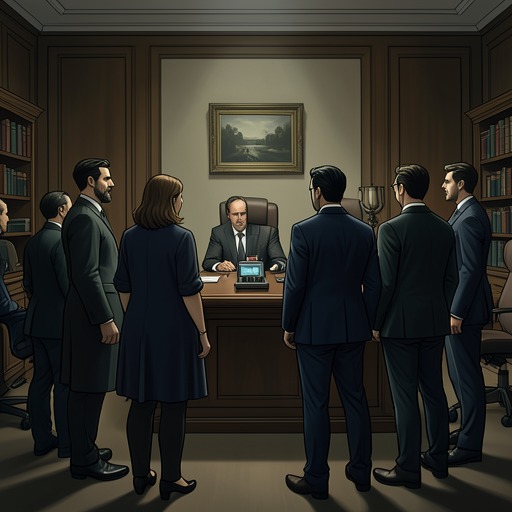
The Gestapo’s presence first registers as a physical obstruction. A man in the corridor is trying to get past four men in suits and repeatedly demands to speak with an Englishman. Once Hugh Legat steps out from his office and identifies himself as English, the man names himself as Dr Hubert Masarík, chief of staff to the Czechoslovak Foreign Minister. He says that he and his colleague, Dr Vojtek Mastny, the Czech Minister in Berlin, are being held in a room by Gestapo men. The organization’s authority is thus introduced through a barrier and a complaint, rather than through an explanation of its formal structure.
Masarík’s appearance gives the confrontation a particular physical immediacy: his pale grey suit and breast-pocket handkerchief remain orderly, but his face is flushed and his round tortoiseshell spectacles have been knocked askew. Legat finds Mastny still wearing his overcoat, seated on the edge of a bed with his hat between his knees. These details accompany the officials’ account that they arrived from Prague less than an hour earlier, were met at the airport, and were taken not to the conference but to the hotel room. The Gestapo has controlled their route from arrival onward, converting an official journey into enforced waiting.
Authority and the Encounter with Legat
When Legat asks who is in charge, a broad-faced officer with pockmarked cheeks turns on him and demands to know who he is. Legat answers that he is the Private Secretary to Neville Chamberlain. The officer’s manner changes at once. He rejects the description of the officials’ situation as imprisonment and says they have merely been asked to wait in their room for their own security while the conference is in progress. The abrupt shift shows that the Gestapo’s control is not presented as independent of political rank: the same officer who confronts an unknown questioner adopts a conciliatory explanation once Legat’s position becomes clear.
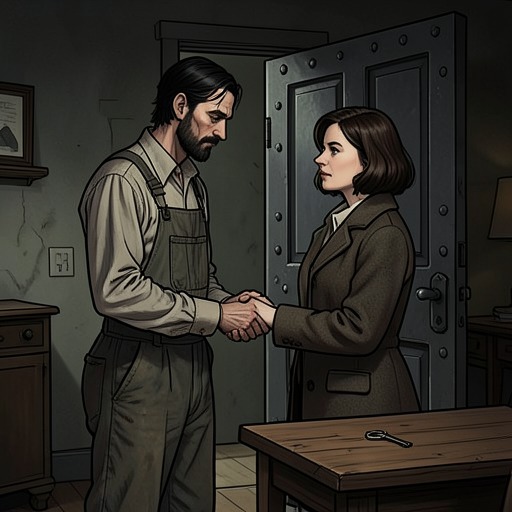
The explanation does not resolve the dispute. Masarík says the two men are supposed to be observers and appeals to the British Government to let them perform the task for which they were sent. Legat asks to pass; the other three Gestapo men look to their officer, who nods, and they stand aside. Legat then shakes Masarík’s hand and asks where his colleague is. The officer’s permission opens the route into the room, but the sequence also exposes how access depends on the Gestapo’s decision: the men first block Legat’s way, then yield only after their superior authorizes it.
Confinement Disguised as Choice
Inside the bedroom, the officer repeats that the Czechoslovak officials are not allowed to participate and must wait until further instructions. Masarík draws out the consequence of that order: if they cannot leave the room to attend the conference, they are under arrest. The officer denies this too, saying they are free to return to the airport and fly back to Prague whenever they wish. Formally, departure is offered; substantively, the offer removes the observers from the proceedings and sends them back from the city from which they have just arrived.
The exchange makes the organization’s method legible without requiring a formal declaration of arrest. Its men have taken the officials from the airport, keep them in a hotel room, and bar them from the conference; the officer can nevertheless describe the arrangement as voluntary waiting and a choice to leave. Masarík’s appeal is directed to a British representative because the Gestapo’s prohibition has made the observers’ access a matter of immediate power, not simply conference procedure. Legat can secure passage through the doorway, but the evidence does not show him reversing the order excluding them from the talks.
Narrative Significance
The scene places the Gestapo’s coercion within an ostensibly diplomatic setting. The conference is in progress, the Czechoslovak officials have arrived as observers, and the officer invokes their security; yet their presence is unwanted and their participation is expressly forbidden. The contrast between the polished language of protection and the room in which the officials are confined gives the encounter its central tension. It also makes exclusion concrete: the dispute is not abstractly about representation, but about who can cross a hotel corridor, enter a meeting, or leave only by returning to Prague.
The threat is not confined to the room. Later, a remark about the same setting describes the whole place as absolutely crawling with Gestapo. That brief recurrence widens the earlier confrontation from one blocked passage and one officer’s orders to an atmosphere in which Gestapo presence is understood to be pervasive. The organization’s narrative role is therefore both direct and environmental: its officers enforce the Czechoslovak observers’ exclusion, while the later remark suggests that their presence shapes what others consider safe to say or do.