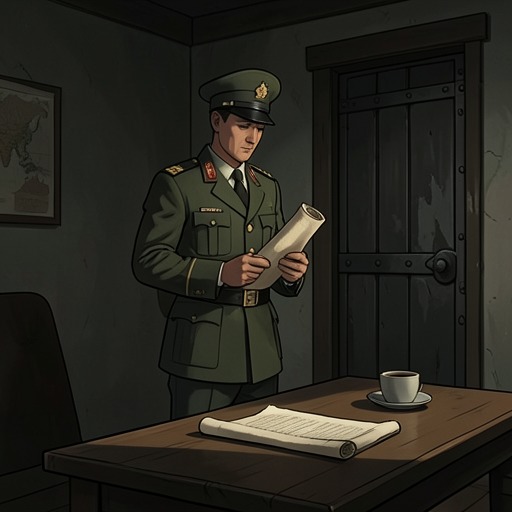
German Wehrmacht
MunichThe German Wehrmacht stands at the center of the crisis as a military force whose preparations make Adolf Hitler’s threat against Czechoslovakia credible, yet whose leadership is not uniformly willing to carry it out. Its oath to Hitler limits direct opposition, while senior officers’ fear that war with France and Britain would be disastrous opens a narrow, conditional possibility of action against the regime.
Military Power and the Threat of War
The threat is made concrete when a column of olive-green armoured vehicles moves south along Wilhelmstrasse in Berlin. The vehicles include artillery half-tracks, Panzers on transporters, and heavy guns; their length suggests to Paul von Hartmann that a full motorised division is passing. The scene gives physical scale to the military force behind Hitler’s policy, though it does not establish that the troops in the column know of or support the resistance being discussed elsewhere.
At the British Cabinet table, Neville Chamberlain reports that Hitler has rejected even a short delay and intends to invade on Saturday. Chamberlain says he has warned Hitler that Britain would support France if France honours its treaty obligations to Czechoslovakia. Against that deadline, the British government considers partial mobilisation: its advocates see a costly signal that Britain is prepared to fight, while Chamberlain fears that it could instead push Hitler into war. The German military threat is therefore part of a contest of credibility, in which preparation can serve as warning but may also accelerate the crisis.
Oath and the Limits of Opposition
General Ludwig Beck explains the central obstacle to military resistance: the armed forces have sworn loyalty to Hitler. In his account, the German Wehrmacht could move into the Reich Chancellery to maintain order if a disturbance occurred, but that action would not be compatible with the oath if the Army itself initiated the move against Hitler. Someone outside the Army must make the first move; only then could the military intervene under the stated rationale of restoring order.
That distinction makes the possibility of a coup dependent on both political framing and military protection. Colonel Hans Oster says that, with surprise and a commitment from the Army to prevent a rescue attempt by the Nazi SS, an initial force of about fifty men might be enough to arrest Hitler. The proposal is not a straightforward declaration that the armed forces will overthrow the regime. It is a plan built around the oath’s constraint, a small arrest force, and the expectation that the Army will secure the action after it begins.
Beck’s Opposition and the Case Against War
Beck tells the conspirators that he resigned as Chief of the General Staff a little under six weeks earlier to protest the plan for war with Czechoslovakia. He had promised Hitler not to make the resignation public, but says he remains in contact with former colleagues in the high command. According to Beck, opposition there is strong enough that, if Hitler orders mobilisation the following day, the Army may disobey and move against the regime. His account identifies a possible break between the regime’s decision and the military’s execution of it, while leaving the outcome uncertain.
Beck distinguishes Hitler’s earlier foreign-policy gains from the impending crisis. The return of the Rhineland and the incorporation of Austria had been bloodless victories; the Sudetenland, he argues, could also have been returned without war. The danger is that Hitler is no longer pursuing his aims peacefully and wants war with Czechoslovakia. Beck says the Army agrees that a war with France and Britain in that year would be disastrous for Germany. Military opposition is thus presented as conditional: officers who accepted or benefited from earlier bloodless advances may resist when the policy turns toward a wider war.
A Force Divided Between Mobilisation and Resistance
The British debate reveals how the German military threat shapes decisions beyond Germany. Sir Horace Wilson proposes urging the Czechoslovak government to accept Hitler’s terms before the deadline, arguing that territorial withdrawal is the surest way to avoid a potentially much larger war. Lord Halifax objects that Britain cannot ask the Czechs to surrender under threat of force without treating it as capitulation, and says Britain cannot guarantee that the German Army would stop at the Sudetenland. The German force is therefore feared not only as an instrument of invasion but as an uncertain limit: accepting the immediate demand offers no assurance against further occupation.
The timetable briefly changes when Sir Nevile Henderson reports that Benito Mussolini has asked Hitler to postpone mobilisation for twenty-four hours so the situation can be reconsidered, and that Hitler has agreed. At a later briefing, Wilson describes Hitler as setting a new Saturday deadline and watching for the pause to expire. The reprieve delays the immediate decision without resolving the underlying question of whether the military will carry out Hitler’s intentions.
The German Wehrmacht’s significance lies in this unresolved division between capability, obedience, and resistance. Its visible machinery gives force to Hitler’s ultimatum; its oath restricts officers who oppose him; and Beck’s account suggests that the Army might refuse mobilisation under particular circumstances. The novel presents no assured institutional break with the regime. Instead, military power becomes both the means by which war could begin and the uncertain safeguard on which the conspirators’ plan depends.