German Land Army
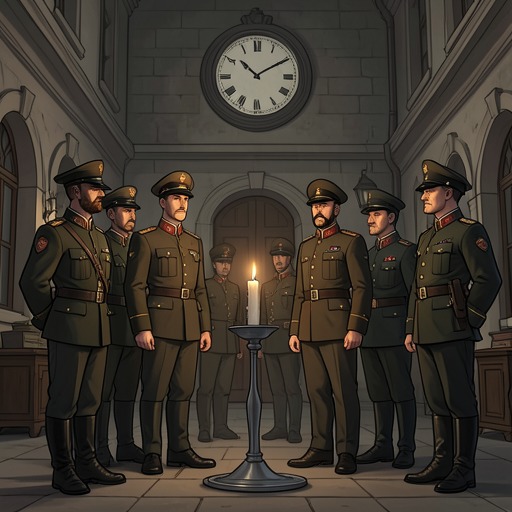
MunichThe German Land Army is presented as the only force with the institutional weight to bring down Adolf Hitler, but not as an uncomplicated instrument of resistance. Its commanders and conspirators describe serious opposition within its ranks, while its oath to the Führer bars it from initiating a move against him. The resulting plan is both practical and precarious: the Army might intervene to restore order after a disturbance in the Chancellery, but it must wait for others to provoke that intervention, and for its command to permit it.
Position in the Crisis
The Army’s potential role becomes decisive as Hitler threatens to invade Czechoslovakia and the prospect of war compresses the conspirators’ timetable. General Ludwig Beck tells the resistance group that he resigned as Chief of the General Staff a little under six weeks earlier, protesting the plan for war. He had kept the resignation private because he had given Hitler his word not to make it public. Only Colonel Hans Oster and Hans Bernd Gisevius know the circumstances of his departure before Beck reveals them to the group.
Beck remains in contact with former colleagues in the high command. He reports that opposition to Hitler’s course is strong enough that, if Hitler issues a mobilisation order the following day, there is a good chance the Army will disobey and move against the regime. This is not a claim that the institution has already committed itself to a coup: it is Beck’s assessment of a possibility, tied to a specific order and an imminent crisis. Oster responds that the revelation changes the group’s calculations and that they must be ready to act decisively, since they may not get another opportunity.
Oath and the Proposed Intervention
The central obstacle is the Army’s oath of loyalty. Beck argues that the oath does not prevent the Army from entering the Chancellery to maintain order if a disturbance occurs; in his formulation, such an intervention would be compatible with the vow. Its limit is equally important: the Army cannot make the first move against Hitler. The conspirators therefore need an initiating action by others that can be treated as a breakdown of order rather than an Army-led attack on the regime.
Oster and Captain Friedrich Heinz have worked out a small-force plan around that constraint. Oster estimates that about fifty men, using surprise, could arrest Hitler, provided the Army undertakes to protect them against an SS rescue attempt. When Erich Kordt asks where such men can be found, Heinz says that they already have them: experienced fighters prepared to move the next day. Oster says that the Abwehr will arm the force and provide safe houses near Wilhelmstrasse, where the men can wait for the signal. The plan thus divides the work between a compact arrest force and the Army’s prospective role as its shield; it does not describe the Army as carrying out the arrest itself.
Command and Conditional Support
The conspirators’ hope of Army backing depends on more than general opposition among officers. Beck’s successor as Chief of the General Staff, Halder, is described as appalled by Hitler’s plans and even more opposed to him than Beck. But Kordt clarifies that Halder is responsible for planning, not operations, and lacks authority to order the Army to move. He must speak to Brauchitsch, the Commander-in-Chief, who possesses that power. Kordt’s account that Brauchitsch is apparently sympathetic offers encouragement, but no confirmed order or guarantee of intervention.
The novel also places the plot against an earlier record of military resistance to Hitler’s strategy. A memorandum dated 5 November 1937 records the advantage Hitler expected from incorporating Austria and Czechoslovakia: shorter and better frontiers, forces freed for other purposes, and the potential creation of up to twelve divisions. Its discussion records the alarm of the senior commanders Blomberg and Fritsch and Foreign Minister Neurath about the strategy’s feasibility, including the strength of the French Army, Czech border defences, and Germany’s weak motorised divisions. Legat recognises that all three have since been removed from their positions and replaced by Keitel, Brauchitsch, and Ribbentrop. The evidence links earlier institutional doubts to subsequent changes in leadership, while showing why past dissent does not by itself amount to present operational control.
Political Stakes and Limits
When Paul von Hartmann warns Chamberlain against signing the agreement, he argues that Hitler’s ambitions extend beyond the Sudetenland and that the incorporation of Austria and Czechoslovakia is only a first step. He says that if Britain and France stand firm, the Army will move against Hitler to prevent a disastrous war. Chamberlain rejects this forecast as a basis for abandoning the conference: he frames the immediate issue as the self-determination of ethnic Germans and gives priority to averting war in the short term. The exchange makes the Army’s possible opposition part of the diplomatic wager, not a certainty on which the British government is willing to stake its decision.
The Army’s conditional role also shapes Hartmann’s own dilemma. He considers whether continuing to work for the regime might let him sabotage it from within, but recognises the cost of a direct assassination attempt: he believes it would bring a bloodbath and destroy his family. His reasoning reflects the same impasse Beck describes at institutional scale. Opposition exists, yet neither the individual conspirator nor the Army can act without confronting the consequences of being first.
Narrative Role and Outcome
The German Land Army consequently stands at the centre of a coup that is both imaginable and dependent on conditions the plotters do not control. Beck’s account gives the resistance a potential mass force; the oath, the need for an initiating disturbance, and the separation between Halder’s planning authority and Brauchitsch’s operational authority expose how many gates must still open before that potential becomes action. The fifty prepared fighters and the safe houses near Wilhelmstrasse make the plan concrete, but the narrative does not establish that the Army issues an order or carries out the proposed intervention.
Later, Hartmann is alone with Hitler while Ribbentrop and Sauer approach. He touches the metal inside his jacket, then withdraws his hand. In that moment, his thought expands from his own hesitation to the wider paralysis of the country: he concludes that no one—not himself, the Army, or a lone assassin—will disrupt their common destiny before it is fulfilled. The scene does not report a new Army decision; it recasts the earlier promise of intervention as a hope that has failed to become action. The institution’s importance lies in that gap between the force it might command and the first move it cannot, or will not, make.